Showing posts with label NAFTA Renegotiations. Show all posts

Monday, October 01, 2018

A Farmer's Lot


I'll have something to say about the new trade agreement when more details are available. However, I understand that Canada's farmers will make concessions under the deal. I'm a city kid. But for forty-five of my seventy one years, my neighbours have been farmers. And a new study concerns me. Kelsey Johnson writes:

Canadian farmers are dangerously stressed out, a reality that’s putting this country’s farm families, rural communities, and entire agriculture industry at risk.
“We can’t have a sustainable food system in Canada if we don’t have sustainable farmers,” Andria Jones-Bitton, an associate professor from the University of Guelph who specializes in farmers’ mental health, told the House agriculture committee on Sept. 27.

When we lived in the Eastern Townships, I got to know several dairy farmers. They were stressed out by milk quotas. But they also understood that those quotas made them sustainable. It sounds like the quota system will be altered -- whether for better or worse remains to be seen.

One statistic is particularly troubling:

It’s estimated Canada’s farm community sees 20 to 30 per cent more suicides compared to other sectors. While Canadian data are limited, a study by the Centers for Disease Control and Prevention in the U.S. found the risk of suicide among farmers was five times higher than for the average American.
In June, Michael Hoffort, the president of Farm Credit Canada (this country’s main agricultural lender) told MPs that in two and a half months, the credit union had already provided emergency funding to 67 families – eight of which involved suicides.

Farmers carry crushing debt loads. And, if they perceive they will never get out from under them, suicide may seem like the only option.

What's to be done?

Coordination between provinces, health professionals and agricultural experts, [Jones-Britton] said, is critical. Programs, she stressed, “need to actually work,” and be designed so that farmers will actually use them.
Those delivering the programs, [she] added, must understand agriculture in order to gain farmers’ trust. Prevention is also critical.


Let's hope Canada's farmers haven't been hung out to dry. A farmer's lot can be perilous.

Image: Telegraph-Journal


Monday, September 17, 2018

Now Is Not The Time


As Parliament re-opens today, the Conservatives have vowed to turn up the heat on reaching a NAFTA deal. Michael Harris writes that Justin Trudeau would do well not to be in a rush to make a deal:

The prime minister should get his staff to dig out the video of President Donald Trump at the 2017 NATO Summit in Brussels.
It would be good for him to take another look at the U.S. president forcefully shoving the prime minister of Montenegro out of his way, as Trump elbowed to the front of an event hilariously referred to as a “family photo.”
Shoving people out of the way is not necessarily the first thing you associate with Canadians. In fact, though generally fair and reasonable, Canadians pretty much can’t stand line jumpers or shove artists.

Mt. Trump shoves people around. That's his modus operandi.  We are about to discover if Justin will fight or fold:

Canada and the U.S. are at profound loggerheads on a host of big ticket issues that go to the heart of national identity.
Trudeau believes that the core of the NATO alliance is shared values amongst members, while Trump thinks it’s about NATO countries that are financial deadbeats who must pay their fair share or else.
On climate change, Trudeau at least says that governments around the world have to act in concert to reduce greenhouse gas emissions. Trump believes the Paris Climate Accord is supported by a club of snowflakes who don’t seem to understand that real countries pollute their way to prosperity.
On immigration, Trudeau refers to Canada as a post-national country that doesn’t need to impose “core values” on immigrants as a precondition of qualifying to come to Canada. Trump wants to wall out Mexicans, ban Muslims and lock up the children of illegal aliens in kiddy concentration camps — often without even knowing who or where their parents are.
Trudeau wants a new deal with the U.S. to include labour standards and protection for workers. Trump has issued executive orders to make it easier to dismiss federal government workers and to weaken their unions.

Trump doesn't understand how trade works; and his ignorance makes it almost impossible to deal with him:

Trudeau is right to keep negotiating without his knees knocking. Should compromises be made on both sides, the two countries can be dance partners again. But if it’s a bad deal, even if it is a punitive one in the short term, Canada should send this message loud and clear to Trump: “You may be able to punish us, but you can’t disgrace or belittle us.”
The one thing Trudeau cannot do given under-performance on a swath of other files is to sign a bad deal with Trump and then try to put lipstick on the pig.
Nor should anyone underestimate what sort of a negotiating partner Trump actually is — and what a deal with him may end up being worth.

Justin can afford to wait:

The fact is, Trump’s presidency is in flames. He is a personal disgrace to his office and the probe of Special Counsel Robert Mueller is moving closer and closer to the White House. Trump’s former campaign manager Paul Manafort has entered a guilty plea to charges he was facing, in addition to eight outstanding felony convictions, and is now cooperating with Mueller. The pressure is beginning to take its toll.
The missives from trump@duh.con (yes, con), always thuggish and puerile, have now become tasteless, tactless and utterly untoward.

That will not stop the Conservatives from angrily criticizing Trudeau. And the corporate lobby will organize a full court press.

But now is not the time to panic.

Image: Quotefancy


Saturday, September 08, 2018

Boneheads


Yesterday, on his way to what comedian Bill Mahar calls one of his "Nuremberg Hillbillies Rallies," Donald Trump threatened the "ruination" of Canada. Daniel Dale writes in The Toronto Star:

He told reporters on Air Force One: “Canada has been ripping us off for a long time. Now, they’ve got to treat us fairly.”
“I don’t want to do anything bad to Canada. I can — all I have to do is tax their cars, it would be devastating. If I tax cars coming in from Canada, it would be devastating,” he continued, according to a pool reporter travelling with him.
“Actually, on some countries, including Canada, a tax on cars would be the ruination of the country,” he said. “That’s how big it is. It’d be the ruination of the country. Now, they’ve taken advantage of us for many decades. We can’t let this happen anymore. We have a country to run.”
Trump made clear, as he has before, that he sees the auto tariff threat as an effective tool in trade talks. He claimed that whenever he broaches such tariffs, negotiators from other countries surrender to his desires: “We’ll do it! We’ll do it! We’ll agree! We’ll agree!”

Given the portrait of the man which emerged this week from Bob Woodward's new book and the anonymous editorial in The New York Times, no one should be surprised by Trump's rhetoric. And what Trump's chief economic advisor, Larry Kudlow -- who incidentally has no  economics credentials -- said yesterday makes it clear that we have a problem:

“The United States would rather have a trade deal with Canada, but it has to be a good deal, right. And the word that continues to block the deal is M-I-L-K,” Kudlow said on Fox Business. “I’m just saying: let go — milk, dairy, drop the barriers, give our farmers a break, and we can fix some other things.”

Auto tariffs on Canada would primarily hit American manufacturers -- GM, Ford and Fiat Chrysler. The fate of Harley Davidson offers a cautionary tale on the subject of Trump's tariffs.

Life is difficult  for everyone when the American president is a bonehead who is advised by boneheads.

Image: One News Page

Thursday, September 06, 2018

In The Long Run


Chrystia Freeland is back in Washington, trying to hammer out a trade deal. That's no small task, given the fact that -- as Bob Woodward's new book and the recent anonymous editorial in The New York Times make painfully clear -- Trump is off his presidential rocker. Part of the problem is Trump's animus toward Canada. Lawrence Martin doesn't pinpoint the cause. but he writes that it burns intensely:

In his America-First campaign, Mr. Trump is remarkably casting Canada among the predator nations taking advantage of his so-called hard-done-by country. As Kim Campbell, our former nano-second Prime Minister, said the other day, we’ve usually been the ones complaining of neglect by the United States. It’s been a staple of our history. Anti-Americanism constituted a lengthy chapter.
Now we have a president who has turned the tables. Canadians are the villains. We’re so dastardly on trade that he’ll have to drive us into submission. We’re also, if it can be imagined, a geopolitical threat, and so he’s hammered us with steel tariffs and warnings of worse to come if we don’t buckle under. Add to this his insults, his distortions and his attacks at the G7 summit, and it can be said that no president has ever treated Canada so badly. If he keeps at it, despite his protestations about loving Canada, Donald Trump will go down as the first anti-Canadian president.

And it's been there for a long time:

In full-page newspaper ads in 1987, he wrote that, “The world is laughing at America’s politicians as we protect ships we don’t own, carrying oil we don’t need, destined for allies who won't help.” Americans, he said back then, “are tired of watching other countries ripping off the United States.” On trade he complained of being “like a whipping post for Japan. ... Look what Japan does with the cars and the subsidies they get.”
With NAFTA, the “worst trade deal ever,” Canada was added to his target list, and there it remains.

Facts have never mattered to Trump. They still don't:

There is no coming to grips with the fact that there is no trade imbalance with Canada, with the fact that the ripped-off charge is imaginary, with the idea that the whole crisis is more Seinfeldian than real. Modernizing a trade agreement hardly had to be an apocalyptic exercise. Dairy trade, for example, is a major sticking point in the talks. Dairy accounts for a minuscule 0.12 per cent of bilateral trade of US$680-billion last year. Canada subsidizes its dairy industry, but so does Washington, which just put up a US$12-billion package to protect U.S. farmers, including dairy producers.

He is, indeed, a mad king. The last one the Americans had to deal with was George III. The simple truth is that we may not be able to deal with Trump. And, in the long run, we may be better off for it.

Image: Twitter

Saturday, September 01, 2018

Amigos No More


The days of The Three Amigos Summits, Susan Delacourt writes, are gone:

The last one was held in Canada in the summer of 2016. No “Three Amigos” summit has been held since Donald Trump became president later that year. And chances of a reunion seem even more remote today, especially if this week has helped set a new standard in the every-nation-for-itself approach to continental relations.
Trump isn’t just averse to summits, he’s clearly not big on the whole idea of multilateralism. The president didn’t enjoy himself at the G7 Summit in Charlevoix, Quebec last June — to put it mildly — and no matter what else has happened this week, he has turned what should have been multilateral trade negotiations into two bilateral sets of talks.
Sarah Goldfeder, a principal with the Earnscliffe Strategy Group in Ottawa, is a former U.S. diplomat who has worked for two American ambassadors to Canada and also in Mexico as a foreign service officer.
She’s been keeping a close eye on how the North American trade relationship has been evolving and says that things between Canada and Mexico were already somewhat shaky before this week.
Last year’s negotiations over the Trans-Pacific Partnership trade arrangement, for instance, saw some tension between Mexico and Canada when Prime Minister Justin Trudeau didn’t show up at a negotiating session in Vietnam. “When Canada didn’t show up, Mexico kind of had to cover,” Goldfeder said. Nor has Canada appreciated the depth or complexity of Mexico’s economic ties to the U.S., she said. “These are all strains on the relationship.”

Trump's "off the record" remarks about Canada yesterday didn't help:

Canadian officials, speaking off the record, insist that negotiations with the United States ended Friday on a good note, despite the comments from Trump, and that no one in Trudeau’s government is interested in picking a fight with Mexico over how everything unfolded this week.
But even if Trump doesn’t end up getting everything that the U.S. wants in whatever new trade deal is reached, he has succeeded in making Canada and Mexico fall into his isolationist, anti-multilateral way of looking at trade relations.

As Peter Wehner wrote in The New York Times last week, "Everyone and everything he touches rots."

Image: CBC

Wednesday, August 29, 2018

Actions And Rhetoric


Donald Trump has given Canada an ultimatum: Sign the new trade deal by Friday, or you're out in the cold. Tom Walkom writes:

Canada has been had. The Mexicans and Americans have agreed behind Canada’s back to cut a bilateral deal that would replace the North American Free Trade Agreement.
Justin Trudeau’s Liberal government has been told it can join in, but only if it capitulates to all of Donald Trump’s demands.

Some of what's in the new deal is good for Canada:

Not everything in the Mexico-U.S. deal would be bad for Canada. Indeed, some parts would be positive.
The original NAFTA allowed companies, particularly big auto manufacturers, to relocate their operations from Canada and the U.S. to low-wage Mexico.
To his credit, Trump recognized that this was a job killer for his country. The new Mexico-U.S. deal specifies that at least 40 to 45 per cent of automotive content must come from factories where workers make at least $16 (U.S.) per hour.
The new pact would also tighten so-called rules of origin to ensure that at least 75 per cent of the content in autos sold duty-free under the deal comes from a country that is signatory to the agreement.
That too would benefit Canadian auto workers if Ottawa signed on.
As well, Mexico agreed to another useful Trump demand — the weakening of a NAFTA provision allowing foreign investors to overturn government laws and regulations that interfere with their profitability.
This so-called Chapter 11 provision has been used mainly against Canada. Yet for reasons that it has never fully explained, Ottawa resisted Trump’s efforts to eliminate it.
The Mexico-U.S. deal doesn’t get rid of Chapter 11. But it would limit its scope to firms operating in specific areas such as energy.

But there are some big poison pills:

In particular, the agreement reached by the Mexicans and Americans appears not to include an independent dispute-resolution system for sorting out trade conflicts among the signatories.
Canada has long insisted that this is a must. NAFTA’s precursor, the original 1989 Canada-U.S. Free Trade Agreement, was almost scuppered by Ottawa over U.S. resistance to this demand.
The Mexico-U.S. deal also includes a so-called sunset clause, a date by which the agreement, unless specifically extended, will automatically expire. According to Trudeau, that too is an absolute no-no for Canada.
True, the time frame has been extended from the original American proposal of five years to 16. But the essential problem with the sunset clause — that placing an arbitrary deadline on a trade deal leads to investment uncertainty — remains.

So it's crunch time. Five of Trump's associates have either pled guilty or been found guilty of crimes. There will be more convictions. It's clear that doing business with Trump is bad business.

Justin has proclaimed that Canada will not be pushed around. Will his actions match his rhetoric?

Image: The Cut


Tuesday, August 28, 2018

No One Should Believe Him


Yesterday, Donald Trump announced that he had reached a trade deal with Mexico. Like so much that comes from Trump's mouth these days, that simply wasn't true. Lawrence Herman writes:

Telling the Mexican President that the United States might want to pursue a separate trade deal with them seems to have taken the Mexicans aback, Mexico never contemplating having to go up alone against the United States. It’s clear by now that Mr. Trump and his team don’t like dealing with Canada. That’s reflected in Canada being sidelined for weeks while the other two governments held high-level meetings behind closed doors – a disgracefully bad-faith tactic on the part of the Americans. Regardless of claims that the auto issues in the North American free-trade agreement were exclusively a U.S.-Mexico concern, Canadian companies have invested heavily in Mexican operations, and Canada had every right to be at the table while the other two governments hammered things out.

Trump wants to name his "achievement" the U.S.- Mexican Trade Deal. But NAFTA is still in effect:

As to talk of a fully revised NAFTA being concluded in the next few weeks, there seems little possibility of that. At last count, 10 of the 30 chapters of this enormously complex agreement, containing some of the most contentious issues, remain unresolved.
Added to these timing difficulties is that U.S. law requires the President to give Congress 90 days advance notice of his intention to sign the agreement, meaning a final treaty, not just an understanding or statement of principles. And after being signed by the President, Congress has a further 90 sitting days to consider it. It can be approved or rejected during that period.
With U.S. mid-term elections in November, it’s impossible for the current Congress, even under the so-called lame-duck period before year-end, to be presented with a new NAFTA and to examine it within 90 sitting days as mandated by statute.

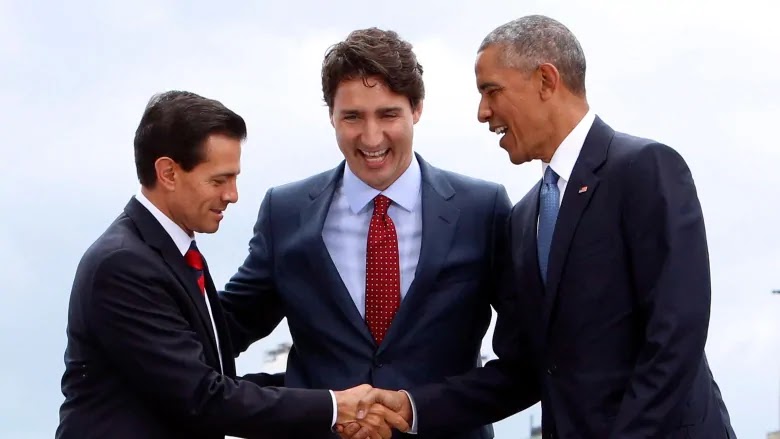
In his telephone call, Mexican president Enrique Pena Nieto kept repeating the mantra "NAFTA," making it clear that he was involved in a three way negotiation. But Trump lives in his own world. He thinks he has a bilateral trade deal with Mexico. In reality, all he has is a shiny object which he can use after the legal pommelling he took last week, and after he was upstaged by John McCain's death.

One only needs to remember that Trump claims to have reached an agreement with Kim Jong Un to get rid of North Korea's nuclear weapons. But North Korea doesn't see things that way.

Will there be a deal? Who knows? But when Trump says he's negotiated such a deal, no one should believe him.

Image: The Independent


Wednesday, July 25, 2018

Not His Strong Suites


Lawrence Martin writes that, if sanity prevails, Donald Trump will not impose tariffs on automobiles manufactured in Canada. Recently, there has been a strong chorus in favour of sanity and against Trump's claim that the tariffs would strengthen American national security:

Vehement voices came together Thursday at Commerce Department hearings on the tariff proposals. It was an onslaught. More than 40 parties testified. With the exception of labour unions, representatives from most every component of the U.S. automotive value chain raised alarm bells.
But if it sounds like a no-brainer that the Trump tariff plan is headed for the dustbin, there are some who believe the President’s mind is already made up, that the hearings are just to show that consultation was undertaken, and that he will move ahead with the measures that promise to be far more punishing than his steel and aluminum tariffs.
The governments of Mexico, Canada and Ontario joined in with similar appraisals. “Rather than potentially strengthening U.S. national security,” Canada’s deputy ambassador to the U.S. Kirsten Hillman said in a strong presentation, “tariffs on automotive imports from Canada would undermine U.S. security and would have a devastating impact on U.S. competitiveness in the auto sector.”
She made the point that given the degree of integrated cross-border production, “Canadian cars are U.S. cars,” explaining that assembled vehicles exported from Canada to the United States contain more than 50 per cent U.S. content.

All quite reasonable arguments. But reason -- and sanity -- are not Donald Trump's strong suites.

Image: Autofocus.ca

Saturday, June 02, 2018

The Uglist American Of All


Russian Roulette is title of a best selling book about Donald Trump by David Corn and Michael Isikoff. Former American Ambassador Bruce Heyman writes that Trump is playing the same game with Canada. Heyman puts the relationship between Canada and the United States into perspective:

With a border of 5,525 miles, the US and Canada share the world’s longest unmilitarized border and also boast the largest balanced bilateral trade relationship; Canada-US annual trade exceeds $630bn in goods and services. Thirty-five US states have Canada as their largest export market and most of the remaining have it as their number two. Canadian soldiers have sacrificed their lives right next to American soldiers in Afghanistan, the Persian Gulf, Kosovo, Korea, and both world wars. After September 11, the people of Gander, Newfoundland, opened their homes to thousands of travelers stranded when we closed US airspace. This heart-warming story is told in, Come From Away, the hit Broadway show. We jointly protect North America through Norad and together protect Europe through Nato. Canada is our neighbor and friend, and our relationship demonstrates how diplomatic and economic friendship provides strong geopolitical stability.

A president who understood that relationship would not do what Trump is doing -- even for reasons of self preservation. It's clear that Trump glories in making enemies, while failing to understand that he is his own worst enemy:

There isn’t a relationship in the world more important to the United States than Canada, but Washington’s recent behavior is cause for alarm.
Trump has persistently tested this friendship over the past year and a half. The trouble started when we withdrew from  and signaled to Canada that the administration was willing not only to sacrifice our commitments but also our environmental future for empty political points.
Our bilateral relationship has been further strained by the travel bans, the Daca decision (over which a dangerous and cruel wave of uncertainty still looms), and the erratic behavior of customs agents. Our reckless approach to immigration has caused a number of refugees to flee the United States to Canada, putting a strain on their resources from coast to coast, but especially in Quebec.

Everything he has done since displays Trump's profound ignorance. He blames Canada and Mexico for the loss of American jobs, but he's too thick to analyze the real cause of that job loss:

The president is prioritizing political tactics over economic strategy, threatening our friendship and potentially millions of American jobs just because he won’t do the hard work that the office of the presidency requires. The administration is using Nafta as a scapegoat for the real problem of jobs lost through technological advancements.

Put simply, the president is intellectually lazy and consequently stupid. Those two characteristics define The Ugly American. Trump is the Ugliest American Of Them All.

Image: Democratic Underground


Thursday, May 31, 2018

NAFTA On the Rocks


During the past year, NAFTA has been encountering ill winds and rough seas. The ill winds come from the Blow Hard-in-Chief. Peter Clark writes:

The Prime Minister has used his personal relationship with Trump to avoid crises. Now Canada is deemed “spoiled” and “difficult”. Trudeau is doing what a responsible leader needs to do when faced with madman tactics and threats to Canada and Canadians by trying to defuse the threat. But his neighbour will not talk to him.

The man who claims he knows all there is to know about the art of the deal has proved to be a deal breaker, not a deal maker.

Chrystia Freeland has shuttled back and forth between Washington and Ottawa. She has had a thankless task:

I don’t envy Freeland.  Imagine negotiating with a four-year-old, with the power and leverage of the President of the United States. Add to that a counterpart in Lighthizer who is impossible to satisfy.  Freeland and Lighthizer talked face to face for two hours Tuesday, but neither was all that interested in listening.
Bashing Mexico and NAFTA worked well for Trump in the primaries and his election. It’s a safe bet that he will keep to his whipping-boy strategy for the mid-terms and tie Canada to the post as well.

Canada has worked hard to garner support from state governors and individual members of Congress. But it's clear Trump doesn't listen to any of those folks. Television is the source of Trump's information. Briefing notes be damned.

NAFTA may well be damned. The winds and seas could get a lot rougher.

Image: Alternet


Wednesday, November 01, 2017

He Does Not Understand


Before anyone starts to agree with former prime minister Stephen Harper's conclusion that the Liberals have been "napping on NAFTA," Tim Harper suggests that they take a look at Stephen Harper's record of dealing with Washington:

While in opposition, Harper aligned himself with George W. Bush’s “coalition of the willing,’’ for his failed invasion of Iraq, something Harper agreed, five years later, was a mistake.

There were early disputes with Bush over Arctic sovereignty, although Harper did win a softwood lumber truce.

Things chilled with the election of Barack Obama, starting with the Democratic primaries of 2008 when a member of Harper’s inner circle was accused of leaking a private conversation from an Obama advisor revealing the candidate’s threat to rip up NAFTA was merely campaign rhetoric.

A deal called Beyond the Border was signed by Harper and Obama in 2011 and hailed as historic. It got bogged down in too many pilot projects and too little interest in the White House.

Obama’s decision to wrap Keystone XL pipeline approval in domestic politics led Harper, in successive U.S. appearances, to label presidential approval a “no-brainer,’’ then vowing he would not take ‘no’ for an answer.

Relations soured to the point that Harper cancelled a trilateral summit with Mexico and the U.S. in 2015. Of course, by then, Harper had angered Mexico by precipitously slapping visa requirements on Mexicans traveling to Canada.

There's not much to crow about there. The Liberals, on the other hand, are dealing with tougher customers:

They are dealing with a U.S. trade representative, Robert Lighthizer, whose comments after the wrap up of the last round of talks were so rude and condescending that, had he made them in Freeland’s home she would have rightly told him to leave.

U.S. Commerce Secretary Wilbur Ross says Washington is asking Mexico and Canada for deep concessions and offering nothing in return, and Trump issues a threat to kill the deal whenever the spirit moves him.

Harper's memo is rooted in his animus to all things Liberal. When it came to dealing with the United States, Harper never really understood our southern neighbour. And now he does not understand that the Party of Trump is a universe away from The Party of Lincoln.


Monday, October 30, 2017

It Doesn't Seem Obvious


Last week, Stephen Harper sent a memo to clients of his firm, Harper and Associates. The memo was titled "Napping on NAFTA." The Toronto Sun reports that:

The memo was obtained by The Canadian Press and it criticizes the Trudeau government in several areas: For too quickly rejecting U.S. proposals, for insisting on negotiating alongside Mexico, and for promoting progressive priorities like labour, gender, aboriginal and environmental issues.

The former prime minister says he was worried by what he heard during a recent trip to Washington, where he discussed NAFTA at an event but did not publicly share his misgivings about the Trudeau government.

"I fear that the NAFTA re-negotiation is going very badly. I also believe that President (Donald) Trump’s threat to terminate NAFTA is not a bluff… I believe this threat is real," [he wrote.] "Therefore, Canada’s government needs to get its head around this reality: it does not matter whether current American proposals are worse than what we have now. What matters in evaluating them is whether it is worth having a trade agreement with the Americans or not."

The memo upset Michael Harris -- who has been on Justin's case of late:

“It does not matter whether current American proposals are worse than what we have now,” Harper wrote.

Of course it matters very much. It also shows Harper at his Yankee-Doodle-Dandy worst, a man willing to accept a bad deal just to make a deal. By contrast, the Liberals have been solid on standing up for Canada’s interests here, including cleverly ignoring taunts and outrageous demands designed to make our negotiators throw up their hands and walk out of the talks. That’s what the Americans were doing when they demanded the end of supply management in this country for dairy, poultry, and eggs.

And Harris gives Trudeau credit for standing along side Mexico:

The Liberals have also been wise to stand with Mexico, rather than throw that country under the bus, as Harper would undoubtedly have done to mollify Trump. The Liberal move will not only improve the relationship with Mexico, but with countries around the world who will view it as proof that Canada sticks by its friends. No matter how tempting it would be to betray them when the going gets tough, or someone proffers forty pieces of silver.

Harris is betting that Trudeau will walk away if he has to -- because he has no illusions about Trump:

If Trudeau is authentic in how he presents himself to Canadians, he should be civil, diplomatic but personally less engaged. After all, you could not make up a less fitting pal for him that Donald Trump — braggart, bully, misogynist and liar.

Once you subtract the aura of office from Trump, you are left with an Il Duce billionaire out to blow up the system of checks and balances designed specifically to prevent a person like him from abusing power.

Trump’s goal, obvious to all but the most gullible, the greedy and the ghastly, is to turn America into a franchise of the super wealthy. That’s why his idea of tax reform would send 80 per cent of the benefits to the wealthy, and pay for it by cutting services to those that need them.

That doesn't seem obvious to Trump's base. And it doesn't seem obvious to Stephen Harper.

Image: 604now.com

Monday, October 16, 2017

Could He Be Right?


Sometimes irony is entertaining. Sometimes it hurts. Tom Walkom points to the irony of Donald Trump's insistence on American content rules as part of NAFTA:

Under NAFTA, automobiles manufactured anywhere in North America may be sold duty-free in Canada, the U.S. or Mexico.

Since, at $2.45 (U.S.) an hour, Mexican wages are a fraction of what they are in the other two NAFTA countries, this is a powerful incentive to locate production there.

As a recent report by former CIBC chief economist Jeff Rubin shows, this is exactly what has happened. Rubin calculates that the number of auto jobs in Mexico has quadrupled over the past decade. Over the same period, auto manufacturing jobs shrank by 26 per cent in Canada and 28 per cent in the U.S.

Which brings Walkom to Unifor's strike against GM's plant in Ingersoll:

Their demands did not focus on the usual issues such as wages. Rather employees sought ironclad assurances from GM that Ingersoll would continue to be the lead plant in North America for production of the popular Chevy Equinox sport utility vehicle.

Earlier this year, GM moved production of its Terrain model to Mexico from Ingersoll — at a cost of 400 Canadian jobs. The CAMI workers and their union, Unifor, wanted to make sure this didn’t happen again.

What the union wants is what Canadian politicians of various stripes used to insist upon:

Until recently, it was the position of the New Democratic Party. A little further back, it was the position of the Liberal Party.

Justin Trudeau may reject economic nationalism as dangerous. But his father, Pierre, did not. Indeed, Pierre Trudeau recognized that sometimes even the most cosmopolitan of nations need to protect themselves from the buffeting winds of the global economy.

It was a principle enshrined in the old Auto Pact. All of which begs the question: Could Donald Trump be right about something?

Image: theguardian.com


Thursday, September 28, 2017

It's The Politics, Stupid


Peter Donolo has an interesting column in this morning's Globe and Mail.  Donolo believes that the NAFTA negotiations are not about trade. They're about politics. The giveaway is that the Americans still haven't old us what they want. He writes:

What does that mean for the NAFTA talks? Don't hold your breath for negotiators to come up with trade solutions to a political problem. And if they do manage an agreement, count the seconds for a tweet from the President of the United States undercutting his own negotiating team. He's done it to his own White House staff, to his cabinet and to his party, time and again.

The term "win-win," which is the essence of any successful negotiation, does not exist in Donald Trump's lexicon. His approach is better described as zero-sum; the only way you can show you have won is by crushing your opponent into dust.

The American decision to add a 220% tariff to Bombardier's C-Series jets should be understood in that context. The decision is not good news for Canada.  And, meanwhile, Trump treats Mexico with utter contempt. That does not bode well for the future:

In less than a year, Mexico will hold presidential elections. Mr. Trump's relentless humiliation of that country has already sunk the hopes of the incumbent PRI and boosted the chances of leftist Andrés Manuel López Obrador. What would be the consequences of a NAFTA "loss" for Mexico? From the relative stability of recent decades, the Mexico-U.S. relationship could very quickly revert to earlier hostile, and even violent, patterns.

So fasten your seat belts. North America -- and, for that matter, the world -- is in for a lot more turbulence.

Image: newstimes.com


Tuesday, August 15, 2017

Is NAFTA Dead?


Andrew Coyne's conservative soul was perturbed by what Chrystia Freeland said yesterday:

I said we should be prepared to walk away from the negotiations. I didn’t say we should deliberately sandbag them from the outset.

The government of Canada has at last revealed its objectives for talks on renegotiating the North American Free Trade Agreement (NAFTA), a month after the Trump administration released its own. Of course, the nature of any such exercise is to reveal as much about each side’s perceptions of the other’s negotiating position; it makes no sense to come to the table with demands that haven’t a ghost of a chance of being accepted.

What particularly stuck in Coyne's craw was the Trudeau government's insistence that climate change, gender and indigenous rights be put on the table: "But do Trudeau’s people really think the Trumpians could be induced to accept bringing climate change into it? And gender? And Indigenous rights?"

Coyne suspects that the Liberals are betting that the talks will fail:

Of three possible outcomes — a successful conclusion to the negotiations, leading to an agreement between the three countries on a renewed NAFTA; failure, followed by Trump making good on his threat to abrogate the treaty; and failure, unaccompanied by abrogation — the third may well be the most likely.

Congress would have to approve Trump's backing out of the treaty -- and these days Congress disapproves of just about everything that Trump does. Canadians might not get their wish list. But Trump wouldn't get his, either.

Image: CNN Money

Sunday, August 06, 2017

Empowering Labour


NAFTA is going to be re-negotiated. That's fine with Linda McQuaig, so long as workers get a piece of the action. She writes:

In reality, NAFTA has been key to the transformation of Canada over the last two decades, enabling corporations to become ever more dominant economically and politically, while rendering our labour force increasingly vulnerable and insecure.

Indeed, the much-lamented rise in income inequality and feelings of powerlessness among working Canadians aren’t mysterious consequences of participating in the global economy. Rather, they’re the predictable consequences of our country signing a trade deal that greatly empowers corporations and their investors at the expense of everyone else.

The agreement's twenty year history makes it abundantly clear that corporations are in the driver's seat:

Gus Van Harten, an Osgoode Hall law professor and expert in international investment law, says NAFTA provides “Exhibit A for how rules of the global economy have been rewritten to favour large corporations and the superrich at the expense of the general public.”

Van Harten is referring to NAFTA’s Investor-State-Dispute-Settlement (ISDS) mechanism which, amazingly, allows foreign corporations to sue governments over laws that interfere with corporate profitability — even if those laws are aimed at protecting the public from, say, environmental or health risks.
These corporate lawsuits are adjudicated by special tribunals — notoriously sympathetic to corporate interests — that can force governments to pay the corporations compensation (out of our taxpayer dollars!) There’s no cap on the size of the awards.

Canada has already been sued this way 39 times, and paid out more than $190 million, with the money mostly going to major corporations and extremely wealthy investors, notes Van Harten. In addition, we don’t know how many times governments have backed off from introducing laws, to avoid provoking a NAFTA lawsuit.

The problem is that the push to empower labour won't come from the Americans: 

But proposals that ISDS be eliminated are unlikely to win support from, for instance, Rex Tillerson, U.S. Secretary of State and former CEO of ExxonMobil, which won $14 million from Canada in a NAFTA lawsuit.

And Trump, a billionaire whose companies (along with daughter Ivanka’s fashion business) routinely outsource work to low-wage jurisdictions, clearly has no interest in tampering with the wildly pro-corporate rules of NAFTA.

And Justin Trudeau doesn't advocate changing the balance of power -- despite his rhetoric. So the push to empower labour will have to come from elsewhere.

Image: SlidePlayer

Wednesday, July 19, 2017

Who Knows?


NAFTA will be renegotiated. But, Tim Harper writes, the negotiations will not be a disaster:

Robert Lighthizer [Donald Trump's Trade Representative] released his 18-page list of priorities for coming NAFTA negotiations, and there was none of that lightning and thunder. Reaction from Ottawa and Canadian trade experts was a polite smile and a readiness to get to the table.

Prime Minister Justin Trudeau had already laid out Ottawa’s low-key resolve in his pre-NAFTA speech to U.S. governors in Rhode Island: “While you, my American friends, may be an elephant, Canada is no mouse. More like a moose. Strong and peaceable, but still massively outweighed. So we have to work harder to make our points.”

When formal NAFTA talks begin next month, Canadians, Americans and Mexicans will largely tune out until there is drama. And, make no mistake, any negotiations involving Trump will inevitably include drama.

At some point in the negotiations, Trump will become loud and bombastic -- because that's what he does. But it's Congress that holds the cards:

Although Trudeau has been at great pains to reject any claim that the Canadian “strategy” is to go around Trump, the trade agenda will be driven by the U.S. Congress, not the president.

It is also a Congress which can read poll numbers — one this week showed Trump with a 55-per-cent disapproval rating — with the U.S. midterms just over the next hill.

And, as the failure of Trumpcare proves, even though the Republicans control all three branches of government, Trump is Colonel Blimp -- full of hot air but not someone they respect.

Of course, someone else could throw a spanner into the works. Who knows? Stay tuned.

Image: CNN Money

Thursday, June 15, 2017

More Than Softwood and Dairy Products


In the coming NAFTA re-negotiations, Linda McQuaig argues that we should focus on Article 605 of the agreement:

Article 605 limits the power of governments to cut back energy exports. So, for instance, Canada must continue to make available to Americans the same proportion of our energy as in the previous three years.

If there were a global oil shortage -- like the ones in the 1970s -- we couldn't cut back our oil exports to the U.S. in order to redirect the oil to Canadians.

While section 605 has always offended those who care about sovereignty, it poses huge new problems in the age of global warming.

If we're serious about fighting climate change, we're going to have to phase out dirty oilsands production and rely on our remaining reserves of conventional oil (we have about 11 years left, at current rates) while we transition to clean energy, argues Gordon Laxer, founding director of the University of Alberta's Parkland Institute and author of After the Sands: Energy and Ecological Security for Canadians.

Mexico objected to Article 605 and got that provision waived. We should do the same. NAFTA is about more than softwood and dairy products.

Image: businessideas 2015-2016