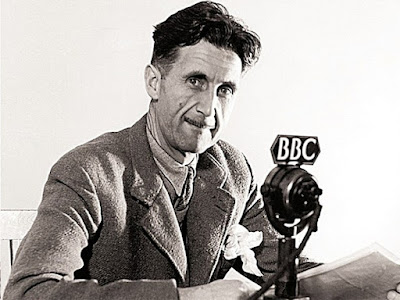
Rebecca Solnit's new book is titled Orwell's Roses. Dorothy Woodend writes that it is a book for our times:
If you need some prickly bits of hope and thorny rationality in these times, George Orwell is your man. The English author of such seminal texts as 1984, Animal Farm and Homage to Catalonia is the subject of American writer Rebecca Solnit’s new book, Orwell’s Roses.
The essay collection, conjoined loosely by Orwell’s life and work, is delicate and perambulating, but also studded with bedrock ideas, emerging like boulders out of deep research and analysis. One moment you’re bobbing along with Solnit’s graceful prose; the next you run face first into a sentence so adamantine in its acuity, that it literally takes your breath away.
It’s a bit akin to getting hit in the head by a rock, but in a good way. You come away feeling stunned, but also profoundly impacted.
The bogeyman of Orwell's time was Joseph Stalin -- who Orwell understood thoroughly:
A great many people believed (and some still do) that Stalin was a fine fellow, when all evidence to the contrary, like millions of dead Russians, indicates otherwise. Even those who knew better looked away from the truth of his rule. Solnit cites playwright George Bernard Shaw and news writer Walter Duranty as Stalin fans and apologists, but there were plenty of western journalists, writers and artists who also capitulated to the Soviet fantasy.
These days, all kinds of people who know better lick Donald Trump's boots. Stalin had a vast coterie of bootlickers -- like Trofim Lysenko:
Lysenko, a bootlicker and master dissembler, told Stalin exactly what he wanted to hear, namely that it was possible to increase crops yields with hardier strains of wheat almost overnight. The end result of his fiction was the death of millions of people. Whereas [Nikolai] Vavilov, who had dedicated his entire career to finding ways of better feeding the world, told the truth and died of starvation in a gulag.
What's the lesson behind all of this?
The lessons of history don’t always pertain exactly, but at best they can remind one that whatever else happens, change is the one constant. Empires rise, empires fall. But before the light returns again, we’re in for a whole lot of suffering.
Still, even in the darkest of timelines, there are things to be treasured, savoured and celebrated. Solnit’s writing is one of those things. Like Orwell, her work shines with the clear light of reason and humanity, reminding readers that this too shall pass, even if it feels like the madness is permanent.
Buckle up. It's going to get darker. But -- somewhere -- there is light.
Image: The Tyee
