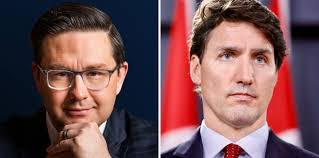
Showing posts with label The Next Election. Show all posts

Friday, August 16, 2024

What You Really Really Want

There is a growing fatalism setting in about the next election. Dale Smith writes:

If you listen to Canadian political commentary, a certain kind of fatalism has sunk in: a Pierre Poilievre and Conservative Party of Canada victory is inevitable in the next election, and nothing is going to matter over the next year-and-a-bit until the next federal election is scheduled. This is possibly the worst of all possible instincts to harbour, and a sign that our media spends way too much time huffing the horse-race poll numbers that they treat as gospel, which is also why Poilievre keeps pushing for an early election, so that he can come in on a sweeping victory. But this sense of inevitability should be fought, particularly among marginalized Canadians who know that a Poilievre-led government is going to be a very big problem for them, and for their rights. 

But voters are befuddled. They like a lot of what Justin Trudeau has done. But they're tired of him:

Saying you like the Liberals’ plan but can’t vote for Trudeau won’t help you keep those Liberal plans alive. There was polling earlier this summer that found that people said they were willing to vote for Poilievre, but they also wanted all of the services that the Liberals (and, to a lesser extent, the NDP) have provided, like child care and dental care. You can’t have both. As much as he can claim to have a coherent ideology, Poilievre has internalized the so-called teachings of crypto bros on YouTube, and thinks that massive spending cuts in order to achieve a notional balanced budget is the way to a prosperous economy (mostly because from all appearances, he doesn’t understand monetary or fiscal policy). That’s going to mean a lot of painful cuts to services. A simple change in government also won’t fix most of the problems that we’re dealing with, such as the housing shortage or the affordability crunch, because many of those problems are structural in nature. No amount of empty slogans will fix those issues, and would in fact be made worse with an austerity agenda.

Things could -- as has recently happened in the United States -- change radically. But that kind of change is rare. Canadians will have to decide what -- like the Spice Girls sang -- they really really want.

Image: The Financial Post

Monday, June 24, 2024

Very Consequential

Canadians aren't impressed by their political leaders. Michael Harris writes:

Federal politics has entered a “none-of-the-above” phase.  

The same polls that show Justin Trudeau taking his party over the electoral cliff if he remains leader also show something else of importance. Canadians are deeply unimpressed with the current crop of federal leaders.  

The latest Angus Reid poll nicely captures Trudeau’s emphatic unpopularity, but also the striking unpopularity of his rivals. The prime minister is viewed favourably by just 28 per cent of respondents in the Angus Reid poll, and unfavourably by a whopping 67 per cent.  

The Conservative Party has a commanding 20-point lead over the Liberals amongst decided voters, a staggering, double-digit lead they have had for months. 

But according to other key findings in the poll, 50 per cent of respondents had an unfavourable view of Pierre Poilievre and Jagmeet Singh.  

That makes predicting what will happen in the next election difficult:

While most observers have counted Trudeau out, based on persistent documentary evidence, [Nick Nanos] came up with another number that puts the Conservative “juggernaut” factor in an intriguing context.  

“Although the Conservatives enjoy a comfortable advantage in vote intentions, their pool of accessible voters—that is, the proportion of Canadians who are open to voting Conservative—is not much larger (45 per cent) than the group of voters accessible to the Liberals (43 per cent).”

In other words, the next election will not necessarily be decided by today’s polls, but by tomorrow’s, next week’s, next month’s, and next year’s political gamesmanship. And happenstance.

Things can change radically over a short period. Like climate change, political change can be swift and very consequential.

Image: CTV Nrews

Monday, December 18, 2023

The Big One

The next election, Michael Harris writes, will be the most consequential in Canada's history:

It will be a choice between today, and all the tomorrows the planet may or may not have; between the cost of living, and the cost of saving what scientists warn is a planet being suffocated by carbon emissions.

Advantage Poilievre. Politics is not known for its long-term thinking, intellectual honesty, or factual reporting. It has become a string of self-serving narratives. Think of Poilievre’s absurd take on housing to deliver that point. He actually said that Canada has the most dirt, so housing should be dirt cheap.

Another comment from the shallow end of the pool. But this is the TikTok age, and Poilievre’s bumper sticker sloganeering resonates, especially if you happen to be living in a tent in a major Canadian city.

Justin Trudeau appears to be at the end of his run:

According to the polls, 58 per cent of Canadians have had enough of Trudeau. The dissatisfaction with the once shiny pony has shown up in poll after poll.

But his record is pretty good:

It is worth noting that public opinion seems to be impervious to the facts. When it comes to inflation, for example—perhaps the hottest of hot-button issues in today’s domestic politics—Canada has one of the lowest rates on the planet.

It lands in the top 10 countries in the world in fighting cost-of-living increases. Within the countries of the G7, Canada is right there with the U.S. and Japan with the lowest inflation rates. Canada is close to the top of the list of best countries in the world to live in.

But the way Pierre Poilievre tells it and sells it, Canadian kids are writing Santa Claus to ask for food, not toys, and the busiest bank in the land is the food bank. Farmers can’t afford to grow crops because of the carbon “tax,” and the media cheerleads for the elites, and death to the CBC, and don’t forget that Poilievre was a reliable paper boy.

According to the polls, while the prime minister rates a negative-33 on the favourability scale, Poilievre is in positive territory at plus-four. As for his party, the Conservatives are leaving the ruling Liberals in their vapour trail. According to the most recent Angus Reid polling, the Conservatives have a massive 17-point lead on the Liberals. At this moment, that is.

With such a huge lead in the polls, it will be in the Conservatives’ interest to get to an election while Trudeau remains yesterday’s political rock star, and today’s political liability.

This kind of data leads to one question:

Does the Liberal Party have a problem, or does it have a Justin Trudeau problem?

What would happen if Trudeau opted to leave on his own terms, rather than be fired? According to Angus Reid, 44 per cent of the soft Liberal vote would be less likely to consider voting for the Conservatives if there were a new Liberal leader.

Something to consider in this week before Christmas

Image: The Hill Times


Monday, September 12, 2022

No Quick Moves

Chantal Hebert writes that Justin Trudeau will not be calling a snap election:

Provided the Liberal/NDP pact holds, Canada will not be going to the polls this fall and perhaps not until 2025. Even if Trudeau wanted to call a snap election to try to get an edge on a rookie leader, his own party is anything but on a solid electoral footing.

By rushing the country to the polls for the second time in as many years, the prime minister would only risk putting the Liberals on the fast lane to an exit from government.

But Trudeau says  he'll be there for the next election:

When that happens, expect a no-holds-barred fight to the finish. Trudeau kicked off his tenure in power as a sunny ways politician, but the next election is promising to be anything but that.

The scorched-earth approach that led to Poilievre’s decisive leadership victory this weekend suggests as much.

His team kept its sharp elbows up long after it must have become evident that the prize was in the bag. A strategy designed to convince one’s supporters that their preferred outcome could still be up in the air almost always leads to rewards on the turnout front.

Poilievre did not just beat Jean Charest, he crushed him, including on the former premier’s Quebec turf.

It is not a coincidence that this upset was scored at a time when the dormant provincial Conservative party is undergoing an awakening under Poilievre’s libertarian pal Éric Duhaime. The federal Conservative brain trust may come to think that working with Duhaime could deliver more Quebec votes to the party than securing premier François Legault’s blessing.

Winning the next campaign will not be easy for Trudeau:

The next campaign will almost certainly be Trudeau’s last. History suggests it will be an uphill battle. Sir Wilfrid Laurier was the last incumbent prime minister to secure a fourth consecutive term.

But those long odds did not prevent Pierre Trudeau or Stephen Harper from trying to match Laurier’s record. And if Jean Chrétien had not been beset by internal challenges, he might have been tempted to stick around to take on the newly reunited Conservative party in 2004.

However, with Poilievre in the Conservative leader's chair, there is more than hubris behind Justin's decision:

In Trudeau’s case, it is likely not just that he thinks he can prevail in a battle against Poilievre but almost certainly that he believes he must.

It is not certain the prime minister would have felt as strongly about potentially leaving Canada in Charest’s hands as he clearly does in Poilievre’s case.

It's clear that the Conservatives want Poilievre as their leader. It's not at all clear that most Canadians want him as theirs.

Image: cultmtl.com


Saturday, September 10, 2022

How Good The Country Is

Justin Trudeau recently announced that he will be around to fight the next election. Michael Harris is betting that it will occur in the spring. And it will be an ugly fight. Trudeau is facing strong headwinds:

Grocery bills look more like car payments thanks to inflation. To get runaway prices under control, the Bank of Canada keeps raising interest rates, as it did again this week. In time, that may help. But for the moment, it merely turns the screws on people seeking or renewing mortgages.

The price of gas is a daily reminder of how much poorer everyone seems to be, drawing attention to Ottawa’s carbon tax of 11.1 cents per litre. Critics say the policy doesn’t work. Some provinces like Nova Scotia want out of the federal system — even though the Supreme Court of Canada has ruled that Ottawa’s carbon tax is constitutional.

The health-care system is sputtering like an old lawnmower. After two years of COVID, doctors and especially nurses, the forgotten people of the system, are beyond unhappy. Although the provinces run health care, Ottawa is taking heat for not paying its fair share of the costs.

What was once a 50/50 split has turned into the provinces footing the bill for 70 per cent of health-care costs. If we get another wave of COVID this fall in tandem with a bad flu season, as they have had in Australia, the system could collapse. Even Trudeau admitted that Ontario Premier Doug Ford was right when he claimed that the status quo isn’t working anymore.

Ditto for the teaching profession, where there are shortages across the country. As of May, British Columbia had 500 vacant positions across multiple school districts. Several other provinces are having trouble attracting and keeping educators.

The queue of immigration applicants hoping to come to Canada is longer than the lineup at a Tim Hortons drive-thru on a rainy day. There are now more than 2.7 million people waiting to have their applications processed, up 300,000 from June.

Canada’s biggest airport, Toronto Pearson International, is an exercise in travel masochism. Once viewed as the best airport in the world, Toronto’s air hub is now seen as one of the worst. Now when you head out to catch a flight, you have to bring survival rations and an overnight bag. 

Trudeau's opponent will be Pierre Poilievre:

Poilievre hopes that he can ride the anger train to power, the way another unqualified candidate became president of the United States for one term. Trump demonized Hillary Clinton, and Poilievre will try to do the same thing to Trudeau using similar techniques. Tom Mulcair recently told me that Canada is “too good a country” for that to happen here.

What Canadians will see in the new Conservative leader is pure Pierre — fangs, venom and the smirk. The fact is Poilievre is a dyed-in-the-wool acolyte of Stephen Harper, proud of his far-right populist views and unapologetic for his dismal record as a member of a government that ignored the environment, abandoned Indigenous peoples, undercut democracy and despised the press.

And oh yes, a government that added $150 billion to the national debt during its time in office.

Poilievre’s fossilized views on vaccine mandates, and his chummy relationship with that mob in trucks that took over Ottawa for three weeks, make the point. Pierre Poilievre is a one-trick pony.

It won't be pleasant. We'll see how good the country is. 

Image: YouTube

Thursday, October 31, 2013

It Will Be All About Integrity


Stephen Harper came to power howling about the lack of Liberal integrity. And the irony is that integrity will be Harper's undoing. Michael Harris writes:

Integrity is the great leveller — and that is bad news for Stephen Harper. It is the fatal deficit of all powermongers. The Harper government’s clothesline is sagging under the weight of dirty laundry.

The man who posed as a scourge against corruption has come to personify it. Consider the record:

Outcast former MP Bill Casey tells me that the PM changed the wording of the Atlantic Accord, cheating Maritimers out of the agreed-upon deal. The PM told him that the words said what he decided they said, case closed. Casey wouldn’t support his own government’s budget for that reason, and was cast out.

The Harper government fudged the numbers on the F-35 jet-fighter acquisition — by a minimum of $10 billion. When they were outed by the auditor general, the Parliamentary Budget Office and an independent audit, their response was more lies. Even Peter MacKay, then at Defence, admitted that cabinet had the higher number from DND but used the lower one instead.

Fisheries and Oceans Canada has told whoppers about new policies designed to move science to the back of the bus, while the Harper government bulldozed its way through Parliament with omnibus legislation that leaves species at risk in Canada at the mercy of megaprojects.

And then there is the cast of characters who have, at one time or another, been the apple of the PM’s eye — and, more importantly, his appointments. Bruce Carson, who came to the PMO with a criminal record and may add to it before his latest legal problems are over. Arthur Porter, who was the overseer of our spy agency, until he ended up in a Panamanian jail fighting extradition to Canada. Election expense cheater and former Harper cabinet minister, Peter Penashue. The PM’s former parliamentary secretary Dean Del Mastro, now out of caucus and facing charges for election expense cheating. Stephen Harper may have integrity, but can he recognize it?

There comes a time when everyone's past -- good or bad -- catches up with him. Those who point out hypocrisy don't have to be saints. Mike Duffy is no saint. But he has defined what the next election will be all about.


Wednesday, March 23, 2011

It Had To Come To This


It has been obvious for a long time, that -- despite his claims to the contrary -- the Prime Minister has been engineering his government's fall. As Hamlet said of another melodrama, he "doth protest too much." For months, he and his ministers have crisscrossed the country, announcing all kinds of government goodies. The attack ads -- which never go on hiatus -- have increased. And pundits like Jeffrey Simpson and Chantal Hebert claim that the election is Harper's to lose.

Mr. Harper approaches the election with the same kind of hubris which led him to rename the government in his honour. Jeffrey Simpson -- again -- claims Harper is absolutely in the driver's seat:

Whatever happens in the campaign, the government presented a reasonable, moderate budget that contained some sensible spending increases, avoided additional and unnecessary tax reductions, and promised a credible, if somewhat leisurely, march toward a balanced budget. The budget won’t survive the House of Commons, but it will carry the Conservatives through an election they’ll almost certainly win.

Simpson's claims that "very few voters pay attention to the goings on under the Peace Tower." Like that great cynic, H.L. Menken, he seems to believe that Canadians are card carrying members of "the booboise." Simpson's colleague, Lawrence Martin, is more measured in his response to Tuesday's events. The election, he writes, hinges on Michael Ignatieff. But unlike Stephane Dion -- who did not allow the Prime Minister his coveted majority -- Ignatieff is no Dion:

While Mr.Ignatieff’s polling numbers are just as weak, he is considerably more gifted in terms of leadership potential. He is more articulate and trenchant. He is stronger in debate, better organized and surrounded by a better team. There will be no grainy videos arriving late at TV studios as there was under Mr. Dion. Mr. Ignatieff is unlikely to have to restart an interview several times, as did Mr. Dion, occasioning an embarrassing mishap at a critical period in the ‘08 campaign.

Moreover, Ignatieff has gotten better at his job. David Olive -- who has published a number of critiques of Ignatieff -- says it's time for Canadians to engineer Mr. Harper's exit:

As Mr. Trudeau said when the press got on his case, "Consider the alternative." And so we thought of poor Bob Stanfield and Joe Clark. And Trudeau lost an election and won four, and served some 15 years as PM. As we should have given Harper his chance - and trust me, we've seen as good as it gets from this cold, mildly paranoid, mean-spirited and visionless man - the most viable alternative now deserves its chance.

Olive has it right. If Simpson has correctly sized up Canadians -- and they are not willing to give the most viable alternative a chance -- then we have engineered the demise of our democracy.

Sunday, March 20, 2011

We Need an Election


Yesterday, in The Globe and Mail, Jeffrey Simpson argued that "we're headed for an election we don't need." While Canadians don't want an election, Simpson wrote, their politicians do:

because politicians live for partisan advantage, and each party now sniffs, for different reasons, that an election will deliver such an advantage. In part, because they’ve turned on their election machines and can’t find the off switch, as witnessed by their spending millions on party ads, finding candidates and using every waking hour to attack each other
.
In the end, Simpson wrote, there is no consensus in the country for change. Several months back, Mr. Simpson argued that Stephen Harper's prorogation of Parliament would be a blip on Canadian radar screens. I believe that, once again, he has underestimated Canadian voters. In this case, it's not the economy, stupid. The crescendo of Conservative contempt for Parliament -- and Canadian voters -- keeps rising. Besides proroguing Parliament, the Speaker has found the government in breech of basic parliamentary democracy three times.

John Baird argues that all of this amounts to a distraction. If he means that all of this emphasis on rules is a distraction for the Conservatives, he's right. Life would be much easier if the government didn't have to face the opposition parties. But the real issue is government hypocrisy. This is a government which was supposed to stand for transparency and accountability. This was a government which supposedly stood foursquare for the common man.

When Parliament demanded information on Afghan prisoners, Mr. Harper padlocked Parliament. When it asked for cost estimates on the government's tough on crime legislation, it refused to provide it. And, last week, when it dumped thousands of documents on the table, it admitted that estimates which had been discussed in Cabinet were being kept under wraps.

Now the Bruce Carson Affair has put the government's position on crime in a stark light. And, once again, it is all about hypocrisy. Mr. Carson went to work for the Conservatives long after he was convicted of defrauding his clients and disbarred. Allan Woods wrote in The Toronto Star that:

According to archived newspaper accounts, Carson, then 37, was criminally convicted of two counts of theft for misappropriating almost $20,000 of his clients’ funds by forging their signatures and stashing the money in his own bank account.

Carson was convicted in 1980. But after his conviction and disbarment, Carson went to work for the Conservatives:

In the meantime, Carson had taken a job as a researcher in the Library of Parliament from 1979 to 1981, then returned to school for a Master's degree in law at the University of Toronto. That helped launch his reinvention as a constitutional wonk and returned him to Parliament Hill for a distinguished career as a high-level Conservative operative.

He rose to become a senior adviser to the Prime Minister. For a man who claims to be tough on criminals, Mr. Harper clearly sees room for exceptions. Those exceptions apply to him and the members of his party.

That is why we need an election.