Sunday, March 06, 2022

We Will Have To Choose

Ukraine wants NATO to protect its skies -- something the alliance, up to this point, has refused to do. We really are caught between a rock and a hard place. Glen Pearson writes

The problem with Ukraine is Putin’s threat to use tactical nuclear warheads.  It changes everything.  Do you protect airspace to safeguard humanitarian supply chains, knowing that any encounter in the air with Russia could set off something unimaginable?  Or do you keep attempting other methods of funnelling supplies into Ukraine?  A debate ensues in the rest of the world that becomes more complicated the longer the fight continues.

 As the fight continues, the situation grows more and more dire:

Women and children are increasingly falling victim to this conflict.  Ukrainian men and even boys use whatever weapons they can find, and their casualty rate will grow as the weeks, months, and years ensue.  In a war of attrition like this, a decision will have to be made: allow Putin to continue the civilian carnage or risk the nuclear option by protecting civilians caught in the mayhem.

Sometime this coming week, the number of Ukrainians fleeing the country and becoming refugees will reach 1.5 million.  Of those, over half a million will be children.  This is ever the way with senseless war.  As Gandhi once put it: “If we are to teach real peace in this world, and if we are to carry on a real war against war, we shall have to begin with the children.”  Conflict becomes senseless when we no longer heed that lesson.

Many kids will lose their fathers, grandfathers, and sometimes their mothers forever.  Whenever this kind of conflict rears its ugly head, parents seek to get their children to someplace safe, just as the English did in World War Two.  We aren’t even two weeks into the conflict, and Ukrainian children are now traumatized, surrounded by mortality, and increasingly facing a future without a father, a mother, or both.

As this conflict wears on and Russia inevitably gains the upper hand, images of the carnage will play much more on the western mind than they do at present.  When enough children perish, pressure will mount for someone to do something, likely starting with creating open skies.  Critics will continually point out that doing so risks the use of nuclear weapons, and they won’t be wrong.

So here we are: neither outcome is acceptable. But, inevitably, we will have to choose.

Image: progressive.org

Saturday, March 05, 2022

Tunnel Vision


The National Post reports that Andrew Scheer will support Pierre Poilievre for the Conservative leadership:

Former Conservative leader Andrew Scheer will support Pierre Poilievre’s bid for leadership. The announcement will be made on Friday evening during a rally in Regina, Saskatchewan.

Scheer was seen beside Poilievre as he was making his second promise as leadership candidate: repealing what he deems as “anti-energy and anti-pipeline legislation,” formally known as bills C-69 and C-48, and building “Canadian pipelines with Canadian workers.”

In addition to killing C-69 and C-48, Poilievre has said that he will scrap the carbon tax: 

Speaking to media, Poilievre promised to replace them with new laws that would “protect the environment, consult First Nations and provide them with paychecks and give quick decisions on proposed energy projects,” should he be named leader and then elected Prime Minister.

Scheer's support for Poilievre indicates that he still doesn't understand why he lost his quest for the brass ring. And Poilievre's stand on the environment indicates that his vision doesn't extend beyond the Manitoba border. 

It's tunnel vision. And it appears that the Conservatives can't find their way out of the tunnel.

Image: tnc.news

Friday, March 04, 2022

Character And Destiny

On one level, the war in Ukraine is a study in character. Eugene Robinson writes:

Perhaps any Russian leader would feel some measure of frustration or even rage at the way their nation’s status has diminished since the Cold War ended. Perhaps anyone calling the shots in Moscow would resent seeing former Soviet republics turn their backs on Russia and embrace the West. Perhaps any master of the Kremlin would believe, deep inside, that Ukraine really is an integral part of Russia.

But Russian President Vladimir Putin holds those views with a tragic intensity. He imagines a Western plot to humiliate Moscow and deny Russia the superpower status it deserves, and he appears to take this grievous insult personally.

Putin has an unusually high tolerance for risk — since World War II, sovereign nations simply do not invade and conquer their neighbors — and he is almost inhumanly callous to civilian casualties, as evidenced by the way he reduced the Chechen city of Grozny to rubble in 1999 when he waged war as prime minister.

Several commentators here have pointed to Russia's humiliation as the driving force behind this war. Russia's greatest novelist, Leo Tolstoy, would probably agree. But to understand why things are as they are, you have to understand Putin:

While attempts at long-distance psychoanalysis are generally worthless, recent images of Putin meeting with high-ranking aides are undeniably weird — Putin keeping them at an unnatural distance and speaking to them as if they were schoolchildren. A different Russian president might have been given a more realistic assessment of how ready his military was to conduct a large-scale invasion, how fiercely Ukrainians would resist and how the international community might react. Putin either didn’t ask to hear such truth or decided to ignore it.

 There is, however,  more than one character involved in this war:

Perhaps any Ukrainian president would have bravely resisted the Russian invasion, but it’s hard to imagine anyone else matching the way Volodymyr Zelensky has performed. Zelensky’s defiance and bravery have rallied Ukrainian soldiers and civilians to fight tooth and nail for every square inch of their homeland. And it is no overstatement to say that his decision to put his life on the line by remaining in Kyiv has inspired support for the Ukrainian cause around the world.

Who could have imagined that a former comedian, famous for winning the local version of “Dancing With the Stars” and playing an accidental Ukrainian president on television, would so rise to the occasion and become such a hero?

“You have to remember that he is a performer, and performance is a big part of this,” former U.S. ambassador to Ukraine William B. Taylor Jr., who knows Zelensky well, told me this week. Indeed, Zelensky knows not just what to say but also how to say it for maximum impact. He understands the visual impact of the olive-drab military T-shirts he wears and the backdrops he chooses for his social media messages.

Zelensky has single-handedly changed the trajectory of the war. He may not be able to change its outcome, but statues of him will be erected in Ukrainian exile communities around the world — and someday, I am confident, in Kyiv.

Character does make a difference. It can inspire and it can destroy. That dichotomy is playing out in Ukraine.

Image: Newsweek


Thursday, March 03, 2022

More Fordian Flim Flam

Three months before an election, Doug Ford wants to raise the minimum wage of gig workers to $15 an hour. But Jim Stanford warns that the devil is in the details:

The biggest problem is that the so-called minimum wage will only apply for time gig workers spend engaged on an assignment: driving a passenger, delivering a meal, or performing some other assigned task. But gig workers regularly spend a great deal of time (often over half of their work day) waiting for those assigned fares/tasks, or traveling back to central hubs after completing a task. This unpaid time is excluded from this new ‘minimum wage,’ with enormous effects. For example, if a gig workers spent half their work day waiting, then the ‘minimum wage’ only pays $7.50 per hour.

This idea of paying workers only for time they are ‘actively engaged’ on a specific task would have nefarious and destructive impacts if applied to other occupations. Retail clerks would be paid only when actively helping a customer. But what if it was a slow day? They could earn almost nothing. Firefighters could be paid only when they are called out on an emergency—not for the time they spend being ready to respond quickly and effectively. Cybersecurity experts would be paid only when their company’s website was under attack.

For centuries employers have tried to shift the cost and risk of fluctuations in their business onto the backs of their workers, using a whole range of strategies: such as piece work, on-demand hiring, labour hire services, and others. There is nothing new in the digital platform industry’s strategy to do exactly the same thing—other than the (economically trivial) fact that they use a smart phone to organize this exploitation. The claim by Uber and others that this is a whole ‘new model’, driven by technology, that requires a ‘new regulatory context’, is a historical lie.

Even worse than not paying for waiting time, is the impact of the endogeneity of labour supply in the platform business model on the realized earnings of gig workers—and this is another gaping hole in this so-called ‘minimium wage’ law. Companies like Uber depend on enough workers signing onto their app to keep a surplus pool of drivers available to quickly meet customer orders. It is to Uber’s benefit to have many workers waiting: it keeps response times lower and consumer satisfaction higher. And since the cost of that unpaid waiting time is borne by workers, Uber has no incentive to try to match labour supply with demand more efficiently. This is why this so-called ‘high-tech’ industry is one of the least productive industries in the whole economy: tens of thousands of workers spend millions of (unpaid) hours sitting around doing literally nothing.thousands of workers spend millions of (unpaid) hours sitting around doing literally nothing.

It sounds good. But it's just more Fordian Flim Flam.

Image: discogs.

Wednesday, March 02, 2022

They Have Short Memories

Vladimir Putin seeks to impose his will on Ukraine. Acting on his wish will lead inevitably to guerrilla warfare. Adnan R. Khan writes:

As the fighting moves into Kyiv, and other major cities like Kharkiv, the war is expected to shift gears. Urban warfare is the bane of any conventional army. No proven doctrine exists to tackle the complexities of fighting a war in the maze of city streets, where the local population is motivated to resist. And Ukrainians are deeply motivated—both by a president who has risen to the challenge of wartime leader and an international community that has rallied behind them in unprecedented ways.

Thousands of Ukrainian civilians are lining up at recruitment centres to join the fight.  Meanwhile, in Canada, the U.K., and elsewhere, leaders have suggested that citizens who wish to join the fight are welcome to do so, even encouraged.

This is looking like the start of an insurgency. 

According to Dr. Eric Quellet, of the Royal Military College, successful insurgencies rest on three pillars:

One is legitimacy. The insurgent force has to be seen as legitimate by the population. That way they get all the logistics support they need—hiding weapons, hiding people, helping with transportation, money, recruits, etc. So that’s one aspect that makes Ukraine very strong from the get go.

The second characteristic is the insurgency’s actual capacity to inflict damage. In Ukraine, they have a very high level because of the military training they have received from countries like Canada, as well as the fighting in the Donbas region, where you have had independent Ukrainian battalions made up of volunteers. These people are still around, and they have real military experience.

The last characteristic of a successful insurgency is external support. Again, Ukraine is really starting at a very high level. The international community has shown that it is ready to back a long-term insurgency. All the pieces are in place. If the Russians try to go all the way–take Kyiv and Kharkiv and the rest of the country–and put a puppet government in place, that government will have zero legitimacy; it will face a very well-organized insurgency that has deep support.

Things are going to get very difficult for the Russians. Ouellet says:

"The problem with an urban insurgency is that you have a fairly high density of people. It’s very easy to hide in the population. And the only way to really fight against that effectively is to have well-established security and intelligence services to figure out who’s who. In a country where nobody wants to work with you, it’s going to be difficult, it will take a while to establish those resources. Even if you install a friendly government, it takes time for it to put in place loyal security services." 

The Russians tried this strategy in Afghanistan, It didn't work. Apparently, they have short memories.

Image: Goodreads

Tuesday, March 01, 2022

Selling Their Souls

Mitt Romney has finally said what the rest of the world has known for some time. There are members of his party who are morons -- and proud white supremacists. Jennifer Rubin writes:

The divisions within the GOP are stark and becoming unsustainable. In the first group are a tiny handful of Republicans who opposed Trump, supported his impeachment (at least the second one), condemned his assaults on the NATO alliance and denounced his Putin-worship. Other than Romney, Rep. Liz Cheney (R-Wyo.) has remained a consistent defender of democracy and opponent of Trump and Putin — and Cheney has been merciless when it comes to their apologists. (“As Russian forces invade Ukraine, Russian TV features Donald Trump, Mike Pompeo and Tucker Carlson praising Putin,” she tweeted on Friday. “Putin is evil. Every American watching what’s happening in Ukraine should know that.”)

It is noteworthy that Romney and Cheney avoid any anti-Biden gibberish, a cheap way for Republicans to appear pro-Trump and pro-MAGA by implication but at the risk of once more undercutting democracies and weakening a united front against Putin.

Then there are the Republicans who are pro-Putin:

From House Minority Leader Kevin McCarthy (R-Calif.) to staunch Trump apologist Rep. Elise Stefanik (R-N.Y.) to the entire Republican Party apparatus (which keeps up a constant stream of juvenile insults directed at Biden), the largest group of Republicans now vilifies Biden for being too weak, despite a unified and robust response from the West that has succeeded in making Putin a pariah. These were the people who suggested there was nothing wrong with Trump’s call in 2019 attempting to extort Ukrainian president Volodymyr Zelensky (now a national hero and international symbol of courage).

Some Republicans get so confused they lose track of who’s on Ukraine’s side. Taking the prize for incoherence, Sen. Ron Johnson (R-Wis.) bizarrely attacked Democrats — such as Speaker Nancy Pelosi and retired Lt. Col. Alexander Vindman and others who played a role in Trump’s impeachment for betraying U.S. security interests and extorting Ukraine — for weakening Ukraine.

Some right-wing pundits become apologists for Putin’s cringeworthy defenders. On NBC’s “Meet the Press,” Danielle Pletka (who defended voting for Trump in 2020) claimed that former secretary of state Mike Pompeo “misspoke” when he repeatedly praised Putin. (NBC foreign affairs reporter Andrea Mitchell appeared flabbergasted, pointing out that Pompeo fawned over Putin more than once.) Self-humiliation is no barrier to hypocrisy.

The third category of Republicans — including Trump, Rep. Marjorie Taylor Greene (R-Ga.) and Fox News’s Carlson (disclaimer: I’m an MSNBC contributor) — remains supportive of Putin. A flock of right-wing media personalities echo their namesake America Firsters of the 1930s, who insisted we had no dog in Europe’s war. (Consider what would have occurred if Trump had been elected in 2020. Ukraine, perhaps the Baltics too, would be cooked, and the West would be in disarray.)

The time is coming when Romney and Cheney will have to cut ties with their party:

How long can Romney and Cheney tolerate the cognitive dissonance required to remain in a party aligned with Trump and Putin apologists? There comes a time when a united front means putting aside partisan differences and doing whatever it takes to stop a pro-Putin, pro-Trump faction from returning to power.

If they don't, they'll have sold their souls.

Image: 

Monday, February 28, 2022

Trumpism Is Here

You may not want to believe it. But, Max Fawcett writes, Trumpism has arrived in Canada:

For more than four years now, Canadians have watched the slow-motion collapse of American democracy with a mixture of horror and schadenfreude. In retrospect, we probably should have spent that time preparing our own country for the arrival of the political virus that Donald Trump created and is now spreading here. After the events of the last few weeks, it’s become clear that it’s already infected thousands of people — and it’s moving fast.

Witness the surge in abuse and violence directed towards journalists during the recent Ottawa protests. As veteran Global reporter Sean O'Shea noted, “I’ve never personally experienced so much personal harassment while covering a story. I had rarely needed a bodyguard before. Covering the protests, television crews at all networks needed security staff to do our jobs safely. That’s a sad fact.”

So too is the fact that journalists were verbally harassed and even spat on by protesters for simply doing their jobs, something their American peers had to deal with more and more over the last few years. As Brent Jolly, the president of the Canadian Association of Journalists, said in an interview last week, “This is what happens when you have brains scrambled by misinformation.”

A lot of those brains -- and a lot of that misinformation -- has found a home in the Conservative Party:

Just as Trumpism transformed the Republican Party from a political vehicle for the interests of the wealthy into a clearing house for conspiracy theories and other flavours of paranoid nonsense, so too has it corrupted Canada’s Conservatives and alienated any remaining moderates in their midst.

Take the way they’ve tried to portray the protests in Ottawa. Just as Republicans did in the wake of their near-insurrection on Jan. 6, 2021, Conservatives in Canada have tried to spin our own anti-democratic movement that sought to overturn the will of the people as a benign expression of patriotism. In the House of Commons, MP Lianne Rood suggested it was “like a Canada Day times a thousand — bigger than any Canada Day I’ve ever seen in this country.”

But while the Conservative Party of Canada has clearly decided it wants to learn to live with the virus of Trumpism, the rest of us must try to fight it off.

We can begin that fight by battling misinformation. Trumpism thrives on it and creates its own Big Lie. Over the weekend, Trump told the CPAC conference in Washington that Justin Trudeau had established a dictatorship in Canada -- as Russian tanks and troops rolled into Ukraine. The Conservatives would desperately like you to believe that. But a minority government refutes that claim.

There is a lot more misinformation that needs to be refuted.

Image: Global News


Sunday, February 27, 2022

What To Do With Trucks

Robin Sears writes now that we have seen trucks used as weapons, we should think carefully about how we regulate them. Consider:

In Toronto, more than half the trucks passing through the city on the DVP, the Gardiner and the 401 have departure points and destinations hundreds of kilometres away. They stop only for gas.

In Ottawa, the city’s website improbably lists Wellington Street as a “truck route!”

Worse, there is no way for trucks travelling from Quebec on their way west not to jam the downtown core, even when they are not protesting. Why do we permit this?

Rule number one should be that tractor-trailers are not allowed into the downtown cores of our cities:

Truckers could be required to take the 407 across Toronto, connecting to the four-lane highways on each end. In the nation’s capital, a tunnel under the Ottawa River has been debated for years, but strenuously opposed by the city’s lame duck mayor, Jim Watson. A tunnel would funnel truck traffic from the Quebec autoroutes directly onto Ontario’s highway system.

Queen’s Park and Wellington Street present different problems. Large semis pass hospital row, circle the Legislature, then pass through miles of residential neighbourhoods on their way north. In recent weeks, we have seen up close the security risks this could present. Ottawa is even more vulnerable, as the truck fleets pass within metres of the prime minister’s office, Parliament and the Supreme Court. A single truck bomb could destroy any one of these government pillars.

However, let us not go down the 9/11 road of increasingly irritating and invasive security measures in dealing with these new realities. Toronto’s risks could be eased immediately by shifting trucks off University Avenue. Ottawa’s short-term solution could be to permit truck traffic only at night on main streets — and never on Wellington.

Longer-term solutions to future threats to the Parliamentary precinct do not require checkpoints, concrete barriers or “red zones.” Simply make Wellington a pedestrian mall, and push underground any bus or LRT infrastructure connecting Ottawa and Gatineau. Buried traffic barriers on each end could be triggered to rise instantly, blocking any renegade attack. Since the murder of the young soldier, Cpl. Nathan Cirillo, these devices have ringed the Parliament buildings, blocking unauthorized vehicles.

And, to mitigate the effects of climate change we must encourage much greater use of public transit:

As the pandemic eases, we will also need to take steps to encourage citizens to return to public transit: health and safety measures — clean, sanitized buses; better comfort and convenience measures — along with reliable route times, mobile phone readers for fares, and security measures in case of attack.

We need to become smarter about integrating new public transportation infrastructure, so that systems seamlessly interconnect and environmental, safety and security needs are all part of the same solutions.

We already knew we need to build back better from the pandemic — in health care, assisted living, schools, building ventilation and housing. We knew we need to reduce our carbon footprint. Now we know that we need to add a new security lens to many projects as well.

But let us not slide into a U.S.-style mass police presence in schools, malls and subways, nor the body search and often rude interrogation that is the norm at airports around the world. By using technology, careful consultation with the citizens affected and restraint, we can adapt to this new reality and feel greener, cleaner and safer.

We must never allow the Occupation of Ottawa to happen again. To ensure that it never recurs, we must understand the lessons it offers.

Image: The Toronto Star


Saturday, February 26, 2022

We Can't Go Home

The Russians have invaded Ukraine. And, Tom Friedman writes, the world won't be the same. We can't go home again:

Our world is not going to be the same again because this war has no historical parallel. It is a raw, 18th-century-style land grab by a superpower — but in a 21st-century globalized world. This is the first war that will be covered on TikTok by super-empowered individuals armed only with smartphones, so acts of brutality will be documented and broadcast worldwide without any editors or filters. On the first day of the war, we saw invading Russian tank units unexpectedly being exposed by Google maps, because Google wanted to alert drivers that the Russian armor was causing traffic jams.

You have never seen this play before.

Some things are familiar:

Yes, the Russian attempt to seize Ukraine is a throwback to earlier centuries — before the democracy revolutions in America and France — when a European monarch or Russian czar could simply decide that he wanted more territory, that the time was ripe to grab it, and so he did. And everyone in the region knew he would devour as much as he could and there was no global community to stop him.

But this war is about much more than annexing land:

In acting this way today, though, Putin is not only aiming to unilaterally rewrite the rules of the international system that have been in place since World War II — that no nation can just devour the nation next door — he is also out to alter that balance of power that he feels was imposed on Russia after the Cold War.

That balance — or imbalance in Putin’s view — was the humiliating equivalent of the Versailles Treaty’s impositions on Germany after World War I. In Russia’s case, it meant Moscow having to swallow NATO’s expansion not only to include the old Eastern European countries that had been part of the Soviet Union’s sphere of influence, like Poland, but even, in principle, states that were part of the Soviet Union itself, like Ukraine.

So we have returned to the jungle. But the old jungle was different than the new one:

We may be back in the jungle — but today the jungle is wired. It is wired together more intimately than ever before by telecommunications; satellites; trade; the internet; road, rail and air networks; financial markets; and supply chains. So while the drama of war is playing out within the borders of Ukraine, the risks and repercussions of Putin’s invasion are being felt across the globe — even in China, which has good cause to worry about its friend in the Kremlin.

Welcome to World War Wired — the first war in a totally interconnected world. This will be the Cossacks meet the World Wide Web. Like I said, you haven’t been here before.

How will it end? Nobody knows.

Image: Urban Barn


Friday, February 25, 2022

The Face Of Fascism

Donald Trump tells a Big Lie. Vladimir Putin tells a Bigger Lie -- which is what all fascists do. Andrew Nikkiforuk writes:

Whenever asked about his historical or philosophical influences Putin cites an obscure Russian fascist by the name of Ivan Ilyin. Born into a noble family in 1883, Ilyin embraced white fascism as a response to Red fascism, also known as Bolshevism. Ilyin openly admired both Mussolini and Hitler and dreamed of a fascist Europe. Not surprisingly he remained a forgotten Russian émigré who died in Switzerland in 1954.

In his writings, Ilyin consistently advocated for a unique brand of Russian fascism. First and foremost he imagined Russia as an innocent Christian “Spirit” that the West had repeatedly tried to corrupt. Russia, in other words, was always a political innocent requiring an imperial defense.

Second, he refuted the rule of law and regarded lawlessness as patriotic act: “The fact of the matter is that fascism is a redemptive excess of patriotic arbitrariness,” he wrote.

Third, he believed that only a dictator could save Russia in its constant historical struggle against evil: a redeemer with a mystical connection to his people and history. In Ilyin’s religious world view all politics becomes “the art of identifying and neutralizing the enemy.” Only a healthy Russian empire could deliver salvation against the godless agents of globalism.

Like fascists before him, Putin seeks to up end the world:

Thanks to Putin’s aggression, democracies will face higher energy prices, severe inflation, rampant political volatility and unexpected consequences throughout the global economy. War has a way of begetting more war.

By invading Ukraine, Putin is also openly signalling to neighboring democracies that he considers them weak and manageable. Sanctions cannot hurt or dissuade this dictator who has imperial ambitions wrapped in a quasi-religious crusade.

Putin has also calculated that the world will not risk nuclear war just to save a struggling democracy of 44 million people in Ukraine.

The truth is that Russia is in a very bad way:

To project strength, the autocrat must make democracies look more disorderly than Russia’s oligarchy. Because Russia can’t address its problems, it must therefore export them — everything from disinformation to lawlessness to inequality abroad. The more democracies celebrate wealthy billionaires and nationalist movements, the more they look like Russia. The more they celebrate emotion and falsehood, the more Putin wins — for the moment.

So besides feeding Putin's lust for power, the war in Ukraine creates a diversion for Russia's population. They will suffer much more before this is over.

Image: CNN


Thursday, February 24, 2022

Not Just Vile

Vladimir Putin has gone to war with Ukraine. In the United States, right-wing pundits and politicians are lining up with Putin. Max Boot writes:

Tucker Carlson has become Putin’s No. 1 American apologist — and a favorite of Russian state television — by incessantly arguing that the United States has no stake in Russia’s aggression against Ukraine. “Vladimir Putin does not want Belgium,” Carlson says. “He just wants to keep his western borders secure. That’s why he doesn’t want Ukraine to join NATO, and that makes sense.”

Carlson’s views are echoed by other America Firsters. Right-wing troll Candace Owens tweets: “NATO (under direction from the United States) is violating previous agreements and expanding eastward. WE are at fault.” Her fellow troll Charlie Kirk opines: “It feels as if Putin is going into places that want him. … It is a family dispute that we shouldn’t get in the midst of, that’s for certain.” Ohio Senate candidate J.D. Vance said, “I don’t really care what happens to Ukraine.” Fox’s Maria Bartiromo imaginatively suggested that the Biden administration’s “hysteria” about a Russian invasion of Ukraine might be a “ruse” to distract from the latest nonsensical allegations about Hillary Clinton spying on Trump.

This is the authentic voice of Trump’s America First movement — and it would be solidly in control of a second Trump term in a way it was not during most of his first term. Indeed, if Trump stages a comeback in 2024, he might well be counting on more political aid from Putin of the kind that he received in 2016.

In Canada, Conservative senator Denise Batters claims that the demonstrators in Ottawa were "friendly," "patriotic," and are being demonized by the "chattering classes." And, in the House, Conservative MP Ziad Aboultaif argues that what happened in Ottawa amounted to a "parking problem." 

Proof that the right-wing isn't just vile. It's insane.

Image: 

Wednesday, February 23, 2022

The Enemy Is Disinformation

The trucks have left Ottawa, only to take up residence in VanKleek Hill and Arnprior. But the problem they represent has not been solved. Andrew Coyne writes that our real enemy is disinformation:

The blockades that paralyzed Ottawa and various border points have been removed, at least for now. But the blockades are merely the symptom. The disease is disinformation.

We are discovering for ourselves what until now we had observed at secondhand: large numbers of our fellow citizens can be made to believe almost anything. This is a challenge to our democracy orders of magnitude greater than the disruptive possibilities of a few strategically placed trucks.

It is a challenge, in part, because we are so reluctant to consider it. If so many people are so upset about something, we think, surely there must be some basis to it. There are two sides to every question, we are taught, and by and large this is a good rule to follow. Too many people nowadays are too ready to declare too many debates “closed.”

The internet -- which was supposed to democratize the world -- has become a monstrous vacuum cleaner that sweeps up garbage and redistributes it with the speed of light:

We should not . . . assume any belief is worth discussing, simply because lots of people believe it. There are not two sides to whether the Earth is flat, or whether Donald Trump won the 2020 election. And yet millions of people believe both.

Opposition to vaccine mandates was not by any means the only idea behind the occupation, or the strangest. Protest leaders appear to sincerely believe, inter alia, that vaccines contain RFID chips, that the governor-general can rule by decree, and that Canada has a First Amendment. This is a movement in opposition not merely to vaccines, but to science, authority, expertise of all kinds: in a word, knowledge.

What is at work here is not a series of individual deficiencies, but a collective failure of socialization. These are people who appear to have detached themselves not only from the behavioural norms of civil society, but from the whole transmission chain by which knowledge is spread among the population.

Knowledge, that is, is a social process. We form our beliefs about the world, not in isolation, but with the help of those around us. We learn from people with more knowledge, experience and judgment than we have, and through them absorb the accumulated wisdom of society. We have to. We cannot individually relitigate every elementary fact of human knowledge every day.

When a significant proportion of us go to war against knowledge, we create a hell of our own making:

Previous generations of class warriors wanted to smash capital, first physical then financial. But in an age in which capital resides in knowledge, the objective must be to smash knowledge itself, together with its repositories – the universities, the courts, the media. All are not merely fallible but hostile, enemies of the people, filled with lies – which is to say, with facts they refuse to believe.

In the end, knowledge can save us. It's ignorance that will damn us.

Image: Quotefancy


Tuesday, February 22, 2022

Enemies Of Democracy

I wrote yesterday that the Ottawa Occupation was a con job. The con job began when the people involved were called protesters. Michael Harris writes that these folks were no protesters:

You don’t have to look very far to confirm that. One of their stated goals was to topple the government. Another was to secure the resignation of Justin Trudeau, implying he was a Nazi.

Which is to say, that they did not come with a critique and a point of view, as legitimate protesters do. They came with ugly biases, lies and an ultimatum. Get rid of all the mandated restrictions related to the pandemic, and get rid of this federal government and this PM or else. Last time I looked, parliament and elected MPs make the laws, not mobs holding their fellow citizens hostage to their cause.

And just exactly what did they mean with their threat, or else?

Or else they would not leave.

Or else they would shut down the national capital, paralyzing a city of 1.18 million people.

Or else they would “slow-roll” their trucks around Ottawa airport to further disrupt things.

Or else their supporters would shut down the Ambassador Bridge, costing the economy $3 billion before it was done.

Or else others would clog border crossings in places like Coutts, Alberta, where four “protesters” are now facing conspiracy to murder charges.

They've left Ottawa. But they've regrouped in places like VanKleek Hill, on the Quebec border.  They haven't gone away. So let's drop the word protesters and call them what they are.

They are enemies of our democracy. And, if they get their way, they'll take it down.

Image: Facebook


Monday, February 21, 2022

A Con Job Par Excellence

We live in an age where con men -- and women -- rule the roost. The Ottawa Occupation was a con job par excellence. Patrick Gossage writes:

There is little doubt we have found out that the ideological leadership for the Ottawa Freedom Convoy was well-organized and funded and bent on challenging the government’s legitimacy to enact vaccine regulations that controlled their lives.

Their deluded stated purpose was to force the removal of all the COVID-19 restrictions applied by a tyrannical government led by the hated Justin Trudeau – even though most of them were instituted by the provinces.

The other irony of the Ottawa occupation, as it developed into a completely equipped village installed in front of the Parliament buildings, is that the majority of the demonstrators there in it were pretty ordinary, mostly young people and families, deluded into believing they were part of a larger patriotic freedom movement.

In the late 1960s, when I was training to be a teacher, most of us read a book by Neil Postman and Charles Weingartner titled Teaching As a Subversive Activity. The authors maintained that good teachers should help their students develop what they called "crap detectors." They wrote:

We believe that the schools must serve as the principal medium for developing in youth the attitudes  and skills of social, political, and cultural criticism.

Educators, they believed, should develop critical thinking skills in their students. 

Beginning in the 1980s, conservatives sought to "reform" education. They changed curricula, insisting that students should be taught to do not to think. Lessons consisted of tasks that were broken into steps. Good students learned how to do the steps in the proper order. Thus, education became a matter of doing things according to a formula.

A good education, of course, should teach students how to do and how to think. Unfortunately, the Ottawa Occupation illustrates what happens when people have not been taught how to think. They become easy prey for con men, who have roamed the planet since the dawn of time.

Image: NOWCastsa


Sunday, February 20, 2022

Down The Rabbit Hole

What has happened to the Conservative Party? That's the question on Andrew Coyne's mind. He writes:

While Conservatives have long flirted with populism, they had until now tried to distance themselves from its more extreme forms, if only to escape association with the deepening Trump disaster in the U.S. The departure of Maxime Bernier to found the People’s Party of Canada promised to leach the more toxic elements from the party, to be contained therein by his own increasing extremism.

No more. In the heat of the crisis, conservative opinion has radicalized. While the public generally has been repelled by the protesters, Conservatives and their media supporters are plainly fascinated by them. The bulwarks that had previously separated the far right, the near-far and the mainstream – bulwarks former leader Erin O’Toole had struggled to maintain – have all but collapsed.

Conservatives who were once considered part of the mainstream are spiralling down the same arc traced earlier by Mr. Bernier and others. For three weeks, with the country’s capital city held hostage, the party’s former leader, Andrew Scheer, its interim leader, Candice Bergen, and its probable future leader, Pierre Poilievre, have all openly sided with the hostage-takers, their rhetoric indistinguishable from Mr. Bernier’s.

Conservative MPs have posed for pictures with protest leaders. Others have minimized the occupation, with its lawlessness and intimidation, as mere “civil disobedience.” In the conservative commentariat, the protest is lauded as a popular uprising, in splendid defiance of the facts: the people are standing up, the convoy has won, the media are lying, and other clichés typical of the form – what might be called populist kitsch.

The effect has been to blur what was previously distinct, to telescope the distance between different points on the ideological spectrum. Right-wing opinion, formerly fragmented, now presents itself as something of a continuum, running all the way from The Rebel through True North to the Sun newspaper chain and, alas, the National Post. People you’d have thought would be able to spot this grift a mile away have instead been enthralled by it, as if the half-witted bros in the convoy really were “fighting for our freedom” and not providing cover for their anarcho-racist leaders.

What's behind it all?

What explains this collective descent? It is tempting to put it down to simple lack of judgment – an inability to make basic moral and political distinctions, as between a genuine assault on freedom and a commonplace public-health measure, or between a peaceful protest and a ransom demand. But that is to describe the symptom, rather than the disease. Why should so many conservatives have suffered the same abrupt failure of judgement at the same time?

Part of it is the allure of tribalism. It ought to be possible to believe that Justin Trudeau is a terrible prime minister, who has serially broken faith with the voters, ruined the country’s finances, and governed the country as if he were president of a particularly woke student council, without rushing to the side of whichever group is calling him names at the moment.

But conservatives seem prone to an especially defensive form of insularity. It is not enough, in conservative circles, for the enemy of my enemy to be my friend – he must also be the friend of my enemy’s worst enemies. Conservatives have of late devolved into political magpies, snatching up whatever shiny object crosses their path, no matter how incoherent, indefensible or unconservative, just so long as it enrages liberals.

They suggest that it's about class warfare:

Conservative commentators have persuaded themselves, or at any rate would like to persuade others, that the blockade participants, because some of them brought trucks, are genuine representatives of truckers as a group, or better yet, the working class. It’s not remotely true – 90 per cent of the working class are fully vaccinated and at work – but it fits with the populist-conservative ambition of hiving off working-class voters from the left, whom they accuse of being more concerned with racial and sexual identity politics than traditional working-class issues.

The party has gone down the rabbit hole -- a black hole -- and one wonders if it will ever come out.

Image: AZ Quotes

Saturday, February 19, 2022

The Fault, Dear Brutus


The events of the last month point to a failure. But, Glen Pearson asks, did our institutions fail, or did we fail them?

We now appear to be in one of those periods where we sense we are losing more than what is being gained. Most of us feel out of sorts. We went from the “we can do this” effort of banging pots and pans for our health-care workers to splintering into strident advocates or detractors in everything from vaccine mandates to trucker convoys. Our loyalties seem all over the map. Our individualism, rather than leading to cooperation, seems less an asset and more of an accelerant for endless criticisms. We are becoming strangers to one another, even in our own families.
Perhaps the worst of it all is that we are having trouble locating what is missing, what it was that held us together in a confusing time. In our worst moments, we entertain the thought of civilization’s collapse. We feel we are wandering about in a revolution of cultural, moral, and spiritual decay. The result is that we hardly know one another anymore.
In our rush to tear down our key institutions, we failed to realize that it was those collective embodiments of who we are that kept us together. Sure, they were flawed and carried historic dysfunctions that blunted their ability to lead us forward, but they were also where we healed, learned, gathered, worshipped, celebrated, governed ourselves, and, though slowly, progressed as a people.  COVID is prompting us to reconsider if, in our abandoning of these benchmark organizations, we have lost our ability to come together to find a way forward
The big question remains: As we forsake our institutions, what is to take their place? Populism? Factionalism? Rampant partisanship? Regionalism? Any attempt to build new institutions to replace what we are disappointed with will take decades to achieve the influence that can help pull us together. Do we have the time left to achieve it, with climate change, economic shifts, homelessness, mental illness, racial divisions, and political extremism on the rise everywhere?

And, so here we are, surrounded by rubble. Can we see our way out of this? The truth is that we are faced with a crisis of character:

We remain a disappointed people, and yet we frequently fail to see our own role in the general despondency. Are we mature enough to confess that we failed our institutions? Far too many of us pulled away from politics as it became more self-absorbed. We treated it more like entertainment than the representative structure it was supposed to be. Before our present appreciation of our health-care workers, millions of us bemoaned the decline of our health systems instead of holding governments and health administrators to account for the erosion of one of our key accomplishments since the Second World War. We often chased after cheaper products at the expense of higher employment and better wages for our domestic workforce.
We watched as our post-secondary institutions spiralled upward in cost, as governments and administrators focused more on earning than on learning. We watched as gender equity stalled in our public institutions and shrugged our shoulders. Witnessing climate change firsthand, too many of us voted against or ignored those organizations that sought to usher in an age of sustainability. We used to boast of how Canada was for kids, but somehow made it into a playground for adults.
None of these things is easy to write or admit, but it is that lack of collective attention that permitted our institutions to lose their way. What is missing in this age of disillusionment is ultimately us. We could vote, spend, save, protect, learn, celebrate, and lead as citizens in ways that would leave this pandemic in the dust. The way to accomplish it is to renew our institutions, not abandon them. They are how we come together to do great things, as our parents and grandparents knew. Blame institutions or rebuild them. That’s the choice and it is ultimately ours.

As Cassius reminded Brutus, "The fault, dear Brutus, is not in our stars, but in ourselves."

Image: mocah.org


Friday, February 18, 2022

Will It Work?

The events of the last three weeks represent the failure of all three levels of our government. They all responded too late. But, Tom Walkom writes, the Trudeau government had no choice. They had to invoke the Emergencies Act:

If Canada was to protect its sovereignty, it had to adopt drastic measures.

Much attention is being paid to the long-running occupation of downtown Ottawa. But the border blockades in places such as Windsor and Fort Erie are much more important.

These have threatened Canada’s ability to protect its own borders.

Leaving the decision on enforcing border laws to private citizens is to surrender Canada’s sovereignty over such laws. And ultimately those surrendered powers will be picked up by whatever government along the border is left standing — which in most cases means the U.S. government.

In short, if Canada is to present itself as a power along the U.S. border, it will have to demonstrate to Washington its ability to exercise control over cross-border trucking.

Invoking the Emergencies Act is an effective way to make that point. It leaves no question as to who is in charge.

The threat comes from inside the country. But it's clear its inspiration -- and much of its support -- comes from south of the border:

The convoy protesters do include people with backgrounds in hard-right politics.

It has been reported that some of the funding for the protests comes from Americans.

The border blockades are gone. This morning, police are moving in on the blockade in Ottawa.

What's really important is that implementation of the Emergencies Act works.

Image: The Toronto Star

Thursday, February 17, 2022

The Washington Post On The Emergencies Act

The blowhards at Fox News are up in arms about what's happening in Ottawa. But, as a counterpoint, consider this editorial in The Washington Post:

Canadian Prime Minister Justin Trudeau is justified in invoking an emergency law enabling enhanced government powers to end the protest that has paralyzed the capital city of Ottawa, savaged public order and inflicted significant damage on the world’s 10th-largest economy.

The prime minister’s unprecedented decision to use the Emergencies Act is also risky, as Mr. Trudeau clearly understands. Some of the protesters, whose ranks include an array of extremists, have signaled through intimidation, threats and aggressive conduct that they do not intend to leave Ottawa without a fight.

Mr. Trudeau will have to tread carefully to avoid giving them one. He has already wisely ruled out deploying the military to unclog the city’s streets, which have been paralyzed since late January with tractor-trailers, blaring their horns and rumbling on diesel fuel. Nonetheless, among other expanded powers, the emergency law grants his government the right to compel towing companies to remove the trucks, which some had said they were reluctant to do. The potential for violence is real.

It's pretty clear that those directing the occupation of Ottawa have an American connection. But not all Americans support this insurrection:

The protest, which has broadened into a tantrum against the Trudeau government generally, has reached a stage where it has moved beyond a legitimate expression of political opinion and dissent. By illegally occupying streets in downtown Ottawa, it has upended daily life in a city of 1 million people. It has broadened to menace supply chains by closing bridges carrying traffic to and from the United States, including, for nearly a week, a crossing near Detroit vital to the auto industry. In language by turns unhinged and menacing, it has demanded the removal or overthrow of Mr. Trudeau, who was just reelected to a third term in September.

That the protesters enjoy bellowing the word “liberty” does not negate the fact that their demands are blatantly antidemocratic and anti-constitutional. What they really favor is “liberty” from democratic norms.

Fundamentally, the protesters are engaged in a resolute effort to play havoc with the strictures of civilized society because they are disgruntled with the actions of a fairly elected government. The government is right to proceed with caution to restore order.

I suspect the people behind all this never read The Washington Post.

Image: CNN


Wednesday, February 16, 2022

Rewriting The Dictionary

Shree Paradkar writes that the Right "have successfully co-opted a noble ideal of liberty for all into a vehicle for far-right grievances to mean the opposite: liberty for a few at the cost of many."

There are all kinds of symbols and outrages at this protest:

Let us for a moment, pretend that this is a protest that’s purely about freedoms. Let us pretend that the swastikas and white extremist flags that [Frank] Stronach denounced in his piece in the Star, but not in the Post, are just bad elements to be found at every protest.

Let’s pretend that HH at this rally truly stands for #HonkHonk and in any case, is cancelled out by the one guy who said on American TV that Canada’s mandates “were like Hitler’s Germany and we’re like the Jews, eh.” Let’s pretend that one of the funding organizers, Pat King, isn’t a known racist or doesn’t go on Islamophobic rants of a plan by non-white people to “depopulate Anglo-Saxons.”

Even if we ignore all these, what freedoms have been taken away?

What freedom is being eroded? Whose freedom? Those protesting say it can mean being asked for vaccine passports. Being shut in a lockdown. Being asked to wear a mask. Being asked to follow any public health measures at all. It all depends on whom you ask. But it looks like people who have the freedom to seek the dissolution of government, freedom to lay siege on the capital city and freedom to gather without fear of authorities feel they’re more hard done by than other Canadians.

When did science-based regulations for societal safety mean an unjustifiable lack of freedom? Are speed limits on roads government overreach? Being asked to drive on the right side of the street? Wearing seatbelts? Wearing helmets on bike rides?

When did freedom go from a humanitarian liberatory idea to a self-centred one? From an inclusive idea to a nationalist one?

The Right has been trying to rewrite recent history. Now they're trying to rewrite the dictionary.

Image: The Guardian


Tuesday, February 15, 2022

The Crossroads


We're at a dangerous crossroads. Andrew Nikiforuk writes:

It is clear now that a highly organized group of militants — some with military and counter insurgency experience — have mobilized incoherent popular frustrations created by the pandemic to shield their goal of undermining a democracy and overthrowing a government they don’t like. Many of these militants hail from Alberta and the west.

The protestors talk about individual rights and freedoms but no one talks about responsibilities and that’s how democracies fail.  

They are aided by the internet, foreign funds and perhaps foreign players (the whole “freedom convoy” movement has the stink of covert Russian involvement). As they occupied Ottawa, they presented a hard face composed of a phalanx of diesel trucks and a soft face made up of rock music, fireworks, kids and hot tubs.

And people defecating on doorsteps.

Unquestionably, these are difficult times:

Like most western democracies Canada seethes with unease and anxiety about a cross-hatch of complex problems: an evolving pandemic and its social fallout, rising inflation, housing shortages, grotesque economic inequality, an opioid crisis, escalating climate destabilization, a degraded media and an unresponsive political class.

Just like Boris Johnson’s political class in England, ours shares a fundamental flaw: a narrow partisan politics committed to permanent campaigns that have nothing to do with the welfare of the people or solving problems.

As a result, Canada’s democracy has become hostage to fragility and idiocy.

Nothing less than our democracy is at stake. And rot abounds:

Mendacity is a now greater contagion in western democracies than COVID, and yes, democracies do fail when political parties reward loyalty over competence and everyone regards the news as “fake.” As Russian operatives realized not so long ago, every war is an information war, and Canada is now in the midst of one, as is every western democracy.

And, most worrisomely, we face a leadership deficit:

Why does it take a week for the premier of Ontario to think that an illegal blockade of Ambassador Bridge might be an economic and international problem that shuts down factories?  

And then there is Premier Jason Kenney, perhaps the most despised politician in Alberta’s history. Facing defections in his own party, he now serves a radical fringe in his party in order to cling to power regardless of the consequences for Albertans. Or Canada.

To appease those blockading a border crossing at Coutts, Kenney abruptly ended all public health restrictions last week. Guess what? The blockaders didn’t move. As Rudyard Kipling wrote about blackmail, once you pay the Dane-geld, “you never get rid of the Dane.”

Members of Kenney’s own party dutifully brought the Coutts blockaders coffee while the RCMP sat on their asses contemplating the vastness of their dysfunction. (Yesterday they arrested a well-armed cell among the blockaders.)

Next comes the Prime Minister Justin Trudeau. He has failed in his duties as spectacularly as Kenney. First he described people hesitant about vaccines or just plain fed up with the pandemic as citizens who “don’t believe in science or progress and are very often misogynistic and racist.”

Much has been written about the protests in Ottawa as somehow being courteous and peaceful. But that’s not true. Occupying a community with large industrial machines that spew toxic diesel fumes is a form of industrial violence and bullying of the highest order.

Blasting that same community with blaring horns exceeding 83 decibels day in and day out is not only offensive but torturous.  

This cannot continue. The question is, what will be left in the aftermath?

Image: chatnewstoday.ca


Monday, February 14, 2022

No Longer The Peacable Kingdom

The events of the last three weeks have exposed the failure of multiple governments across Canada. At the root of it all, Susan Riley writes, is a failure of leadership:

We desperately need a confident leader, not just to stare down the incoherent bullies that have been tormenting the citizens of downtown Ottawa and wreaking economic havoc at our borders, but someone who could lead, or even inspire, a massive groundswell of hope and unity after the insurrection and the pandemic are over. Someone with a sharp mind, a kind heart and the courage to speak for the majority of reasonable, law-abiding Canadians whose voices have been drowned out lately by extremists and their enablers.

At the moment there appears to be no such person in sight:

NDP Leader Jagmeet Singh arose from his torpor last week to insist the prime minister “show leadership,” and “use the resources at his disposal” to end this thing immediately. He didn’t suggest what resources, but if the PM summoned the army to help move trucks (the only practical option, say some), Singh would be likely the first to denounce the intrusion on human rights.

Meanwhile, amid lame scoldings from Trudeau, the very late arrival Ontario Premier Doug Ford, the useless hand-wringing of mayors and police chiefs, the braying contempt of Conservative MPs concerned only for their own electorate prospects, an astonishing web of lies has risen almost unchallenged—from the basic to the truly bizarre.

Then there is Justin. He's been long on meetings and short on actions:

There is an air of privilege surrounding Trudeau, given his pedigree and his personal wealth (although he is probably no richer than that champion of the little guy, career politician Poilievre) and a lot of his critics hate him for it. And hate isn’t too strong a term.

The protesters have taken their inspiration from the American Alt Right:

The protest is no longer about truckers, or mandates, or even Bitcoin—a tangent that emerged last week. But it is definitely about harassing, intimidating, and trying to silence reporters covering the event. The convoy’s clamour for “freedom” apparently does not include freedom of the press, a requirement of every robust democracy. Is the bullying of individual reporters not deserving of outrage from some politician? Anyone? Not the careful “tut-tuts,” or scripted rebukes we have heard so far, but real conviction, real fire?

And who is speaking for Canadians who have played by the rules -- those who do not bathe in hot tubs in the streets?

And who, in all this, is passionately defending the majority of Canadians who are fully-vaccinated? Who speaks for those who lost parents, spouses, loved ones to this virus—or for the exhausted health-care workers so frequently lauded, so inadequately resourced, the teachers and parents and everyone else, just as fed up with life under COVID as the petulant, self-interested supporters of the protest? (And, as an aside, how many protesters benefited from CERB, or the other federal supports that helped mitigate the pain?)

Historians used to call Canada The Peaceable Kingdom. We are no longer that place. This is not a protest. This is sedition. Who will save our democracy?

Image: Sky News

Sunday, February 13, 2022

The Rule Of The Minority

"Trudeau is dividing the country." These days, that's the mantra of the Conservative Party. Supriya Dwivedi writes:

Conservatives across this country have been trying their hardest to convince Canadians that the country is extremely divided because of vaccine mandates.

Maybe Conservatives think Canadians are either too dumb or lazy to look up our vaccination rates. Or maybe it’s because they assume Canadians are fed a steady diet of perpetual outrage in the form of commercial talk radio, tabloid print, and clickbait online content provided by Conservative proxy outlets like Canada Proud or The Post Millennial.

It’s impossible to tell why the Conservatives would try and suggest that Canadians are divided on the issue of vaccines, given that it such an easily disproven claim, as roughly 84 per cent of eligible Canadians are fully vaccinated.

But that is exactly what they've been doing:

Instead of speaking to — and for — most Canadians who have adhered to public health guidance and have rolled up their sleeves to get jabbed, Conservatives have decided to take their political cues from a group of people who have occupied the capital for the last two weeks and have in recent days clogged up major ports of entries, resulting in tens of millions of dollars in quantifiable losses to the Canadian economy.

Everyone is sick of the pandemic. And nobody likes having to deal with the virus’s impact on our daily lives. But Conservatives in this country are either too busy endorsing the world’s longest hissy fit, like Conservative leadership front-runner Pierre Poilievre, or just readily throwing in the towel, like premiers Scott Moe and Jason Kenney.

In Conservativeland . . . you don’t get tons of likes and retweets for thoughtful, substantive policy proposals. But say that the prime minister is the greatest threat to freedom in the country, and watch your phone blow up with notifications.

You could vaguely call on the prime minister to end restrictions, like Kenney did. What restrictions, exactly? It doesn’t matter. Nor does it apparently matter that the bulk of pandemic management and restrictions are under provincial jurisdiction, and that the few areas of federally imposed restrictions for the general public — like showing proof of vaccination for domestic air and rail travel — only impact people who continue to refuse a safe and effective vaccine by choice. Those federal “restrictions” don’t actually restrict anything for the bulk of Canadians.

It's pretty clear what this is all about. It's about entrenching the rule of the minority.

Image: The Toronto Star

Saturday, February 12, 2022

A Trumpified Canada?

Are we being Trumpified? A clear segment of the population has succumbed to the Trump Disease. Susan Delacourt writes:

In late 2018, Steve Bannon, one of the leading strategists behind the rise of Donald Trump, swaggered across a stage in downtown Toronto and spoke portentously about the “great turmoils to come” in the world order.

“Our strength is the ‘deplorables,’ just like in Canada. It’s the little guy. It’s upon their shoulders everything rests and they’re the backbone of the populist movement,” Bannon said in his closing arguments in a public debate with journalist David Frum.

Events in Canada over the past couple of weeks certainly look like Bannon’s turmoil fantasies come to life. A Trump-style rally, minus the ex-president, has escalated into a full-fledged emergency in Canada’s capital and its largest province.

We have our own deplorables:

“I see absolute cross-pollination between that movement there and what’s happening in the United States,” veteran U.S. journalist Alex Wagner told Ben Rhodes, the host of the “Pod Saves the World” podcast and a former national security aide to Barack Obama.

The revealing parallel is not the anger of the crowds, Wagner observed, but the joy. “That’s part of the whole thing, right? That there are people installing hot tubs,” she said. “There’s like a sort of rowdy carnival-like atmosphere, which is something you see at every Trump rally.”

Delacourt puts the question squarely:

Is Canada undergoing a political earthquake — a shifting of the tectonic plates under our democracy — or a large-scale national security incident, a one-off? In the newsroom, we might ask: Do we put our political reporters on this story, or our war correspondents?

The answer may be in a new book, Reclaiming Populism, by Paul Somerville and Eric Portzer:

It’s getting a lot of attention now because of the convoy, but also among some governments because of what the book has to say about keeping governments from falling into populist discontent.

Good news: their research has shown that Canada, unlike the United States or Britain, doesn’t have the required ingredients for a populist movement to take hold in any real way.

“What we’re seeing in Ottawa, in Canada, is not populism,” says Summerville, a former financial executive who has made some forays into politics over the years, including running as an NDP candidate in Toronto. “It’s a natural political event that comes after two years (of the pandemic) that goes against every way we’ve been living. It’s not the same as the long-brewing populist eruptions.”

Protzer and Summerville have closely analyzed what exactly was brewing in countries such as the United States when populism crashed the gates of power. Populism, they found, requires deep, entrenched economic unfairness — a general sense in a large part of the population that people are trapped in their current economic classes. An absence of “social mobility” is how the experts describe it. That is a much more dire situation in the U.S. than it is in Canada, they argue. In social-mobility terms, Canada and the United States are worlds apart.

Protzer, a research fellow at Harvard University, says frustration with COVID-19 restrictions — the spark for the convoy — is very different from the historic frustrations that gave rise to Trump or even Boris Johnson in the U.K. He describes the latter this way: “Two generations of economic unfairness, where people have felt that success is a product of family origins and elite machinations and not as a result of talent and effort.”

There are those who would argue that we have two generations of unfairness in Canada. We will soon see whose analysis is right.

Image:cfr.org 

Friday, February 11, 2022

The American Disease In Canada

People are beginning to look into the sources of support for the occupation of Ottawa. What they're discovering is deeply troubling. David Climenhaga writes:

The evidence of American interference in the attempt to overthrow the recently re-elected Liberal government with truck blockades supposedly protesting provincial vaccine mandates is compelling.

The paw prints of malign actors like former Trump administration ideologue Steve Bannon are all over the occupation of Ottawa by the “Freedom Convoy” and disruptions of other Canadian cities and transportation corridors by far-right rent-a-mobs.

Journalist Sandy Garossino, a lawyer and expert on the Canadian charitable sector, calls the $10.1 million raised by convoy protest organizers’ GoFundMe campaign in the two weeks before the crowd-funding site suspended it Friday “extremely suspect.”

“If you think there’s something extremely fishy about the GoFundMe ‘Freedom’ campaign, you’re onto something,” she wrote in the National Observer.

For one thing, she said, “the campaign’s donation pattern is wholly unreliable. To any knowledgeable observer just looking at the data itself, the irregularities are a five-alarm fire.”

And among right-wing loudmouths in the United States, the trucker convoy has become a cause celebre:

Former U.S. president Donald Trump and his eponymously named son both pumped the protest, as did billionaire Elon Musk.

In a statement, the elder Trump called Canada’s prime minister “far-left lunatic Justin Trudeau who has destroyed Canada with insane COVID mandates,” showing a remarkable level of ignorance for a former head of state about Canadian jurisdictions, the reliable neoliberalism of Trudeau, and the current undestroyed state of the Dominion.

Apparently also unaware that Canada is a sovereign country, Florida Gov. Ron DeSantis and state officials in Virginia and Louisiana vowed to investigate GoFundMe for not handing the cash donated by U.S. supporters to the law-defying rent-a-mob.

Well, to give DeSantis his due, he’s probably right to say American donors should get back the money now permanently frozen by GoFundMe — if only to help Canadian authorities identify who those donors were.

Georgia Congresswoman Marjorie Taylor Greene, the notorious white supremacist and QAnon follower, called GoFundMe “corporate communists” and said “they should be arrested” for interfering with the right of Americans to fund insurrection in Canada.

Right-wing American media personalities also piled on. For example, according to Fox News bloviator Tucker Carlson, “there’s no more fearful despot than Canada’s prime minister.” 

The American Disease has made a mess of Central and South America. They must not be allowed to do the same to us.

Image: The Medium


Thursday, February 10, 2022

Political Myopia

Glen Pearson writes that the trucker convoy has revealed our political myopia:

For the average Canadian attempting to muddle through the pandemic, the truck convoy that arrived in Ottawa seemed something of an anomaly – a fringe protest using its heavy rigs to make a statement.    Almost two weeks later, we are coming to understand that perhaps the most dangerous aspect of it all has been the political response.

What is apparent, however, is that the more radical right of the political spectrum, still furious of the result of the last federal election, has found another cause celebre with which to disrupt as much of Justin Trudeau’s tenure as it can.  The chaos it has caused in Ottawa, Windsor and Coutts, Alberta, has risen in importance in a way that makes official responses to the protests seem timid.  At first, it all appeared like the tolerant way Canadians have of dealing with such things, but the more gridlock that results, the lack of an effective response has likely emboldened the protestors.

It’s all fascinating theatre, reminiscent of developments south of the border, but the crucial story in it all has been the rise of the Right once more in a nation that is largely centrist.  By playing politics with it, the Conservatives hope to wrangle power out of all the tumult.  And it’s not just the fringe of the party.  The majority of the Conservative caucus tossed the more centrist O’Toole out the door, opening the floodgates for a free for all political season.

We used to think that these folks were the nutbars in the People's Party of Canada. But we forget that Maxime Bernier almost won the leadership of the Conservative Party. These people have been around for a long time. And ignoring them won't make them go away:

Canadians get it that large swaths of our population feel disenchanted, disconnected, and denied, but little in our national tendency has been towards hatred, anarchy, or violence.  And, yet, there are those moments like the trucker protest when we wonder if we are inching closer to the precipice of political and social chaos.  We understand that the truckers have the right to demonstrate, but others are attaching themselves to the protest who have nothing but democratic chaos on their minds.  There is a difference, and we can’t permit the former while coddling the latter.

These people must be confronted and called out for who and what they are.

Image: Global News


Wednesday, February 09, 2022

Beware Poilievre

Gary Mason writes that the word "freedom" has been weaponized. The latest example of that process comes from Pierre Poilievre:

If you watched any of federal Conservative MP Pierre Poilievre’s video announcing his candidacy for the leadership of his party, you might have discerned a theme: freedom.

Variations of the word were used nine times in his three-minute performance. If he is elected leader and is ultimately successful in becoming prime minister, Mr. Poilievre promised, among other things, to make Canadians the “freest people on earth,” with “freedom to make your own health and vaccine choices, freedom to speak without fear.”

“Freedom over fear,” he recently tweeted.

This is not by accident, of course.

Authoritarians around the world are doing what Poilievre is doing -- particularly the Orange One just south of us:

Freedom, as an ideology, has been appropriated by the Make America Great Again (MAGA) wing of the U.S. Republican party. There is a strong MAGA fan base in this country, apparently with prominent supporters such as Candice Bergen, the new interim leader of the federal Conservative Party of Canada. Undated photos circulating on social media appear to show Ms. Bergen sporting a camouflage MAGA hat.

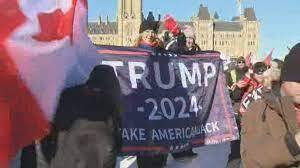
MAGA hats and Trump signs have been ubiquitous at the Freedom Convoy occupation in Ottawa, which has attracted donations and political support from the U.S. One man rode a horse through the downtown streets carrying a flag emblazoned with the word “Trump.” The word ‘freedom’ could be found on most signs being touted by the protesters. For many, it’s a word that has become code for white-identity politics and the far-right’s weapon of choice in the culture wars.

Mr. Poilievre has been a strong advocate of those gathered in Ottawa, meeting with them and helping get their message out.

He’s been less vocal about the lawlessness that has taken place or the harm that the encampment has caused to commerce and downtown residents. It would appear that the presumptive favourite to win the Conservative leadership isn’t prepared to jeopardize his relationship with potential supporters in the name of law and order.

It's not as though we haven't been warned:

As Elisabeth Anker, a professor of American studies at George Washington University and author of Ugly Freedoms recently wrote in The New York Times: “Today, more and more, laws, caucuses, rallies and hard-right movements use the language of freedom as a cudgel to erode democratic governance and civil rights; these laws expand the creep of authoritarianism.”

And George Orwell, of course, knew how authoritarians can pervert language to corrupt thought.

One wonders what he would say about Mr. Poilievre.

Image: The Toronto Star