Monday, March 22, 2021

In Retreat

Sometimes it doesn't seem like it -- particularly given this weekend's Conservative convention. But, E.J. Dionne writes that, globally, the Far Right is in retreat:

There’s a long-standing habit among Americans of reading our own politics as a signal for where the whole democratic world is moving. Sometimes it’s justified. Ronald Reagan’s election was clearly part of a broad movement toward the free-market right in the 1980s. Bill Clinton’s embrace of a centrist brand of progressivism in the 1990s was widely imitated.

So is a Joe Biden wave forming out there? Perhaps more importantly, has the drift toward right-wing authoritarianism that Donald Trump’s ascendancy seemed to herald been checked?

Of course it’s early, and many key national elections — in Germany and France, for example — lie in the future. But voting in the Netherlands last week and recent state elections in Germany and Australia point to a covid-era seriousness about government’s responsibilities, a search for democratic stability after a series of right-wing uprisings, and a redefining of progressive politics in a green direction.

We're not talking a wave. But, in Europe and Australia, the pandemic has produced political moderation:

Here’s the most striking fact about the Dutch vote, two state elections in Germany and an election in Western Australia: The incumbents did well in all of them. And while parties of the far right in the Netherlands and Germany held their own — advancing a bit in the Netherlands, moving backward in Germany — their surge has been checked. They are no longer, as they were in the Trump years, at the center of the news.

If nothing else, Biden’s defeat of Trump has shifted the momentum away from the global far right. And the pandemic and growing concerns about the climate have made electorates more practically minded and more focused on results. That’s progress.

We'll have to see if the progress continues.

Image: Napoleaon.org


Sunday, March 21, 2021

The Stupid Party

Chantal Hebert writes that, on Thursday, the Supreme Court will rule on the Trudeau government's carbon tax:

For Justin Trudeau’s government, the stakes could not be higher. Should the court find that Ottawa has exceeded its constitutional powers, one of the consequences of the decision would be to transfer the lead in the Canadian fight on climate change to largely unfriendly premiers.

The federal carbon tax only applies in provinces that decline to meet the floor price on greenhouse gas emissions set by Ottawa using policies of their own. With Ontario, Alberta and Saskatchewan leading the charge, they have been fighting the tax in the courts.

There is a consensus that without a carbon tax in its toolbox, Ottawa would struggle to craft an alternative plan efficient enough for Canada to have a shot at meeting its 2050 target of a carbon-free economy. That consensus includes a number of prominent Conservative thinkers.

Yet, at this weekend's Conservative convention, the delegates voted down a resolution recognizing the reality of climate change. Erin O'Toole bowed to his delegates' wishes:

On Friday, he told his party’s convention that a Conservative government would “scrap Justin Trudeau’s carbon tax on working Canadians.” In the same breath, the CPC leader promised to come up with a credible alternative.

That's exactly what Andrew Scheer promised in the last election, where "two-thirds of the electorate voted for parties that supported a carbon tax."

Back in the 1950s, a significant number of Americans referred to the Republican Party as "The Stupid Party." That moniker applies equally to the 21st Century Conservative Party of Canada.

Image: quotefancy.com

Saturday, March 20, 2021

O'Toole's Speech

Last night, Erin O'Toole delivered a speech to the Conservative convention. It was all about change. First, he started with the facts:

We have lost two elections in five-and-a-half years. In that time, we have had four leaders. We must present new ideas, not make the same arguments hoping that maybe this time more Canadians will come around to our position.

Then he stated the obvious:

We are never going to win over Canadians just by relying on Justin Trudeau to continue to disappoint. His scandals, as outrageous as they often are, will never be enough to defeat him.

Then he lambasted the Liberals:

The Liberal government has used the worst health and economic crisis in generations to help some well-connected friends get ahead. While hundreds of thousands of Canadians got left behind. But even that will not be enough to defeat him. The Conservative Party can defeat him. But only with the courage to grow. To move beyond a party that does well only in certain parts of Canada, while leaving other Canadians out.

But he didn't say what kinds of changes the party needs to make. He did said he would introduce a jobs recovery plan. But it was pretty thin gruel. There's a reason the party's numbers are flat. Canadians know that Mr. O'Toole is pretty thin gruel.

And they know that O'Toole leads a party that is fixated on turning back the clock. That policy will no longer sell.

Image: macleans.ca


Friday, March 19, 2021

Learning As He Goes

Lots of people predicted that, if Joe Biden became president, he'd look and act goofy. He looked goofy in the past. But, so far, we've not seen any evidence of the old Biden. Frank Bruni writes:

He has . . . exploded that musty maxim about old dogs and new tricks. When Trump failed to “grow” into the presidency, as critics and even some fans hoped he would, the consensus was that it had been foolish to expect otherwise. Who but Trump could Trump be? Besides, he was 70 on the day of his inauguration. He’s going to grow and learn and change after that point?

Biden was 78 on the day of his inauguration, and in the year and a half immediately leading up to it, he demonstrated the new tricks of reticence and restraint. He continues to demonstrate them — “The Invisible President?” was the headline on a recent article by Joel Mathis in The Week — presumably on the theory that the less flamboyant his style, the more likely his actual policy triumphs, which won’t be complicated by his becoming a symbol of grander battles or turning himself into a cultural lightning rod.

His new tricks include a more progressive bent than in the past and, it seems, a less firm attachment to bipartisanship than he once claimed — developments that take into account the ravages of a pandemic, the toll of income inequality and his party’s current pulse. Remember those history-class debates about whether the leader makes the moment or the moment makes the leader? The moment is making — or, rather, remaking — Biden.

Donald Trump is a moron. He learned nothing in office -- because he can't learn anything. Let's hope Biden's take on things continues. As long as we can learn as we go, there's hope.

Image: The New York Times

Thursday, March 18, 2021

The Rubber Has Hit The Road

The filibuster -- as it currently exists -- is on the way out. E.J. Dionne writes:

Change is on the way. President Biden has signaled that the days of the Senate filibuster’s stranglehold on majority rule are numbered. Senate Minority Leader Mitch McConnell (R-Ky.) is scared to death that he’s right.

McConnell is particularly worried that Democrats will use their majorities in the House and Senate to enact fundamental reforms to our political system, from protecting voting rights to containing dark money’s influence on elections. That’s why the man who supposedly loves Congress’s upper chamber promised to create “a completely scorched earth Senate” if Democrats try to make it easier to pass legislation.

The Republicans have been a minority party for decades. They know they don't have the votes to win elections. So they have tried everything -- from voter supression to the filibuster -- to maintain minority rule. And they have changed the filibuster to maintain that minority rule:

Adam Jentleson is a former top Senate Democratic aide and the author of “Kill Switch,” an appropriately titled book on the chamber. He offered a brisk history of the filibuster in an interview. The 60-vote standard for passing most legislation is really the product of the past 20 years, Jentleson said, and has been truly routine only since 2007.

At the beginning of the republic, he noted, “there was no filibuster.” Then, “there was the talking filibuster, used rarely, mostly against civil rights. Then there was a slow rise [in its use] through the latter half of the 20th century, then it skyrocketed under Sen. McConnell,” Jentleson said to me in an interview. Little wonder, as the author noted, that the word filibuster comes from Dutch references to pirates.

The days of Mr. Smith Goes To Washington have long passed. Biden proposes to return to the days of Mr. Smith and institute a talking filibuster when: "stalling action required its members 'to stand up and command the floor, and you had to keep talking.' That was the rule when Biden first arrived in the Senate.

A voting rights bill will soon usher in change:

Biden made his comments on the filibuster on Tuesday, the eve of the formal Senate introduction of the For the People Act that has already passed the House. The comprehensive political reform bill would block the scandalous attack on voting rights in some Republican states. It would also curb gerrymanders that distort representation, take major steps to limit the power of dark money by expanding disclosure and create strong incentives for politicians to rely on small as opposed to large contributions.

The rubber has hit the road.

Image: 

Wednesday, March 17, 2021

COVID And Inequality

The pandemic has exposed glaring inequalities in Canadian society. Susan Delacourt writes:

For the past year, Canadians have been forced to rein in a lot of their rights — their liberty, their freedom to assemble, to name just two.

But equality, or the lack of it, has continued to elbow its way into the existential conversations taking place in a year of pandemic living.

Canada may not be a more equal nation when the pandemic is over, but we’ll know a lot more about where inequality exists. Whether we do anything about it lies at the heart of all those promises to “build back better.”

“The legacy of the lost year will be devastating inequality,” Bloomberg news announced in a headline over a recent special to mark the first anniversary of the COVID-19 crisis. This past year, it said, “amplified every structural bias that exists.”

Those inequalities can no longer be ignored:

Across North America and many other parts of the world, people stepped out of pandemic isolation to say “enough” to racism in the wake of George Floyd’s death last spring. It was almost as if the hardship of pandemic living had sharpened awareness of racial inequality and lit a fuse that still burns.

Here in Canada, Black women made serious, historic strides in two leadership contests. The Greens elected Annamie Paul to lead them into the next election, and the Conservative leadership race was energized by the unexpected surge in support for Leslyn Lewis, who will be one of the co-hosts of the party’s big convention this weekend.

Those who chose to turn a blind eye to the inequalities have paid a price:

Politicians were punished most severely when they failed to be mindful of equality with their voters — travelling over the Christmas and New Year’s holidays while others were forced to stay home, acting as though they were above the limits that are supposed to be endured universally in a pandemic. Trudeau’s most serious ethical controversy over the past year touched on whether one charity was being singled out for special treatment.

The next federal budget will tell us if any lessons have been learned over the last year.

dchas.org


Tuesday, March 16, 2021

Work After The Pandemic

The pandemic has changed the way many of us work. Paul Krugman writes:

A year of isolation has, in effect, provided remote work with a classic case of infant industry protection, a concept usually associated with international trade policy that was first systematically laid out by none other than Alexander Hamilton.

Hamilton asserted that there were many industries that could flourish in the young United States but couldn’t get off the ground in the face of imports. Given a break from competition, for example through temporary tariffs, these industries could acquire enough experience and technological sophistication to become competitive.

John A. Macdonald's National Policy was imported from Alexander Hamilton. Working from home is a little bit like Macdonald's National Policy:

The pandemic, by temporarily making our former work habits impossible, has clearly made us much better at exploiting the possibilities of remote work, and some of what we used to do — long commutes so we can sit in cubicles, constant flying to meetings of dubious value — won’t be coming back.

For many, it's a new way of doing things. But it won't completely revolutionize the world of work. Its effect will be something like what happened when e-readers were introduced:

A decade ago many observers believed that both physical books and the bookstores that sold them were on the verge of extinction. And some of what they predicted came to pass: e-readers took a significant share of the market, and major bookstore chains took a significant financial hit.

But e-books’ popularity plateaued around the middle of the last decade, never coming close to overtaking physical books. And while big chains have suffered, independent bookstores have actually been flourishing.

Why was the reading revolution so limited? The convenience of downloading e-books is obvious. But for many readers this convenience is offset by subtler factors. The experience of reading a physical book is different and, for many, more enjoyable than reading e-ink. And browsing a bookstore is also a different experience from purchasing online. But what I find in a bookstore, especially a well-curated independent store, are books I wasn’t looking for but end up treasuring.

The remote work revolution will probably play out similarly, but on a much vaster scale.

So what will work look like in the future?

The advantages of remote work — either from home or, possibly, in small offices located far from dense urban areas — are obvious. Both living and work spaces are much cheaper; commutes are short or nonexistent; you no longer need to deal with the expense and discomfort of formal business wear, at least from the waist down.

The advantages of going back to in-person work will, by contrast, be relatively subtle — the payoffs from face-to-face communication, the serendipity that can come from unscheduled interactions, the amenities of urban life.

So the best bet is that life and work in, say, 2023 will look a lot like life and work in 2019, but a bit less so. We may commute to the office less than we used to; there may well be a glut of urban office space. But most of us won’t be able to stay very far from the madding crowd.

We await the future.

Image: ricoh-europe.com


Monday, March 15, 2021

The Meaning Of Wealth


A recent incident at a Vancouver Pizza Pizza outlet has attracted a lot of attention. David Ball reports:

In the final hour of Feb. 20, two smartly dressed, middle-aged white guys cruising around Vancouver decided they had a hankering for pizza. The stakes seemed pretty low when they pulled into Pizza Pizza, a glowing outpost in an otherwise dimly lit plaza on the eastern edge of the Kitsilano neighbourhood.

But within a few minutes a video camera had captured the men screaming bigoted insults at the young workers and boasting of their riches compared to the servers “worth zero.”

On their way out of the store, a recording shows, the men encountered an apparently Asian teenager and physically attacked him.

The incident made the news and soon it was announced that Brenton Woyat, a wealth manager, and James Davidson, whose line of work remains unknown, had been charged with assault, and one with impaired driving.

The incident was apparently triggered by a request from the restaurant's staff to comply with the medical officer's mandate to wear masks:

That night at Pizza Pizza, Woyat stood at the counter wearing a mask. But Davidson clutched one in his hand or wore it uselessly under his chin, his mouth exposed as he declared, “You’re Nazis. You guys are complete fucking morons. COVID is a joke. You guys are fucking brainwashed.”

He shouted: “Are you fucking Middle Eastern or where are you from?” And, “I’m worth $50 million, you’re worth zero.”

There have been other such incidents:

In Prince George, a Walmart customer refusing to wear a mask pummeled a store greeter to the ground, repeatedly punching his head into the floor.

In Nelson, a hotel employee suffered a heart attack after being spat on and screamed at by a customer refusing to wear a mask. 

It appears that wealth can have deleterious effects. Wealth does not mean entitlement. It should mean noblesse oblige.

Image: 

Sunday, March 14, 2021

We Still Need Stimulus

Canada's employment numbers for February looked pretty good. But, Heather Scoffield writes, the devil is in the details:

With 259,000 new jobs in February, many of them in the sectors that have been hit repeatedly by the pandemic, there is good reason for solace.

We are still short 600,000 jobs though, compared to the glory days of February 2020. Plus, an additional 400,000 people are working less than half their usual hours.

Measured another way, Statistics Canada estimates that there are about 3.4 million people today who are unemployed, not working but want to work, or are not getting enough hours. That’s a million more “underutilized” people than a year ago.

And many of those "underutilized" people are going to have a hard time finding jobs:

Young workers, especially women, can’t seem to catch much of a break, mainly because their jobs in accommodation, food services and retail have been the hardest hit. Will those jobs ever return in full?

Self-employment is in a dismal state. The number of self-employed workers didn’t change much in February despite gains in many other areas of the economy, and the number of hours those self-employed workers are putting in has declined 11.8 per cent compared to a year ago. That’s compared to just 1.6 per cent for other employees.

Many small businesses say they are on the brink and fear they won’t last the pandemic, meaning those jobs won’t return in the same way, even with widespread vaccination.

Long-term unemployment receded in February by 49,000 people but from a high of 512,000 in January. These people will have a tough time getting back into the workforce as their skills atrophy and their experience grows stale.

The pandemic has created a lot of pent-up demand. But the federal government is still going to have to spend money to make sure that all of Canada's workers can take advantage of that demand.

Image: bellissimolawgroup.com


Saturday, March 13, 2021

Nice Work

In response to the economic damage done by COVID, governments everywhere are planning to spend on infrastructure. But Linda McQuaig writes, in Canada, that spending will benefit the wealthy. Justin Trudeau has established the Canada Infrastructure Bank and endowed it with $35 billion:

Of course, municipalities badly need new infrastructure so the bank, endowed with $35 billion in public money to help finance infrastructure, should be a godsend.

But it isn't -- except for business and investors.

That's because of the business-friendly way the Trudeau government designed the bank. Municipalities that want the bank's financial support for an infrastructure project must "partner" with a private business.

These public-private partnerships (P3s) ultimately drive up the cost of the projects and leave municipalities with less control over their own infrastructure.

The problem is that " if municipalities don't want to "partner" with business -- if they want instead to handle the projects themselves, raising the money through municipal bonds as they've traditionally done -- Canada's new public bank won't help them."

Consider what happened in Mapleton, Ontario:

Like many municipalities, Mapleton needed to upgrade its water and wastewater systems. The CIB offered a $20-million debt-financing package, and proudly promoted Mapleton as a "pilot project" for its new model of financing municipal water projects.

But the $20-million financing package was aimed at ensuring the private partner achieved its profit targets, and offered nothing directly to the municipality.

When Mapleton township studied the deal carefully, it realized that it would be cheaper for the township to do the water project itself. So it cancelled the deal -- and received no help from the CIB.

All that Mapleton was left with was a $367,000 legal bill in connection with the CIB process.

But why didn't the CIB offer the $20-million subsidy directly to the municipality to help finance the project? Why must a private partner be involved?

What the CIB calls its "innovative financing model" is really a mechanism for directing taxpayer dollars to private companies so they can earn profits managing our infrastructure -- even though we can build and operate these projects more cheaply on our own.

What's the point of this bank -- besides ensuring businesses profit from our public services?

That really is nice work -- if you can get it.

Image: cib-bic.ca


Friday, March 12, 2021

Over a Barrel

The election of Joe Biden has put the relationship between Canada and the United States on a better footing. David Carment and Richard Memijean write:

Biden has already returned the relationship to normal by making his virtual meeting with Trudeau his first as leader, reflecting his plan to stabilize American foreign policy.

Despite disagreement on a few key issues, Canadians were pleased. Biden and Trudeau have an obvious personal chemistry, reinforced by their centrist ideological outlooks and their recognition that politically they need to tack left. Both want their countries to “build back better” while paying attention to climate change and addressing socioeconomic inequality. Progress will occur on other shared concerns, such as NATO’s future, multilateralism, human rights and democracy promotion.

But there is a downside. As we grow closer to the United States, our options become more limited:

A friendly American administration will not necessarily make it easier for Canada to pursue its interests and enhance its sovereignty. Biden is an American president first and foremost, and is using diplomacy and statecraft to promote his interests and goals. Like Trump and Obama before him, Biden will pressure Canada to help him succeed, such as by spending more on defence and security.

On issues that truly matter to Canadians, he so far has given precious little. There was no word on American assistance on vaccine procurement, exemptions from Biden’s nationalist procurement strategy, or consideration for Canada’s pipeline concerns.

Biden’s “alliance of values” seeks to restore American hegemony. He wants to re-establish American leadership in areas that risk being dominated if not controlled by China. Allies can go along for the ride and help Biden address his political concerns. Otherwise, they face the prospect of heightened tensions, as Europe is now encountering as it tries to work constructively with both China and the U.S.

And to solve our problems with China, we must rely on the United States:

The new framework on Canada-U.S. relations states that the two countries are discussing how “to more closely align our approaches to China.” Ironically, Conservative leader Erin O’Toole’s attempt to portray the Liberals as soft on China, such as the recent House motion declaring crimes against the Uyghurs to be genocide, will if anything only push Canada deeper into the American orbit, since Canada on its own lacks the power to stand up to China.

So, in some way, things are better. But, on the other hand, we are over a barrel.

Image: Getty Images

Thursday, March 11, 2021

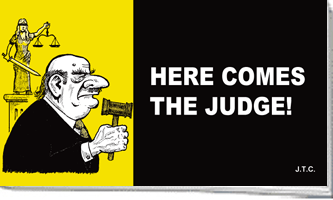
Here Come The Judge


His recent appearance at CPAC has made clear that Donald Trump does not intend to go away. But, as he plots his comeback, something else is going on. He faces multiple lawsuits. Donald Ayer and Norman Eisen write:

Recent statements by Donald Trump and his enablers prove that he and his Big Lie that the 2020 election was stolen aren’t departing from American politics anytime soon. But neither is the push to hold him legally accountable, as shown by a new lawsuit — the second against Trump by a member of Congress arising out of the failed Jan. 6 insurrection. As attorneys who have overseen prosecutions or other accountability efforts in Republican and Democratic administrations alike, we believe the combination of civil cases and a pair of rapidly accelerating state criminal investigations make for a potent force to combat the ex-president’s ongoing wrongdoing.

Congressman Eric Swalwell -- a former federal prosecutor -- has sued Trump for his role in the capital insurrection on January 6:

Rep. Eric Swalwell (D-Calif.), alleges that the former president, his son Don Jr., his lawyer Rudolph W. Giuliani and Rep. Mo Brooks (R-Ala.) conspired to prevent Swalwell and other members of Congress from discharging their duty to certify that Joe Biden had won last year’s presidential election. The complaint says the defendants engaged in an extensive, months-long promotion of the Big Lie, capped off by Trump’s fighting words and the violence that followed on the day of the electoral vote count.

Recent days also saw the delivery of long-sought tax and financial information to Manhattan District Attorney Cyrus Vance Jr. as part of an investigation into Trump’s many alleged misdeeds in New York City’s jurisdiction, including bank and tax fraud. That should greatly accelerate the long-running investigation. So too should Vance’s recent hiring of a top deputy with extensive experience trying complex criminal matters, Mark Pomerantz. He and Vance are reportedly sharpening their focus on the Trump Organization’s chief financial officer, Allen Weisselberg, whose cooperation could also speed up the case.

And then there is the case taking place in the suburbs of Atlanta:

There’s a matching criminal threat from Fulton County, Ga., District Attorney Fani Willis over Trump’s call to ask that the secretary of state in Georgia “just … find 11,780 votes” to help Trump beat Biden. This is a more recent investigation, but it’s also potentially much less complex than the case in Manhattan, now in its third year. As a result, the Fulton County investigation may move even faster. Indeed, a grand jury met in the Georgia investigation last week, and Willis recently added a nationally recognized racketeering expert to her investigative team. Look for the New York and Georgia probes into criminal liability to close in on Trump.

They're coming for Trump. That's why he's desperately raising money from his supporters. He wants them to pay his legal bills.

Image: Chick Publications

Wednesday, March 10, 2021

Some Of Us

During the pandemic we have repeated the mantra, "We're all in this together." But the pandemic will leave some people better off -- and millions of people worse off than they were. That's certainly the case in Britain. Rafael Behr writes:

The language of collective endurance has helped sustain public spirits, but it also elides major sacrifice with acts that, in the wider scheme of human experience, register more as inconvenience: wearing a mask; foregoing meals out.

It might seem callous to talk now about anyone having had a “good pandemic”, but it is dishonest to pretend that the nation will walk out of the darkness together, with one story to tell. The disease has ravaged some and spared others. It gets deadlier with age, but appears also to have discriminated along racial lines for reasons that are not yet fully understood. Partly, that is likely to be a function also of class inequality. Covid thrives on deprivation: crowded accommodation; poor diet; precarious jobs that make it harder for people to self-isolate or take time off work for convalescence.

A release of pent-up consumption by the lucky group will generate flattering growth statistics, although that economic bounce will leave millions behind. Boris Johnson’s MPs will resist efforts to force the winners to subsidise the losers on any adequate scale. The Conservative cult of self-reliance usually provides intellectual anaesthesia against the discomfort of living in a very unequal society. There is less duty to care about unemployment once it is cast as a self-inflicted penalty for idleness. It gets harder to argue along the same lines when a pandemic is the cause of people’s suffering, but then the myth of collective sacrifice and the rhetoric of “hard choices” can be applied to salve wealthy consciences. We are all in it together. Some are just in deeper than others.

And that is the point. Some of us are in much deeper than others.

Image: quotefancy.com

Tuesday, March 09, 2021

It Won't Be Harry


A short time ago, there was speculation that Prince Harry would be appointed Governor-General. Susan Delacourt writes:

Just a little over a year ago, about 60 per cent of Canadians polled said the Queen’s runaway grandson would be a good fit for the viceregal post — which, as coincidence would have it, is now vacant.

This was right after Harry and Meghan had found temporary refuge in Canada, before the pandemic, before they decamped to California and most importantly, before the bridge-burning interview with Oprah Winfrey that aired on Sunday night.

But times -- and opinions -- have changed:

The Winfrey interview is the worst thing that’s happened to the royalty on TV since season 4 of “The Crown,” which also seems to have awakened a strong anti-monarchist streak in this country, according to recent polling by Abacus Data.

Abacus CEO David Coletto binge-watched the latest series of “The Crown” late last year and got to wondering how it was making Canadians feel about the monarchy. Not good was the answer — 52 per cent of the people who had finished watching the series leaned toward abolition of the monarchy.

If some of these Canadians saw Sunday night’s interview with Harry and Meghan, chances are that those views are even stronger today. As Harry pointed out, the troubles that Meghan endured as a new part of the Royal Family felt like history repeating itself — the history of Princess Diana, depicted in season four of “The Crown.”

With the Royals, there's always the issue of security:

But there was a lot of discussion about security, which was a very live issue in Canada in the weeks after the two made a temporary home in British Columbia. While everything pre-pandemic feels like ancient history now, we might remember that debate was raging in this country over who would be paying for security for Harry and Meghan and their young son, Archie.

Security is a big deal to the family, as the interview revealed. Meghan recounted to Winfrey how crushed she was to discover that the Firm was not going to be paying for security for her son — the same son whose skin colour had been a matter of royal concern. As she said she was told while still pregnant: “He won’t be given security, he’s not going to be given a title, and also concerns and conversations about how dark his skin might be when he’s born.”

Having a royal family costs money. And it appears that lots of people don't want to foot the bill. Even the Royal Family doesn't want to foot the bill.

Something's out of joint. And now it's certain that Harry won't be the next GG.

Image: 

Monday, March 08, 2021

Underestimating Biden

During the Democratic primary and the election, Jennifer Rubin writes, the media consistently underestimated Joe Biden. This weekend his COVID rescue plan passed the Senate. Much has been made of the lack of bipartisan support for the plan. But it depends on how you define bipartisan support:

The president pushed aside repeated media chiding that he was not being bipartisan enough. In fact, as he observed in a victory lap speech on Saturday, “without the overwhelming bipartisan support of the American people, this would not have happened.” He continued, “Overwhelming public support — every public opinion poll shows overwhelming support for this plan. And for the last weeks, it’s shown that. Every public opinion poll shows the people want this, they believe it’s needed, and they believe it’s urgent.” Bipartisanship, the administration maintained, was not found in capitulating to Republicans whose paltry $650 billion plan failed to grasp the magnitude of the dual economic and health threats. Bipartisanship was achieved in meeting the needs of Americans who are eager for active government.

Biden faces huge challenges ahead. There will be a lot of heavy lifting. But the president and his team are focusing on citizens, not members of congress -- and that has advantages:

The Biden team’s focus allowed them to woo back into line moderate Democrats such as Sen. Joe Manchin III (D-W.Va.), who might irrationally deny a qualified woman of color a Cabinet spot or seek the limelight in holding up the deal to lower the unemployment subsidy from $400 to $300. Frustration is kept behind closed doors; the eyes of Biden’s colleagues are invariably on making the most important deal when the chips are down.

Donald Trump claimed to know the Art Of the Deal. Four years proved that he knew nothing about making deals. The only thing he understood was self-interest -- the kind of self-interest that gave him a COVID vaccination long before anyone else in the country got one. Biden knows how to make deals. And this success can lead to more successes:

Success builds on success. As Biden turns to items such as infrastructure, Republicans may feel more pressure to end their reflexive obstruction. One wonders if having bet against an overwhelmingly popular rescue plan, swing-district and swing-state Republicans want to keep turning up their noses at the very economic populism they insist they support. In the 1930s, disaster struck and metastasized on the Republicans’ watch; now, similarly, the GOP may find out that opposition to vigorous governmental action is a political loser that may keep them out of power until memories of their gross mismanagement fade.

It's too soon to reach any conclusions. But the Republicans could be out of power for a generation.

Image: Forbes.com


Sunday, March 07, 2021

Pandemic Politics

The pandemic has left its mark on Canada's political parties. Chantal Hebert writes:

Never have so many Canadians had to rely on governments for so much and for so long as they have over the past 12 months.

Given that, it should come as little surprise that the pool of progressive voters and the ranks of those who support government activism seems to have expanded over the course of the COVID-19 episode.

That reality has caused considerable pain for Conservatives -- who are philosophically committed to the principle of less government:

A year into the pandemic, the Conservatives are the only federal party that is consistently falling below its last election score in voting intentions.

Even as a debate has raged over the federal delivery of vaccines, the Conservatives, who — based on their seat count — are best positioned to replace the Liberals in government, have failed to hang on to their 2019 audience, let alone add to it.

Every national poll published since Feb.1 has Conservative support hovering around the 30 per cent mark. That’s down four points from the party’s election finish.

The same fate holds true for Conservative premiers:

Over on the Conservative side, the reviews range from decisively mixed in the case of Ontario’s Doug Ford and Manitoba’s Brian Pallister to outright negative in the case of Saskatchewan’s Scott Moe and Alberta’s Jason Kenney.

Even in the Conservatives’ heartland, the pandemic is doing the Canadian right no favours.

The pandemic has also improved prospects for the NDP:

As support for the Conservatives has shrunk, that for the NDP has expanded. In all but one of the last six national polls, the New Democrats have scored better than in the last election.

That is not to say Jagmeet Singh is necessarily on a roll. Historically some of the NDP’s best polling results have been achieved between elections.

We'll have to see if the Dippers fortunes have improved permanently. And the Green Party is still trying to find its footing under its new leader, Annamie Paul.

So, despite Justin Trudeau's stumbles, the Liberals appear to have weathered the pandemic pretty well.

Image: 

Saturday, March 06, 2021

Getting Our Act Together

Mark Bulgutch is mystified about Ontario's vaccination program. He writes:

I readily admit some things are beyond my understanding. I don’t understand black holes in space for example. I don’t understand the rules of cricket or how a match can go on for days. I don’t understand why toast always falls to the floor with the buttered side down.

But what I really can’t understand right now is how Ontario botched its vaccination program so completely. It is as if the powers that be had no idea they would need to prepare for the day when vaccines arrived. I accept that the pandemic caught everyone off-guard, and there was a scramble to deal with getting ventilators for hospitals, PPE for front-line health care workers, and establishing rules for shutting down the economy.

By last summer, however, could not somebody have been told to begin to organize a vaccination plan? We didn’t need it the next day or the next, but we’d need it one day. Our political parties are forever planning the next election, even if it’s four years down the road. Our military plans for wars that we hope will never happen. Yet there is no evidence that anything was done to prepare for the certainty that vaccines were going to show up one day. It was a notion that caught Ontario by surprise.

Quebec has had all kinds of problems with COVID -- particularly deaths in nursing homes. But, at least, the province has a vaccination plan:

The good news is that something similar now seems to be happening here. Yesterday, my wife's friend took her elderly mother to a local community college gym. At the beginning of the morning, there was some delay in getting the process going. But, once things got started, vaccinations were given smoothly and quickly.

Finally, we're getting our act together.

Image: The Montreal Gazette

Friday, March 05, 2021

Neanderthal Thinking

Wearing a mask during the pandemic is not an impossible burden. Paul Krugman writes:

We’ve made a lot of progress against the pandemic over the past couple of months. But the danger is far from over. There are still substantially more Americans hospitalized with Covid-19 now than there were, say, last June, when many states were rushing to reopen and Mike Pence, the vice president then, was assuring us that there wouldn’t be a second wave. Roughly 400,000 deaths later, we know how that worked out.

Yet Texas and Mississippi have just ended their statewide mask requirements.

It’s true that there is now a bright light at the end of the tunnel: The development of effective vaccines has been miraculously fast, and the actual pace of vaccinations is rapidly accelerating. But this good news should make us more willing, not less, to endure inconvenience now: At this point we’re talking about only a few more months of vigilance, not a long slog with no end in sight.

But conservatives are having a tantrum. They want their porridge -- and they want it now:

So what’s motivating the rush to unmask? It’s not economics. As I said, the costs of mask-wearing are trivial. And basic economics tells us that people should have incentives to take into account costs they impose on others; if potentially exposing those you meet to a deadly disease isn’t an “externality,” I don’t know what is.

Of course, we know what’s actually going on here: politics. Refusing to wear a mask has become a badge of political identity, a barefaced declaration that you reject liberal values like civic responsibility and belief in science. (Those didn’t used to be liberal values, but that’s what they are in America 2021.)

This medical version of identity politics seems to trump everything, up to and including belief in the sacred rights of property owners. When organizers at the recent Conservative Political Action Conference asked attendees to wear masks — not as a matter of policy, but simply to abide by the rules of the hotel hosting the meeting — they were met by boos and cries of “Freedom!” Do people shriek about rights when they see a shop sign declaring, “No shoes, no shirt, no service”?

This insanity is no longer surprising:

These days conservatives don’t seem to care about anything except identity politics, often expressed over the pettiest of issues. Democrats appear to be on the verge of enacting a huge relief bill that embodies many progressive policy priorities. But the Republican response has been remarkably low energy, and right-wing media are obsessed with the (falsely) alleged plot to make Mr. Potato Head gender-neutral.

Joe Biden has called this Neanderthal thinking. Contrary to popular belief, Neanderthal Man did not go extinct. He obviously still lives in certain woe begotten areas of this planet.

Image: Sci-News.com


Thursday, March 04, 2021

Who Is Being Served?

Rishi Sunak is Britain's Chancellor of the Exchequer. More than anyone else, he is responsible for the disaster that has hit Britain. Owen Jones writes:

Rishi Sunak is one of the chief architects of Britain’s economic calamity. He is an arsonist posing as a firefighter, not that you would know it from some of the media profiles, which suggested he had more than risen to the occasion. Last year, the BBC released – and, following protests, hastily deleted – a video of the chancellor as Superman; ts offering this year included talking heads complaining that he’s too “lovely” to dig any dirt on.

The charge sheet against Sunak is straightforward – or, at least in a functioning democracy, it should be. A public health crisis is, in turn, an economic crisis. The countries that have most effectively suppressed the virus have tended to be spared the worst economic consequences. That Britain simultaneously has one of the world’s worst death tolls and most severe economic hits is a case study in positive correlation, not coincidence.

Sunak is a master of the art of self-promotion. But the facts on the ground belie the hype:

In a budget supposedly designed to solve a nightmare deepened by Sunak’s own actions, the man who applauded public-sector workers and then imposed a real-terms pay cut on many of them provided no answers for the NHS and social care. If a political consensus is to emerge from the rubble of this national emergency, surely the need to bolster our health and social services is it: the failure to do so led Richard Sloggett, a former special adviser to health secretary Matt Hancock, to call out an “error”.

While Boris Johnson vowed no return to “austerity”, day-to-day spending was slashed by £4bn. While corporation tax will supposedly be raised to 25% by 2023 (whether this commitment will stick, time will tell) big businesses have been handed an untargeted £25bn tax break in the meantime. While the state puts its arm around British bosses, a cut to universal credit in six months will further strip security away from those already stricken by the crisis. While the Tories raid the rhetoric of Jeremy Corbyn and John McDonnell’s 2019 manifesto, its substance has been hollowed out: £12bn is offered for a “green industrial revolution”, derisory compared with Labour’s £250bn commitment.

But it would be too easy for the government’s opponents to retreat into a comfort zone of deriding the same old Tories with their same old cuts. Boris Johnson and, more reluctantly, Rishi Sunak voice a willingness to spend in a way their Conservative predecessors did not. The consistent thread that runs through every Tory project, however, is mobilising the resources of the state to provide support and security for private interests. The dividing line, then, is: who should the state exist to provide for?

That is the central question of our time.

Shareeverything.com

Wednesday, March 03, 2021

Stacking The Deck

The Ford government has introduced new legislation which -- supposedly -- will protect Ontario's elections. The bill's real purpose is to protect Mr. Ford. Marcel Wieder writes:

The proposed bill will now limit how important conversations take place about the current and future direction of the province. Under the bill, groups that either support or oppose government legislation must register a full year before an election and are limited to how much they can spend; how they interact with other like-minded groups; and what suppliers they can use. This has the chilling effect of restricting free speech and the right to association.

The amount that third parties can spend have been cut in half under the proposed bill. The current limits, which are currently the subject of a Charter challenge, do not come anywhere close to what the political parties can spend; are not tax deductible and do not reflect the cost of a sustained communications campaign.

Under the proposed legislation, individuals or organizations that wish to comment on a government bill that could be considered an election issue will need to register if they spend more than $500 conveying their opinion. The chief electoral officer is given the responsibility of determining whether it falls into the category of political advertising.

Even more outrageous is that this bill limits individuals or organizations from sharing information, appealing to donors who share a similar point of view and using a common vendor.

Ford is trying to shut down his opposition before the election. And the number of Ontarians opposed to Ford is growing:

The Doug Ford government is taking this draconian effort prior to the next election to block critics who oppose this government’s handling on a number of issues.

Health-care workers are critical of the government’s handling during the COVID-19 crisis, especially among the personal support workers.

Family members are mad at Ford over the disastrous response to long-term care residents.

Parents and education workers are upset over mixed messages, lack of planning and overall handling of the response to the education system during the pandemic.

Small business owners, restaurant owners and others who have been affected by closures, lockdowns and restrictions that have forced them out of business or to take on massive debt.

Ford wants to have all the cards in his hand. And he's stacking the deck.

Image: instructables