Saturday, September 22, 2018

The Fix Is In


Michael Stern is a former prosecutor from Michigan. He admits that he found prosecuting sexual assault cases difficult:

In my early career, as a state prosecutor outside of Detroit, I dreaded handling sexual assault cases. After my first 10 cases, the ache in my stomach would come like clockwork as I sat down to open a sexual assault file for the first time. Evidence in sexual assault cases is often thin and trying to bring justice to a victim in a case with thin evidence is a prosecutor’s worst nightmare.

It all came down to he said/she said. But there was a witness to what happened between Brett Kavanaugh and Christine Blasey Ford -- Mark Judge:

To a prosecutor, learning of a third-party eyewitness to an alleged sexual assault is a boon. Apparently, this additional evidence has had the opposite effect on the Senate judiciary committee.
Rather than embracing testimony from Judge as a means of finding the truth about Ford’s allegation, the Republican Senate judiciary committee chairman, Charles Grassley, has scheduled a hearing for Monday and has refused to call Judge as a witness.
There is a sleight of hand that has allowed Grassley to turn a blind eye to this pivotal piece of evidence. Mark Judge sent a letter to Grassley’s committee saying he had “no memory” of the incident Ford disclosed. Judge also said he never saw Kavanaugh “act in the manner Dr Ford describes”. Other Republican senators, including Lindsey Graham, have fallen in line behind Grassley, saying that there is “no reason” to call Judge to testify because they already know what he will say – exactly what he said in his letter.
But wait. If Mark Judge’s letter to the judiciary committee is sufficient to make its Republican members accept the contents of the letter at face value, why don’t they do the same for the letter Ford sent to ranking committee member Diane Feinstein? The answer simple: Republican members of the judiciary committee want to believe Judge, not Ford.

And that's precisely the point. The fix is in. As Mitch McConnell told an audience yesterday, Kavanaugh will be confirmed to the Supreme Court.

Image: BBC

Friday, September 21, 2018

No Guarantee


As Chrystia Freeland tries to hammer out a new NAFTA deal, Paul Krugman writes about Donald Trump's tariffs:

Trump’s tariffs really are a big, bad deal. Their direct economic impact will be modest, although hardly trivial. But the numbers aren’t the whole story. Trumpian trade policy has, almost casually, torn up rules America itself created more than 80 years ago — rules intended to ensure that tariffs reflected national priorities, not the power of special interests.
So far, Trump has imposed tariffs on about $300 billion worth of U.S. imports, with tariff rates set to rise as high as 25 percent. Although Trump and his officials keep claiming that this is a tax on foreigners, it’s actually a tax hike on America. And since most of the tariffs are on raw materials and other inputs into business, the policy will probably have a chilling effect on investment and innovation.
But the pure economic impact is only part of the story. The other part is the perversion of the process. There are rules about when a president may impose tariffs; Trump has obeyed the letter of these rules, barely, but made a mockery of their spirit. Blocking imports from Canada in the name of national security? Really?

As the fight over Supreme Court nominee Brett Kavanaugh confirms, Trump corrupts everything he touches:

As with so many other things, Trump has basically abrogated the rule of law and replaced it with his personal whims. And this will have a couple of nasty consequences.
First, it opens the door for old-fashioned corruption. As I said, most of the tariffs are on inputs into business — and some businesses are getting special treatment. Thus, there are now substantial tariffs on imported steel, but some steel users — including the U.S. subsidiary of a sanctioned Russian company — were granted the right to import steel tariff-free. (The Russian subsidiary’s exemption was reversed after it became public knowledge, with officials claiming that it was a “clerical error.”)
Beyond that, America has thrown away its negotiating credibility. In the past, countries signing trade agreements with the United States believed that a deal was a deal. Now they know that whatever documents the U.S. may sign supposedly guaranteeing access to its market, the president will still feel free to block their exports, on specious grounds, whenever he feels like it.

And that, in a nutshell, is the problem Canada faces. Even if we sign a new NAFTA deal, there is no guarantee that Trump will live by its rules.

Image: Me.me

Thursday, September 20, 2018

Ignoring His Colours


The Ontario Court of Appeal has decided that what Doug Ford did in the middle of Toronto's municipal election was unfair but not unconstitutional. Ford could have waited for the ruling. Instead, he chose to exercise the nuclear option. In the final analysis, the appellate court has underscored the first court's conclusion. The premier's judgment can't be trusted. Martin Regg Cohn writes:

If the verdict was a vindication on constitutionality, there was precious little validation of the premier’s own judgment: His unilateral move to redraw Toronto’s electoral boundaries “disrupted the campaigns that were already underway,” the judges noted. “The decision of the Legislature to change (the rules) during the campaign was unexpected and perhaps alarming.”

There is a lesson for every Ontarian in all of this:

The takeaway for Ontarians is that the premier boasts of his willingness to take away their rights on a moment’s notice, in midnight sittings, while they sleep. People who weren’t paying attention may now watch closely; those who gave his government the benefit of the doubt are now on notice; voters who assumed Ford’s cabinet would keep the premier in check should now check more closely.
Will our lawmakers learn lessons from this fiasco? The premier’s honeymoon has been eclipsed by his darkest hour. He escalated an ephemeral question of municipal seat size into an existential matter for his fledgling government, flouting the fundamental protections of the Charter on a whim.

Ford has displayed his true colours. Most Ontarians knew what they were. Sixty percent of them did not vote for him. Ignoring those colours, however, could be catastrophic.

Image: Tumblr

Wednesday, September 19, 2018

In A Box


Mitch McConnell is a shrewd and putrescent politician. But he did warn Donald Trump not to choose Brett Kavanaugh for his Supreme Court nominee. Walter Shapiro writes:

Mitch McConnell sent a private warning to the White House. The Senate majority leader urged the president to choose someone other than Kavanaugh because the federal appeals court judge had too long a public record dating back to his days as a top assistant to Grand Inquisitor Kenneth Starr.
It is possible that McConnell was also concerned about something personal on Kavanaugh’s record in addition to his paper trail from the George W Bush White House. But Trump, whose idea of a “listening tour” is to watch recordings of his own rallies, turned a deaf ear to McConnell’s plea. The selling point for Trump may have been Kavanaugh’s extreme belief that a president (even one who watches Fox News all day) is far too busy to be questioned by an outside investigation.

Now Trump and McConnell are in a box:

Once Republicans thought that they could politically exploit the votes of red-state Democratic senators who opposed Kavanaugh. Now vulnerable Senate Democrats like Heidi Heitkamp (North Dakota) and Claire McCaskill (Missouri) have a convincing non-ideological explanation for voting against the nominee.
Not only would McConnell’s scorched-earth battle for Kavanaugh unite the 49 Senate Democrats, but it would also put beleaguered Republican incumbents like Nevada’s Dean Heller and even the fiercely ideological Ted Cruz in Texas in an uncomfortable position. Then there is Republican House member Martha McSally, who is running for the Arizona Senate seat being vacated by Jeff Flake. McSally, who once called the Access Hollywood tape “disgusting,” had to embrace Trump to survive a vicious right-wing primary challenge last month. Now she will face an even trickier decision on the campaign trail after describing the charges against Kavanaugh as a “very serious allegation.”
McConnell is boxed. The more he fights for Kavanaugh, the more he risks alienating women voters in November. Already, political analyst Nate Silver gives the Democrats a 30% chance of winning back the Senate, despite a political map tilted towards the Republicans like a rigged roulette wheel. If the Republicans go too far in defaming Ford, they risk the greatest gender-based political uprising since the suffragette movement.
But the situation is equally dispiriting for McConnell if Kavanaugh withdraws or loses on the Senate floor. Trying to jam through the next name on the Federalist Society’s list in a post-election session would also arouse united opposition from the Democrats who remember that McConnell refused to grant Merrick Garland even a hearing in the election year of 2016. Waiting for a new Senate in 2019 would mean that pro-abortion-rights Republican senators like Susan Collins and Lisa Murkowski are more likely to be skittish about their own 2020 reelection prospects.

But that's what happens when you make a deal with the devil.

Image: Mindful Matters

Tuesday, September 18, 2018

Why Bother?


That's the question facing Ontarians. With Doug Ford in office, Martin Regg Cohn writes, why bother with democracy?

Why bother going through the motions of filing legal motions in court, notably his government’s appeal of the ruling that his plan was unlawful? While there is every possibility the government will win a stay of the verdict after Tuesday’s hearing before the Court of Appeal, why seek to overturn a decision if you can routinely override it by invoking the Charter of Rights’ “notwithstanding” clause?
Why bother with debates in the legislature if you can always outvote the other side? While it’s true that the opposition parties collectively won more votes than the 2.3 million Ford keeps boasting of, he won more seats — fair and square — and it’s the seat tally that counts. Why not settle another score by reducing the legislature to a human scorecard, where MPPs’ votes are tallied up but their voices tuned out?
Why bother with our parliamentary system of cabinet government in an era where the premier wields virtually total control over his obedient, obsequious ministers? Why bother with free votes if Ford makes a mockery of them — publicly daring his MPPs to vote their conscience, knowing full well they will fall into line behind him, with nary a single dissenter? Not even ex-PM Stephen Harper, a ferocious disciplinarian, cowed his Conservative caucus with such efficacy on Parliament Hill.
Why bother with the unelected media? What right have they to question the premier (notwithstanding protections in the Charter of Rights on “freedom of the press and other media of communication”)? Ford displayed his attitude by deploying paid government staffers to news conferences where, until recently, they cheered and clapped wildly to drown out annoying followup questions from reporters who dared to ask more than the maximum of five questions dictated by his handlers.

When Ford ran for office, Ontarians heard nothing about reducing the size of Toronto's city council. Ford has created chaos in Toronto. But Todd Smith -- the Government House Leader, and my local MPP -- says the bill the government is pushing through the legislature is all about restoring certainty to North America's fourth largest city.

Why bother with truth, when lies can get the job done?

Image: The Toronto Star

Monday, September 17, 2018

Now Is Not The Time


As Parliament re-opens today, the Conservatives have vowed to turn up the heat on reaching a NAFTA deal. Michael Harris writes that Justin Trudeau would do well not to be in a rush to make a deal:

The prime minister should get his staff to dig out the video of President Donald Trump at the 2017 NATO Summit in Brussels.
It would be good for him to take another look at the U.S. president forcefully shoving the prime minister of Montenegro out of his way, as Trump elbowed to the front of an event hilariously referred to as a “family photo.”
Shoving people out of the way is not necessarily the first thing you associate with Canadians. In fact, though generally fair and reasonable, Canadians pretty much can’t stand line jumpers or shove artists.

Mt. Trump shoves people around. That's his modus operandi.  We are about to discover if Justin will fight or fold:

Canada and the U.S. are at profound loggerheads on a host of big ticket issues that go to the heart of national identity.
Trudeau believes that the core of the NATO alliance is shared values amongst members, while Trump thinks it’s about NATO countries that are financial deadbeats who must pay their fair share or else.
On climate change, Trudeau at least says that governments around the world have to act in concert to reduce greenhouse gas emissions. Trump believes the Paris Climate Accord is supported by a club of snowflakes who don’t seem to understand that real countries pollute their way to prosperity.
On immigration, Trudeau refers to Canada as a post-national country that doesn’t need to impose “core values” on immigrants as a precondition of qualifying to come to Canada. Trump wants to wall out Mexicans, ban Muslims and lock up the children of illegal aliens in kiddy concentration camps — often without even knowing who or where their parents are.
Trudeau wants a new deal with the U.S. to include labour standards and protection for workers. Trump has issued executive orders to make it easier to dismiss federal government workers and to weaken their unions.

Trump doesn't understand how trade works; and his ignorance makes it almost impossible to deal with him:

Trudeau is right to keep negotiating without his knees knocking. Should compromises be made on both sides, the two countries can be dance partners again. But if it’s a bad deal, even if it is a punitive one in the short term, Canada should send this message loud and clear to Trump: “You may be able to punish us, but you can’t disgrace or belittle us.”
The one thing Trudeau cannot do given under-performance on a swath of other files is to sign a bad deal with Trump and then try to put lipstick on the pig.
Nor should anyone underestimate what sort of a negotiating partner Trump actually is — and what a deal with him may end up being worth.

Justin can afford to wait:

The fact is, Trump’s presidency is in flames. He is a personal disgrace to his office and the probe of Special Counsel Robert Mueller is moving closer and closer to the White House. Trump’s former campaign manager Paul Manafort has entered a guilty plea to charges he was facing, in addition to eight outstanding felony convictions, and is now cooperating with Mueller. The pressure is beginning to take its toll.
The missives from trump@duh.con (yes, con), always thuggish and puerile, have now become tasteless, tactless and utterly untoward.

That will not stop the Conservatives from angrily criticizing Trudeau. And the corporate lobby will organize a full court press.

But now is not the time to panic.

Image: Quotefancy


Sunday, September 16, 2018

Fasten Your Seat Belts


Nouriel Roubini -- the man who forecast The Great Recession -- writes that another big downturn is coming down the tracks. He estimates that the train will arrive sometime in 2020. There are ten reasons buttressing his forecast. These are some of them:

First, the fiscal-stimulus policies that are currently pushing the annual US growth rate above its 2% potential are unsustainable. By 2020, the stimulus will run out, and a modest fiscal drag will pull growth from 3% to slightly below 2%.
Second, because the stimulus was poorly timed, the US economy is now overheating, and inflation is rising above target. The US Federal Reserve will thus continue to raise the federal funds rate from its current 2% to at least 3.5% by 2020, and that will likely push up short- and long-term interest rates as well as the US dollar.
Third, the Trump administration’s trade disputes with China, Europe, Mexico, Canada, and others will almost certainly escalate, leading to slower growth and higher inflation.
Fourth, other US policies will continue to add stagflationary pressure, prompting the Fed to raise interest rates higher still. The administration is restricting inward/outward investment and technology transfers, which will disrupt supply chains. It is restricting the immigrants who are needed to maintain growth as the US population ages. It is discouraging investments in the green economy. And it has no infrastructure policy to address supply-side bottlenecks.

Donald Trump has had a lot to do with what is going to hit us. But things are happening in other places:

Europe, too, will experience slower growth, owing to monetary-policy tightening and trade frictions. Moreover, populist policies in countries such as Italy may lead to an unsustainable debt dynamic within the eurozone. The still-unresolved “doom loop” between governments and banks holding public debt will amplify the existential problems of an incomplete monetary union with inadequate risk-sharing. Under these conditions, another global downturn could prompt Italy and other countries to exit the eurozone altogether.
The leverage in many emerging markets and some advanced economies is clearly excessive. Commercial and residential real estate is far too expensive in many parts of the world. The emerging-market correction in equities, commodities, and fixed-income holdings will continue as global storm clouds gather. And as forward-looking investors start anticipating a growth slowdown in 2020, markets will reprice risky assets by 2019.

 Most importantly, we're not prepared for what is coming:

Once the perfect storm outlined above occurs, the policy tools for addressing it will be sorely lacking. The space for fiscal stimulus is already limited by massive public debt. The possibility for more unconventional monetary policies will be limited by bloated balance sheets and the lack of headroom to cut policy rates. And financial-sector bailouts will be intolerable in countries with resurgent populist movements and near-insolvent governments.
In the US specifically, lawmakers have constrained the ability of the Fed to provide liquidity to non-bank and foreign financial institutions with dollar-denominated liabilities. And in Europe, the rise of populist parties is making it harder to pursue EU-level reforms and create the institutions necessary to combat the next financial crisis and downturn. 
Unlike in 2008, when governments had the policy tools needed to prevent a free fall, the policymakers who must confront the next downturn will have their hands tied while overall debt levels are higher than during the previous crisis. When it comes, the next crisis and recession could be even more severe and prolonged than the last.

Fasten your seat belts. If you thought the last time around was a wild ride, you ain't seen nothin' yet.

Image: Goodreads

Saturday, September 15, 2018

We, The People, Are In Trouble


It's about more than the not withstanding clause. As The Ford government meets in a rare Saturday session today, Martin Regg Cohn writes that this is all about our democratic norms:

Going forward, there’s a bigger question: What has the premier done to our democratic norms?
The Constitution is merely a piece of parchment. But our democracy is an unwritten code of conduct.
To understand the risk to Ontario’s democratic institutions, mind the premier’s public musings. Never mind a columnist’s calumny or lawyers’ disputatiousness.
Pay attention to Ford. Notwithstanding what the premier did with that contentious constitutional clause, it’s the why he did it that is so unforgiveable.

Ford believes that, in a democracy, the only thing that matters is elections. And, once elected, the winners can do whatever they want:

Consider his most frequent, yet fearful, refrain: “We were elected by 2.3 million people to move forward and make changes in this province.”
Is he not now premier of all 13 million Ontarians — not merely those who cast ballots from his besotted base, or voters who held their noses? Is he merely leader of Ford Nation, or premier of our province?
Defending the notwithstanding clause — often dubbed the “nuclear option” by legal experts — Ford demonstrated his newfound command of the law: It’s part of his toolbox, and “if it wasn’t there to be used, it would not be there.”
A novel argument, unless an American president ever used that logic for his own (non-constitutional) nuclear arsenal: If it’s there, surely it’s there to be used, so why not press the nuclear button to break a deadlock? Just because you can, doesn’t mean you should.
Whatever one thinks of Ford’s invocation of the notwithstanding clause, never before used in Ontario, it is his demonization of the judiciary that is unprecedented in this country’s recent history. That not a single member of his cabinet or caucus dissented from his rhetoric is to their enduring discredit.

When all the members of a government follow a fat headed fool over a cliff, we the people are in trouble.

Image: NPR

Friday, September 14, 2018

Monumental Stupidity


Everyone is fixated on Hurricane Florence. News networks have sent reporters down to the Carolinas to ride out the storm. And they're reporting -- windblown and soaked to the skin -- every fifteen minutes. But, Michael Harris writes, they're missing the point:

It comes down to this: Warmer air holds more moisture, intensifying extreme weather events like hurricanes.
Higher sea levels from melting ice caps raise the height of storm surges.
Hotter temperatures draw moisture from vegetation, turning forests and brush into tinder. That is partially why California has been fighting wildfires this year that cover nearly two million acres in the state.
And with the thawing of the permafrost in parts of Alaska, a potentially vast amount of greenhouse gases could be released if the process of warming continues.

This kind of weather doesn't happen by accident:

Despite all the global conferences, despite the policies of government, despite a token tip of the hat to alternate energy sources like wind and solar, despite all the hype surrounding electric cars, greenhouse gas emissions are rising. According to the Global Carbon Project, after three relatively flat years, there was a two per cent rise in emission rates in 2017.
Worse, emissions are growing at exactly the point at which radical cuts are needed to escape a 2 C rise in temperature that would plunge the planet into chaos, or even its death throes. The UN’s Intergovernmental Panel on Climate Change says that a 70 per cent cut in greenhouse gas emissions must be made by 2050 to break the earth’s rising fever.
The planet is experiencing unprecedented droughts, floods, hurricanes and wildfires scientists believe are linked to global warming.
And Earth is heading for a tipping point. We have already passed the dreaded threshold of 400 parts per million of carbon dioxide in the atmosphere. MIT professor Kerry Emanuel, who is a prominent hurricane expert, thinks that rainfall could go up by a factor of ten in new superstorms.

Justin Trudeau bought a pipeline, Doug Ford got rid of the Green Energy Program, and Donald Trump thinks global warming is a hoax. It's monumental stupidity.

We're screwed.

Image: LoHud.com

Thursday, September 13, 2018

Where's Caroline?


That's Bob Hepburn's question in this morning's Toronto Star:

Mulroney, who was appointed as attorney general in June by Premier Doug Ford, is turning out to be a huge disappointment to progressives within the Conservative party.
Indeed, Mulroney, who is viewed as decent, hard-working and compassionate, is virtually missing in action as Ford tramples all over her justice portfolio, stomping on the rights of citizens and thumbing his nose at democratic practice and decency.

When The Federal Court ruled against Ford, it did not declare that Ford could not pass his legislation. It simply decreed that he couldn't do it in the middle of an election. If Ford waited until after the election, there wouldn't be a problem. The solution was simple.

But, having been told how to go about passing his legislation, Ford stomped off and invoked the not withstanding clause -- because, in Ford's estimation, the Law is an Ass. Dougie's brain only has four cylinders -- and frequently at least one misfires.

Caroline's father, was not impressed:

Even her father, former prime minister Brian Mulroney, who says he hasn’t talked to her about this issue, must be shaking his head at her support for Ford’s action.
“Everybody knows I’m not a big fan of it (the notwithstanding clause) and I never have been,” Mulroney said Tuesday during an appearance in Ottawa. “Look, to me, the backbone and the enormous strength of Canada is the independence and the magnificence of our judiciary. … That is a major thrust of our citizenship.”

Even former premier Bill Davis echoed the elder Mulroney's comments. But Caroline has remained silent:

So where was Caroline Mulroney, our attorney general? Did she speak up in cabinet? Did she let Ford know this was the wrong thing to do? Or did she quietly agree to go along with our bully premier?
Mulroney was noticeably absent from Ford’s press conference on Monday. Only hours later did she send out a short tweet backing his plan. She parroted that support Wednesday in the legislature.

In the face of profound arrogance and stupidity, Caroline toes the line.

Image: The Toronto Star

Wednesday, September 12, 2018

He's Insane


We're told that Donald Trump is beating the bushes trying to find out who "Anonymous" is. Tom Friedman writes that he, she or them are hiding in plain sight. In fact, Friedman writes, it may be "them:"

More and more, I wonder if the disgruntled senior Trump administration official who wrote the anonymous Op-Ed in The Times was actually representing a group — like a “Murder on the Orient Express” plotline where every senior Trump adviser was in on it. Why? Because the article so perfectly captured the devil’s bargain they’ve all struck with this president: Donald Trump is amoral, dishonest and disturbed, a man totally unfit to be president, but, as the anonymous author self-servingly wrote, “There are bright spots that the near-ceaseless negative coverage of the administration fails to capture: effective deregulation, historic tax reform, a more robust military and more.”

But ,whether it's he, she or them, they are not heroes. While striking an heroic pose, Anonymous pledges fealty to most of Trump's agenda. And it's Trump's agenda that is the real problem:

What if Trump’s tax cuts, deregulation, scrapping of Obamacare without any alternative and military spending surge were actually ill-thought-through, short-term-focused initiatives that all ignored expert opinion — because they mostly emerged from off-the-cuff remarks at Trump pep rallies — and collectively amount to a sugar high that not only will be unsustainable but will leave our economy far more vulnerable in the long term?
When Trump simultaneously cuts corporate taxes and withdraws America from the Paris climate accord, tries to revive the coal industry by lowering pollution standards and weakens fuel economy standards for U.S.-made cars and trucks, he is vastly adding to the financial debts and carbon debts that will burden our children.
And he is doing this despite many economists warning that increasing the deficit when your economy is already growing nicely is really, really reckless — because you may need that money to stimulate your way out of the next recession.
In June, The Associated Press reported on the latest International Monetary Fund survey of the U.S. economy, which concluded that as a result of Trump’s “tax cuts and expected increases in defense and domestic programs, the federal budget deficit as a percentage of the total economy will exceed 4.5 percent of G.D.P. by next year — nearly double what it was just three years ago.” Such a “big boost … has not been seen in the United States since President Lyndon Johnson in the late 1960s boosted spending on the Vietnam War at the same time it was adopting Johnson’s Great Society programs.”
Faced with so much debt, which the country will not be able to grow out of, The A.P. story continued, paraphrasing the I.M.F. report, the U.S. “may need to take politically painful steps,” such as cutting Social Security benefits and imposing higher taxes on consumers. (We’ll probably also have to limit spending on new roads, bridges and research.)
You might want to let your kids know that.

It's not about the kids. It's about ME. Trump has always been in it for himself -- always. Those who support him claim that selfishness is a virtue. It's obviously not.

The people who believe that are insane. And that's what Trump is -- insane.

Image: Issues Under Fire

Tuesday, September 11, 2018

As Unfit As He Is


Yesterday, Doug Ford performed as predicted. He questioned a fundamental principle of Canadian democracy -- that we are a nation of laws, not men. Carissma Mathen writes in The Globe And Mail:

Ontario’s plan to invoke the notwithstanding clause – inserted into the Charter as part of final negotiations, and rarely used – was bound to be controversial. One might expect Section 33 to be used to respond to, or prevent, court decisions that imperil public safety (say, that strike down serious criminal offences) or wreak havoc to government’s finances. To use Section 33 then to maintain a preferred size of a city council is completely out of proportion – like using a drone strike to deal with a boisterous block party.
The problem is with how the Premier described his decision. He said the use of the notwithstanding clause was justified because of his political mandate. He said he was elected – and Justice Belobaba was merely appointed. The idea that governments might see their legislative goals struck down by a single judge was, he said, “scary.” Indeed, Premier Ford said he is prepared to use the notwithstanding clause again – leaving the clear impression that it will be his preferred response to any judicial setbacks.
There is so much wrong here one barely knows where to begin. First, while the Premier is correct that judges in Canada are not elected, he seems indifferent to the reasons why. We appoint judges and grant them security of tenure to preserve their impartiality and protect them from political reprisal. Indeed, it is the very nature of the judicial role that makes appointment rather than direct election necessary.
More fundamentally, the Premier seems to think his mandate entitles him to do whatever he pleases and any opposition is illegitimate. He suggests there is something wrong with judges overriding democratic decisions – even when those decisions are found to violate the Constitution. To be sure, many governments have expressed frustration with court decisions. But it is virtually unheard of for a Canadian political leader to appear to question the idea that we are a nation of laws.

And that is precisely the point. Ford has no idea of how the law works. Worse still, he has no respect for  the law. Most importantly, he received no mandate to reduce the size of Toronto's Council. He never mentioned the plan during the election. And, as far as his claim that he is the people's premier, it's clear he can't do basic math:

Mr. Ford says he was elected by 2.3 million people. But Ontario has over 13 million residents, all of whom are protected by the Constitution and all of whom deserve political leaders who understand what that means.
There is room for a serious discussion of the notwithstanding clause. The Premier’s comments fall dramatically short of that. They indicate an intention to rule by fiat and to attack the safeguards built into our system to prevent such rule. Eventually, the Premier will discover that his power is not limitless. The notwithstanding clause itself only applies to a few of the Charter’s provisions. But in the interim, he risks enormous damage to the fragile political trust, between the legislative, executive and judicial branches, that makes our system possible.

With his brother Rob, Doug created chaos when he was on Toronto City Council. He'll do the same for Ontario. If his caucus supports his decision, they are as unfit to govern as he is.

Image: Twitter


Monday, September 10, 2018

Is The Man Smart Enough?


Like his predecessor, Mike Harris, Doug Ford plans to remake Ontario. And, just like Harris, he's starting with education. He has rolled back the sex ed curriculum of the previous government. And he's let it be known that funding in higher education depends on colleges and universities adopting "free speech" policies. Gerry Caplan writes that Ford has done many unexpected things:

But during the election, Ford pledged that "to tie university funding to free speech on university campuses." Last week he delivered on this pledge, warning colleges and universities, as the Globe explained, "they will face funding cuts if they fail to adopt free-speech policies that defend controversial speakers on campus." This echoed a position taken also by the federal Conservative Party leader during his leadership campaign last year. So much for the cherished principle of university autonomy.

Caplan believes that Ford's proposed policy has nothing to do with free speech:

I don't believe that's what's going on here at all. It reflects, rather, a conviction among conservatives that "radical left-wing" students are mobilizing to keep conservative speakers off Canada campuses. Those who know Ford's record are convinced he's determined to end this phenomenon and open universities to "controversial speakers" such as Holocaust deniers, anti-abortion activists, and far-right radicals.
After all, many of the speakers whose presence on campus has been opposed by the "politically correct" surely deserve total opposition. The Globe itself points to the presence at Wilfrid Laurier University early this year of one Faith Goldy, described as "a white nationalist and supremacist activist who has appeared on neo-Nazi podcasts". Is this the kind of person whose rights Mr. Ford is championing?
Should we fight for the rights of outright bigots? What about anti-Semites? What about those who champion the KKK? Surely they have crossed the line by inciting hatred against various minority groups. We can't stop students from being exposed to these racists and homophobes and misogynists. But what gives them the right to appear at our public universities? And what if a professor appropriately introduces the words of such demagogues in the course of their lectures?

There's an irony in all of this,

because almost all conservatives go on to make an exception for a category of those whose civil liberties they would not defend: those who criticize the state of Israel, especially those who promote the Boycott, Divestment and Sanctions (BDS) campaign against Israel advocated for around the world.
In fact, despite winning many powerful supporters, the BDS campaign has garnered a universe of angry, indignant opposition, and has even been made illegal in some jurisdictions. In 2016, for example, hysteria overcame the Ontario legislature when Liberal and Conservative members united to pass a motion that rejects the 'differential treatment' of Israel by the BDS movement". Heaven knows what that meant, but its sentiments were clear enough.

It's all about free speech for those we agree with.

Ford has only been in office four months. Today, the Ontario Superior Court ruled that his plan to slash the number of seats on Toronto's City Council is illegal. Ford also recently lost a lawsuit brought by Tesla.

Is the man smart enough to read the signs?

Image: Twitter


Sunday, September 09, 2018

A Snap Election?


For the last couple of months, pundits have been speculating about a snap election. Robin Sears adds to that speculation. There are, he writes, several reasons why Justin Trudeau might call an election:

The Federal Court and Donald Trump have both just stuck a finger in the Prime Minister’s eye. This is an opportunity to return the favour with a much harder counterpunch, a strong new political mandate.
Tragically, the court has just heightened the prospect of a just-elected Premier Jason Kenney stumping Western Canada next summer on behalf of the federal Tories, blaring a searing message on Western alienation. Single-handedly, he may attempt to return Canada to the angst and disruptive regional tensions in which we languished for more than two decades.
This fall the economy is in good shape, a year after a blow-up with Trump with key Canadian economic sectors staggering under heavy U.S. tariffs, maybe not so much. A swaggering new right-wing Quebec government may have been elected, keen to challenge Ottawa on every front. Premier John Horgan may have called — and probably have won big — a B.C. general election between now and then, strengthening the federal NDP in that province and giving him a stronger anti-pipeline mandate.

Trudeau faces tough decisions and he might seek a mandate to support him in those decisions. He might decide to launch "a legislative counterattack on the Federal Court decision to allow work on the Trans Mountain pipeline to relaunch immediately. They could also ask voters to support a tough pushback on Trump on cultural protection and dispute settlement under any NAFTA deal."

And with NAFTA headed for rough waters, "do not be surprised if Trudeau orders his negotiating team back home soon — just as Brian Mulroney did on the FTA. Ironically, the breakdown is on precisely the same issue: American refusal to accept a genuinely neutral legal structure to decide trade disputes."

Theresa May tried the same tactic not long ago. It did not end well. We live in interesting times.

Image:UCL


Saturday, September 08, 2018

Boneheads


Yesterday, on his way to what comedian Bill Mahar calls one of his "Nuremberg Hillbillies Rallies," Donald Trump threatened the "ruination" of Canada. Daniel Dale writes in The Toronto Star:

He told reporters on Air Force One: “Canada has been ripping us off for a long time. Now, they’ve got to treat us fairly.”
“I don’t want to do anything bad to Canada. I can — all I have to do is tax their cars, it would be devastating. If I tax cars coming in from Canada, it would be devastating,” he continued, according to a pool reporter travelling with him.
“Actually, on some countries, including Canada, a tax on cars would be the ruination of the country,” he said. “That’s how big it is. It’d be the ruination of the country. Now, they’ve taken advantage of us for many decades. We can’t let this happen anymore. We have a country to run.”
Trump made clear, as he has before, that he sees the auto tariff threat as an effective tool in trade talks. He claimed that whenever he broaches such tariffs, negotiators from other countries surrender to his desires: “We’ll do it! We’ll do it! We’ll agree! We’ll agree!”

Given the portrait of the man which emerged this week from Bob Woodward's new book and the anonymous editorial in The New York Times, no one should be surprised by Trump's rhetoric. And what Trump's chief economic advisor, Larry Kudlow -- who incidentally has no  economics credentials -- said yesterday makes it clear that we have a problem:

“The United States would rather have a trade deal with Canada, but it has to be a good deal, right. And the word that continues to block the deal is M-I-L-K,” Kudlow said on Fox Business. “I’m just saying: let go — milk, dairy, drop the barriers, give our farmers a break, and we can fix some other things.”

Auto tariffs on Canada would primarily hit American manufacturers -- GM, Ford and Fiat Chrysler. The fate of Harley Davidson offers a cautionary tale on the subject of Trump's tariffs.

Life is difficult  for everyone when the American president is a bonehead who is advised by boneheads.

Image: One News Page

Friday, September 07, 2018

It's In the Voters' Hands


Eugene Robinson writes this morning that Americans have known all along who Donald Trump is:

We’ve all known about Trump from the beginning. We’ve known that he was entirely unfit to hold any public office, much less wield the awesome powers of the presidency, regardless of what political views he might have. Trump demonstrates this fact every single day.

All the reporting -- particularly Bob Woodward's new book -- confirms what  thinking Americans have always known. The problem is that those who occupy the seats of constitutional power will do nothing about Trump:

Trump’s enablers in Congress have all been lying to us. They pretend there is a normal president in the White House instead of, let’s be honest, a maniac. They know the risk the nation is running. They have the power to alleviate that risk, but they do nothing, instead counting on “mature adults” in the administration to keep Trump from plunging the nation off some cliff.
As for the anonymous “senior official” who penned the op-ed in the Times, I’m not inclined to join the chorus of commentators who say he or she is being cowardly and instead should have gone public, resigned in front of television cameras, marched up to Congress and demanded to testify and . . . and then what? Exactly what would such a performance achieve?
Does anyone believe the Republican leadership in the House and Senate would do anything? As Corker said, Trump’s unfitness has been obvious from the beginning. Republican officials have made the conscious decision to see, hear and speak no evil. We’re probably better off with the “senior official” still in place, saving us from Trump’s destructive whims.
The whistleblower wrote that “there were early whispers within the cabinet of invoking the 25th Amendment” by which Trump could be removed, but “no one wanted to precipitate a constitutional crisis.”

There is only one remedy that will work. Voters will have to take Trump out. And that means they will have to reduce the Republican Party to an impotent rump. Are they up to the job?

We'll see.

Image: Benzinga

Thursday, September 06, 2018

In The Long Run


Chrystia Freeland is back in Washington, trying to hammer out a trade deal. That's no small task, given the fact that -- as Bob Woodward's new book and the recent anonymous editorial in The New York Times make painfully clear -- Trump is off his presidential rocker. Part of the problem is Trump's animus toward Canada. Lawrence Martin doesn't pinpoint the cause. but he writes that it burns intensely:

In his America-First campaign, Mr. Trump is remarkably casting Canada among the predator nations taking advantage of his so-called hard-done-by country. As Kim Campbell, our former nano-second Prime Minister, said the other day, we’ve usually been the ones complaining of neglect by the United States. It’s been a staple of our history. Anti-Americanism constituted a lengthy chapter.
Now we have a president who has turned the tables. Canadians are the villains. We’re so dastardly on trade that he’ll have to drive us into submission. We’re also, if it can be imagined, a geopolitical threat, and so he’s hammered us with steel tariffs and warnings of worse to come if we don’t buckle under. Add to this his insults, his distortions and his attacks at the G7 summit, and it can be said that no president has ever treated Canada so badly. If he keeps at it, despite his protestations about loving Canada, Donald Trump will go down as the first anti-Canadian president.

And it's been there for a long time:

In full-page newspaper ads in 1987, he wrote that, “The world is laughing at America’s politicians as we protect ships we don’t own, carrying oil we don’t need, destined for allies who won't help.” Americans, he said back then, “are tired of watching other countries ripping off the United States.” On trade he complained of being “like a whipping post for Japan. ... Look what Japan does with the cars and the subsidies they get.”
With NAFTA, the “worst trade deal ever,” Canada was added to his target list, and there it remains.

Facts have never mattered to Trump. They still don't:

There is no coming to grips with the fact that there is no trade imbalance with Canada, with the fact that the ripped-off charge is imaginary, with the idea that the whole crisis is more Seinfeldian than real. Modernizing a trade agreement hardly had to be an apocalyptic exercise. Dairy trade, for example, is a major sticking point in the talks. Dairy accounts for a minuscule 0.12 per cent of bilateral trade of US$680-billion last year. Canada subsidizes its dairy industry, but so does Washington, which just put up a US$12-billion package to protect U.S. farmers, including dairy producers.

He is, indeed, a mad king. The last one the Americans had to deal with was George III. The simple truth is that we may not be able to deal with Trump. And, in the long run, we may be better off for it.

Image: Twitter

Wednesday, September 05, 2018

Ford And The Courts


Doug Ford's caucus never questions what he says or does. But the courts do. And although he's only been in office for four months, they are questioning the big man's wisdom. Martin Regg Cohn writes:

In the first of Ford’s legal confrontations, he was trounced by Tesla — that emblem of elitist environmentalism. The Tories had tried to make an example of the luxury California carmaker by depriving it of rebates flowing to competitors. But Justice Frederick Myers wasn’t buying it — lambasting the government for acting in an “egregious” and “unlawful” way. He also ordered it to pay $125,000 for Tesla’s legal costs.
Government lawyers were in court last week defending the premier’s impulsive meddling in the middle of Toronto’s municipal elections. They had to explain why Ford ordered a virtual halving of representation after candidates had begun campaigning and fundraising — an intervention without precedent. A baffled Justice Edward Belobaba asked rhetorically whether the premier had bothered to seek formal legal advice from his attorney general before interfering: “I’ll bet the answer’s no.” Government lawyers wouldn’t say.
The Canadian Civil Liberties Association sought a court injunction against the government’s arbitrary rollback of the updated sexual education curriculum (reinstating a dated, two-decade-old version). The Tories want all parents consulted (father knows best), ignoring the 4,000 parental representatives from schools surveyed for the 2015 update written by panels of pedagogical experts. Will a judge let a government erase the minority rights of LGBTQ students on the say-so of the loudest online voices?
Recipients of a minimum income program prematurely cancelled by the Tories have launched a class action lawsuit. More than 4,000 impoverished people enrolled in the pilot program — set up on the recommendation of Hugh Segal, a former Conservative senator (and adviser to ex-premier Bill Davis) — which the Ford campaign explicitly pledged to keep going. Within weeks, the government went back on its word. Promise made, promise broken?
All these legal costs pale beside the $30 million budgeted by the Tories to fight Ottawa over a federal carbon tax triggered by Ford’s cancellation of Ontario’s cap and trade program (costing the province its exemption). Even Manitoba’s PC government has refused to join Ford’s fight because its legal experts say contesting an undisputed federal taxing power is pointlessly political.
Rolling back renewable energy laws has exposed Ontario to litigation by companies that collectively spent billions of dollars on carbon allowances under the cap and trade regime. It has also opened the door to lawsuits over cancelled wind turbine contracts.
How long until the families of overdose victims sue the government for recklessly endangering lives by suspending emergency prevention sites on the flimsy grounds that more evidence is needed? Bad enough that the premier ignores outside evidence on sex education; how can he flout the medical consensus on overdose prevention?

Like so many of his conservative brethren, Doug Ford has no use for facts or evidence. But courts do. And his refusal to deal with facts will cost him -- big time.

He vows that he will cut the deficit. But his legal bills will add to it.

Image: Toronto Star

Tuesday, September 04, 2018

Not Merely Window Dressing


The Federal Court of Appeal rejected the Trans Mountain Pipeline Project because, it said, there had not been "meaningful consultation." But what, exactly, does that mean? Don Lenihan writes:

After last week’s judgement, lots of Canadians are confused: if the First Nations at the table are firmly opposed to the pipeline, how can dialogue lead to anything but disagreement?
CBC journalist Terry Milewski goes even further. If consultation isn’t just listening – if the government must engage in dialogue to “accommodate” Indigenous concerns – aren’t we saying that First Nations have the power to say no to the pipeline, that is, that they have a veto?
First, the ruling explicitly states that meaningful consultation does not create a veto. This is simply a misunderstanding. But neither does it commit government to accept whatever views a community espouses. That too is a misunderstanding.

So, what is the correct understanding of the phrase?

Dialogue is a rules-based process where the participants are expected to listen to one another, learn about each other’s concerns, discuss their similarities and differences, weigh evidence, and work together to strike a better balance between competing values and interests. We can call these “the rules of engagement.”
Reliable information is also critical so, to prepare the way, government usually carries out some preliminary research. In the Trans Mountain case, this included an environmental impact study and some legal analyses on which Indigenous communities’ rights might be affected by the pipeline and how. The results of these studies were then made available to affected communities and each one was invited to respond.

Reliable information is at the crux of the matter. National Energy Board Assessments have for years been tilted towards the oil barons. But, besides that bias, other kinds of information have simply been ignored -- particularly issues at the heart of life as native people live it:

The issues push discussion beyond scientific or legal analysis and into an examination of the community’s emotional, aesthetic, and spiritual life. Assessing the impact calls for new ways of gathering information, including listening to stories about the community’s lifestyle, examining its cultural practices, and investigating its oral traditions.
Engagement experts call this kind of evidence lived-experience and Community Dialogue is a – perhaps the – critical tool for gathering and interpreting it. Dialogue provides a forum in which the community can use this information to challenge the government’s plans and propose changes to it. Officials, in turn, are expected to respond and, where appropriate, to challenge the community’s views.

The bottom line is that two things are paramount:

First, the dialogue should remain focused on how the project will impact specific Indigenous rights. Any claims or demands beyond this are not part of “the duty to consult” and should be treated no differently from those made by non-Indigenous Canadians.
Thus, while a community may be committed, say, to the reduction of greenhouse gas emissions, the government’s responsibility to accommodate that commitment applies only insofar as it can be shown to be necessary to address an impact on some Aboriginal right.
Second, even where such an impact can be established, government is free to propose alternate ways to address the concerns. Thus, if it can show that, say, more stringent safety standards will prevent tanker spills that may be enough to achieve a reasonable accommodation.

The Kinder-Morgan "consultation" papered over these elements. The Court has decreed that real consultation is not merely window dressing.

Image: CBC


Monday, September 03, 2018

Silent Hypocrisy


At John McCain's funeral on Saturday, Americans displayed -- for a brief moment -- the better angels of their nature. But, David Leonhardt writes in The New York Times,  for Republicans the display was an act of silent hypocrisy:

It was an act for Mitch McConnell, the Senate majority leader. It was an act for Paul Ryan, the speaker of the House. It was an act, most jarringly, for Lindsey Graham, McCain’s dear friend and the senior senator from South Carolina. It was an act for Orrin Hatch, Rob Portman and nearly all of the other Republican members of Congress who attended the service.
It was an act because they have not kept faith with the principles that McCain held dear — and that he himself organized his memorial service to celebrate, as a clear rebuke to Trump and Trumpism. McConnell, Ryan, Graham and the others have instead done the very opposite of keeping faith. They have made possible Trump’s hateful, petty, law-defying politics.

Their record, under Trump, speaks for itself:

They have refused to defend America’s national security in the face of Russian attacks. They have refused to defend the rule of law against Trump’s attacks. They have refused to defend the F.B.I., the Justice Department and the First Amendment. They have refused to defend the basic civil rights that Trump seeks to deny to dark-skinned American citizens, including the right to vote and the right to hold a passport.

George W. Bush's praise of McCain was a rebuke to them:

“He was honorable, always recognizing that his opponents were still patriots and human beings. He loved freedom, with the passion of a man who knew its absence. He respected the dignity inherent in every life, a dignity that does not stop at borders and cannot be erased by dictators. Perhaps above all, John detested the abuse of power. He could not abide bigots and swaggering despots.”

And Meghan McCain's anger was aimed directly at them:

“The America of John McCain is generous and welcoming and bold. She is resourceful and confident and secure. She meets her responsibilities. She speaks quietly because she is strong. America does not boast because she has no need to. The America of John McCain has no need to be made great again because America was always great.”

They should have sat in shame. But they didn't. Their hypocrisy will be in full display this week as they rush through Brett Kavanaugh's confirmation to the Supreme Court, and refuse to release 100,000 pages of the paper trail Kavanaugh created.

McCain knew who they were. One hopes most Americans know, too.


Image: The New York Times

Sunday, September 02, 2018

Barbarians In the Boardrooms


When policies fail over and over again, Jacob Bacharach writes, it's because their real intent is succeeding. And, for the past forty years, capitalism's real intent has been on a tear:

It’s not that “Capitalism isn’t working,” as Noah Smith recently argued in Bloomberg. It’s that it’s working all too well.
Real wage growth has been nonexistent in the United States for more than 30 years. But as America enters the 10th year of the recovery—and the longest bull market in modern history—there are nervous murmurs, even among capitalism’s most reliable defenders, that some of its most basic mechanisms might be broken. The gains of the recovery have accrued absurdly, extravagantly to a tiny sliver of the world’s superrich. A small portion of that has trickled down to the professional classes—the lawyers and money managers, art buyers and decorators, consultants and “starchitects”—who work for them. For the declining middle and the growing bottom: nothing.
This is not how the economists told us it was supposed to work. Productivity is at record highs; profits are good; the unemployment rate is nearing a meager 4 percent. There are widely reported labor shortages in key industries. Recent tax cuts infused even more cash into corporate coffers. Individually and collectively, these factors are supposed to exert upward pressure on wages. It should be a workers’ market.

But it isn't -- not by a long shot:

Wages remain flat, and companies have used their latest bounty for stock buybacks, a transparent form of market manipulation that was illegal until the Reagan-era SEC began to chip away at the edifice of New Deal market reforms. The power of labor continues to wane; the Supreme Court’s Janus v. AFSCME decision, while ostensibly limited to public sector unions, signaled in certain terms the willingness of the court’s conservative majority—five guys who have never held a real job—to effectively overturn the entire National Labor Relations Act if given the opportunity. The justices, who imagine working at Wendy’s is like getting hired as an associate at Hogan & Hartson after a couple of federal clerkships, reason that every employee can simply negotiate for the best possible deal with every employer.

Franklin Roosevelt saved capitalism by building in safeguards to keep it from going off the rails. Employment Insurance gave workers the ability to endure economic downturns. The National Labor Relations Board restored the balance between capital and labor. And, during major disruptions  -- like the Great Depression -- when large segments of the population were out of work, the Works Progress Administration put them back to work on public projects. Neo-liberalism has systematically removed Roosevelt's safeguards. And, capitalism, once again, has run amok.


Now, for people at the top, things are going gangbusters. Bacharach warns that those who fear that the barbarians are at the gate have been asleep. They are, he writes, in the boardrooms.

Image: Truthdig

Saturday, September 01, 2018

Amigos No More


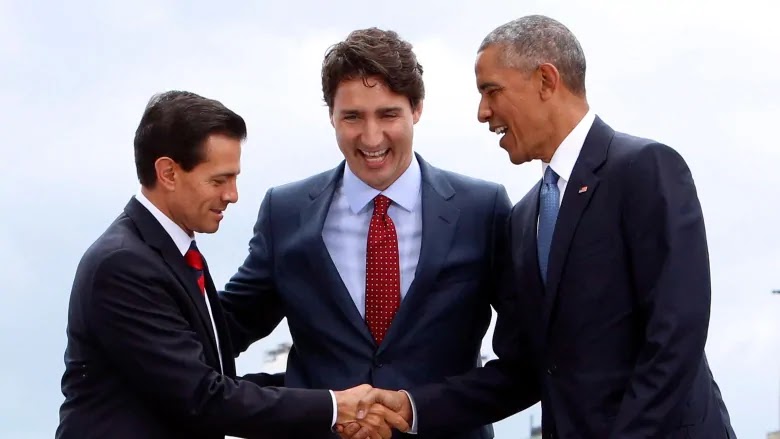
The days of The Three Amigos Summits, Susan Delacourt writes, are gone:

The last one was held in Canada in the summer of 2016. No “Three Amigos” summit has been held since Donald Trump became president later that year. And chances of a reunion seem even more remote today, especially if this week has helped set a new standard in the every-nation-for-itself approach to continental relations.
Trump isn’t just averse to summits, he’s clearly not big on the whole idea of multilateralism. The president didn’t enjoy himself at the G7 Summit in Charlevoix, Quebec last June — to put it mildly — and no matter what else has happened this week, he has turned what should have been multilateral trade negotiations into two bilateral sets of talks.
Sarah Goldfeder, a principal with the Earnscliffe Strategy Group in Ottawa, is a former U.S. diplomat who has worked for two American ambassadors to Canada and also in Mexico as a foreign service officer.
She’s been keeping a close eye on how the North American trade relationship has been evolving and says that things between Canada and Mexico were already somewhat shaky before this week.
Last year’s negotiations over the Trans-Pacific Partnership trade arrangement, for instance, saw some tension between Mexico and Canada when Prime Minister Justin Trudeau didn’t show up at a negotiating session in Vietnam. “When Canada didn’t show up, Mexico kind of had to cover,” Goldfeder said. Nor has Canada appreciated the depth or complexity of Mexico’s economic ties to the U.S., she said. “These are all strains on the relationship.”

Trump's "off the record" remarks about Canada yesterday didn't help:

Canadian officials, speaking off the record, insist that negotiations with the United States ended Friday on a good note, despite the comments from Trump, and that no one in Trudeau’s government is interested in picking a fight with Mexico over how everything unfolded this week.
But even if Trump doesn’t end up getting everything that the U.S. wants in whatever new trade deal is reached, he has succeeded in making Canada and Mexico fall into his isolationist, anti-multilateral way of looking at trade relations.

As Peter Wehner wrote in The New York Times last week, "Everyone and everything he touches rots."

Image: CBC

Friday, August 31, 2018

Not A Good Day


Yesterday was not a good day for the Trudeau government. The Federal Court of Appeal shut down the Trans Mountain Pipeline Project. And word out of Washington is that the Trumpian Trade Talks are souring. On the subject of Trans Mountain, Tim Harper writes:

In a stunning confluence of events, the court overturned the National Energy Board and cabinet approval of the Trudeau pipeline expansion on the same day that shareholders with Kinder Morgan, no doubt with huge grins on their face, washed their hands of the project and gave it — lock, stock and legal headache — to the prime minister and Canadian taxpayers.
Even if it only delays the project, the court decision will mean a bigger price tag for the taxpayer, and raise another red flag to foreign investors looking at Canada as a place to do business.
[Rachel] Notley remains landlocked, and that figure in her rearview mirror is the anti-carbon-tax Jason Kenney.
It also must pain a government that has hung so much of its credibility on Indigenous reconciliation to be told by a court that its consultation with Indigenous communities concerned about this expansion amounted to little more than note-taking.
“The government of Canada was required to engage in a considered, meaningful two-way dialogue,’’ the court said in its decision. “However, for the most part, Canada’s representatives limited their mandate to listening to and recording the concerns of the Indigenous applicants and then transmitting those concerns to the decision-makers.”

Trudeau's rhetoric has met the road. In fairness, Canadian Federalism has several moving parts, and getting them to all move in the same direction is no mean feat.

Besides Trans Mountain, Trudeau has been trying to do business with the Orange Ignoramus south of the border, who former Canadian trade negotiator Gordon Ritchie has called "an appallingly ignorant man."

Trudeau and Chrystia Freeland may leave Washington without a deal. And without a pipeline, Justin will face a storm of criticism -- from all sides.

Image: DADCAMP

Thursday, August 30, 2018

Under The Banner Of Populism


Doug Ford claims he's a populist. But, Linda McQuaig writes, he spouting hogwash:

While the word “populist” is bandied about to describe plain-talkin’, right-wing politicians, that description tarnishes the reputation of real 19th-century populists in the U.S. (and Canada) who actually championed the interests of ordinary folk over the wealthy elite. Pressure from populist ranks helped put in place the U.S. income tax in 1913, as a way to tax the rich.
Doug Ford is no more a populist than my grandmother was a stage-coach. Like Donald Trump, Ford got his start by inheriting wealth, and his policies favour the rich, not the poor.

In fact, Ford is walking in the footsteps of his predecessor, Mike Harris -- who waged class warfare:

The new premier has already signalled he’s gearing up to revive the nasty class war against the poor waged by former Conservative premier Mike Harris.
What makes this revival particularly insidious is that Ford didn’t campaign on it; he refused to reveal where he’d wield the knife to produce $6 billion in spending cuts, and specifically denied he would end the Basic Income Pilot Project.
But one of his first acts was to cut off that pilot project, ignoring promises of extra income that had been made to 4,000 poor people, many of whom went back to school excited by the dream of improving their difficult lives.
Another clear signal of the Ford government’s class-war intentions was its decision last month to cut in half the scheduled increase in benefits for social assistance recipients, including those with disabilities.

The people who are in Ford's sites are an army of a million poor people. But they are voiceless and powerless:

Their powerlessness is illustrated by the fact that, after Mike Harris slashed their benefits by a whopping 21.6 per cent in 1995, they never managed to recover. Twenty-three years later, their benefits are actually slightly lower today, having been whittled away further through inflation.
Just before the June election, the Liberals pledged to increase those welfare benefits by 3 per cent, which would have raised them roughly to the level where Harris had left them.
But Ford quickly jumped in, quashing any budding hopes among the deprived that there might be a tiny bit of progress — for the first time in 23 years! Instead, the Ford government cut the planned increase from 3 to 1.5 per cent, thereby snatching $150 million from the poorest citizens in the province — and then having the impudence to call its action “compassionate.”
This is likely just a foretaste of the assault on the poor that’s coming. The Ford administration is conducting a 100-day review of social assistance, which will probably lead, among other things, to a clampdown on welfare fraud, even though the province could collect far more revenue by clamping down on the tax fraud routinely committed by lawyers and businesspeople deducting sports tickets as “business entertainment.”

Ford's brother Rob used to show up drunk at Leafs games, make an ass of himself, and claim he was never there. It's clear Doug has as much acquaintance with the truth as his dead brother.

Things are going to get rough -- under the banner of populism.

Image: CBC


Wednesday, August 29, 2018

Actions And Rhetoric


Donald Trump has given Canada an ultimatum: Sign the new trade deal by Friday, or you're out in the cold. Tom Walkom writes:

Canada has been had. The Mexicans and Americans have agreed behind Canada’s back to cut a bilateral deal that would replace the North American Free Trade Agreement.
Justin Trudeau’s Liberal government has been told it can join in, but only if it capitulates to all of Donald Trump’s demands.

Some of what's in the new deal is good for Canada:

Not everything in the Mexico-U.S. deal would be bad for Canada. Indeed, some parts would be positive.
The original NAFTA allowed companies, particularly big auto manufacturers, to relocate their operations from Canada and the U.S. to low-wage Mexico.
To his credit, Trump recognized that this was a job killer for his country. The new Mexico-U.S. deal specifies that at least 40 to 45 per cent of automotive content must come from factories where workers make at least $16 (U.S.) per hour.
The new pact would also tighten so-called rules of origin to ensure that at least 75 per cent of the content in autos sold duty-free under the deal comes from a country that is signatory to the agreement.
That too would benefit Canadian auto workers if Ottawa signed on.
As well, Mexico agreed to another useful Trump demand — the weakening of a NAFTA provision allowing foreign investors to overturn government laws and regulations that interfere with their profitability.
This so-called Chapter 11 provision has been used mainly against Canada. Yet for reasons that it has never fully explained, Ottawa resisted Trump’s efforts to eliminate it.
The Mexico-U.S. deal doesn’t get rid of Chapter 11. But it would limit its scope to firms operating in specific areas such as energy.

But there are some big poison pills:

In particular, the agreement reached by the Mexicans and Americans appears not to include an independent dispute-resolution system for sorting out trade conflicts among the signatories.
Canada has long insisted that this is a must. NAFTA’s precursor, the original 1989 Canada-U.S. Free Trade Agreement, was almost scuppered by Ottawa over U.S. resistance to this demand.
The Mexico-U.S. deal also includes a so-called sunset clause, a date by which the agreement, unless specifically extended, will automatically expire. According to Trudeau, that too is an absolute no-no for Canada.
True, the time frame has been extended from the original American proposal of five years to 16. But the essential problem with the sunset clause — that placing an arbitrary deadline on a trade deal leads to investment uncertainty — remains.

So it's crunch time. Five of Trump's associates have either pled guilty or been found guilty of crimes. There will be more convictions. It's clear that doing business with Trump is bad business.

Justin has proclaimed that Canada will not be pushed around. Will his actions match his rhetoric?

Image: The Cut


Tuesday, August 28, 2018

No One Should Believe Him


Yesterday, Donald Trump announced that he had reached a trade deal with Mexico. Like so much that comes from Trump's mouth these days, that simply wasn't true. Lawrence Herman writes:

Telling the Mexican President that the United States might want to pursue a separate trade deal with them seems to have taken the Mexicans aback, Mexico never contemplating having to go up alone against the United States. It’s clear by now that Mr. Trump and his team don’t like dealing with Canada. That’s reflected in Canada being sidelined for weeks while the other two governments held high-level meetings behind closed doors – a disgracefully bad-faith tactic on the part of the Americans. Regardless of claims that the auto issues in the North American free-trade agreement were exclusively a U.S.-Mexico concern, Canadian companies have invested heavily in Mexican operations, and Canada had every right to be at the table while the other two governments hammered things out.

Trump wants to name his "achievement" the U.S.- Mexican Trade Deal. But NAFTA is still in effect:

As to talk of a fully revised NAFTA being concluded in the next few weeks, there seems little possibility of that. At last count, 10 of the 30 chapters of this enormously complex agreement, containing some of the most contentious issues, remain unresolved.
Added to these timing difficulties is that U.S. law requires the President to give Congress 90 days advance notice of his intention to sign the agreement, meaning a final treaty, not just an understanding or statement of principles. And after being signed by the President, Congress has a further 90 sitting days to consider it. It can be approved or rejected during that period.
With U.S. mid-term elections in November, it’s impossible for the current Congress, even under the so-called lame-duck period before year-end, to be presented with a new NAFTA and to examine it within 90 sitting days as mandated by statute.

In his telephone call, Mexican president Enrique Pena Nieto kept repeating the mantra "NAFTA," making it clear that he was involved in a three way negotiation. But Trump lives in his own world. He thinks he has a bilateral trade deal with Mexico. In reality, all he has is a shiny object which he can use after the legal pommelling he took last week, and after he was upstaged by John McCain's death.

One only needs to remember that Trump claims to have reached an agreement with Kim Jong Un to get rid of North Korea's nuclear weapons. But North Korea doesn't see things that way.

Will there be a deal? Who knows? But when Trump says he's negotiated such a deal, no one should believe him.

Image: The Independent