Showing posts with label The Federal Election 2019. Show all posts

Saturday, October 26, 2019

Whither The Conservative Party?


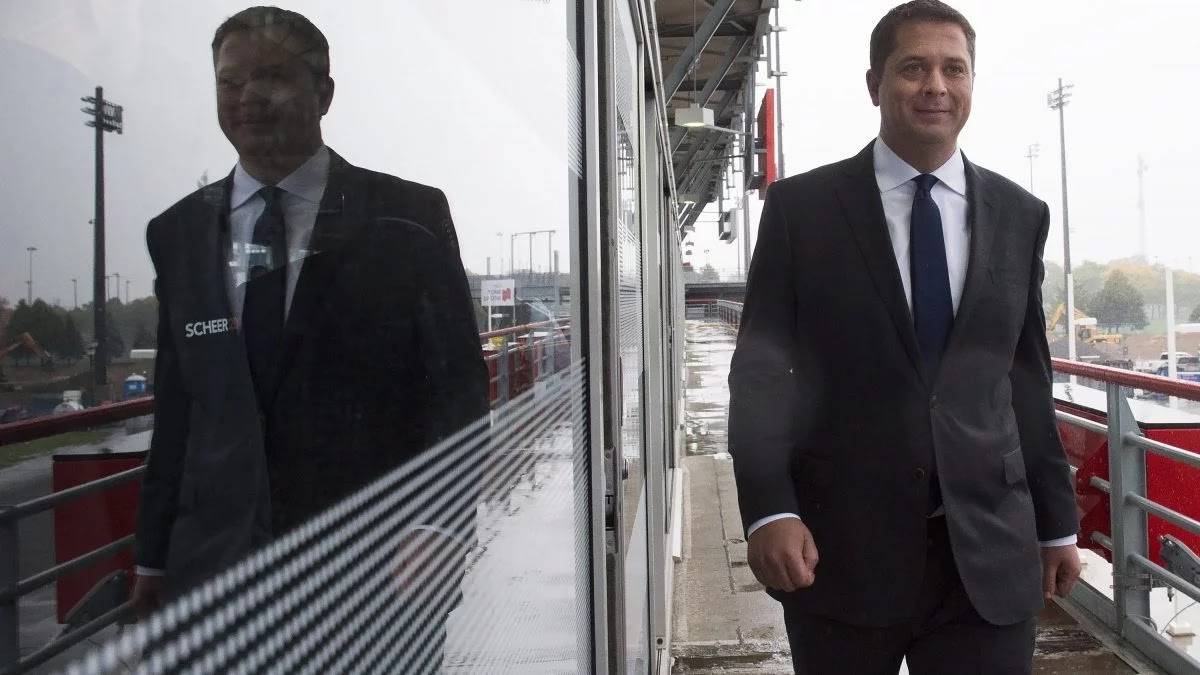
Since Monday's election, Andrew Scheer's continued leadership of the Conservative Party has become an open question. Chantal Hebert writes:

Since election night, Scheer has tried to cast the result as a first step back to federal power for the Conservatives. To listen to him, an electoral rematch would be too imminent for his party to consider a leadership change.
But he is really clutching at straws in the hope of consolidating a potentially untenable leadership position.
Scheer’s days as leader may be numbered, but a change at the top will not alone fix the Conservatives’ post-election woes.

It is the Conservative Party itself that is in trouble -- mainly because it has been enthralled by William F. Buckley's definition of a conservative as  someone who "stands athwart history yelling stop." That definition is driving politics in Alberta and Saskatchewan. Jason Kenny and Scott Moe believe they are in a life and death struggle. But each man refuses to recognize an inconvenient truth. Energy no longer has to come from out of the ground. And they refuse to recognize the multi-party consensus that has developed in the rest of Canada:

On Scheer’s watch, the Conservatives have deliberately broken away from what has evolved into a multi-party consensus.
The party’s base in the Prairies has come to equate the drive to more seriously address climate change with an existential threat to their region’s aspirations.
Scheer and his provincial allies have fostered that perception every step of the way. That stands to come back to bite the federal party.
If the Conservatives are to expand their narrow base, they will have to find a way back to the climate change mainstream.

Scheer said that his first act as prime minister would have been to scrap the carbon tax. It was simply the wrong message. And the majority of Canadians didn't buy it. Doug Ford says he will continue to fight the carbon tax in court. He still hasn't figured out why he's booed at public events. And Scheer hasn't figured out why he lost the election.

Image: CTV News


Thursday, October 24, 2019

The Ford Factor


Some pundits -- including Bob Rae -- are suggesting that Andrew Scheer's decision to keep Doug Ford under wraps during the election was a mistake. Bob Hepburn writes:

In Scheer’s case, he appears delusional about how he fared in Ontario, telling reporters on Tuesday that “we made significant gains throughout the GTA and throughout Ontario.”
In fact, the Tories didn’t win a single seat in Toronto, failed to increase their seat total in the 905 area, saw the Liberals’ seat total in Ontario drop by just one to 79, and witnessed the percentage of votes the Tories won slip to 33.2 per cent from 35 per cent in the 2015 election.
How can Scheer believe all that negative news constitutes “significant gains?”
In reality, the Conservatives lost the election because they failed to increase their number of seats in vote-rich urban areas of Ontario, the key battleground where the progressive voters that Scheer needed to attract were fed up with Ford. Ontario was the only English Canada province where the Tories’ vote percentage actually dropped.

The simple fact is that many Ontarians didn't vote for Scheer because Doug Ford had persuaded them not to:

Polls clearly showed most Ontario voters took Ford into consideration when deciding which party to support. An exit poll conducted for Global News indicated more than half those polled said Ford “had at least some impact on their vote.”
Also, Vote Compass, a civic engagement app distributed through the CBC, showed 51 per cent of some 24,000 who took part said they were much less likely to vote for Scheer because of Ford’s policies.
In addition, Conservative candidates knocking on doors across the province spoke candidly about encountering countless voters with a visceral hate for Ford, who told them that because of Ford there was no way they would vote Tory.
Scheer hurt his own cause by running a campaign dramatically out of touch with where most Ontario residents are these days, especially on issues such as climate change. But he would have hurt it much worse if he had bowed to siren calls to set Ford free.

There's a clear message in Scheer's failure to win power. It's a mistake to take the road Doug Ford has taken.

Image: SlidePlayer


Wednesday, October 23, 2019

Their Alternate Facts


Tom Walkom writes that voters punished all the parties in this election. But that reality hasn't set in yet. All of the leaders seem to be living in an alternate reality:

Conservative Leader Andrew Scheer treated the Liberal minority win as if it had never happened.
He made no mention of the fact that his party had failed to oust Prime Minister Justin Trudeau’s government. Instead, he treated the election as a way station on the road to an inevitable Conservative victory sometime in the future.
There was no talk from Scheer on how to make a minority parliament work. Rather, he suggested that any attempt to do so would be somehow illegitimate, noting that his party won marginally more of the popular vote than the victorious Liberals.
Referring to his Conservatives as the government in waiting, he said that his work would not be over until he demolished the Trudeau regime.

Justin Trudeau sounded like a man who had won a majority:

The prime minister made no explicit reference to the fact that Canadians had deprived him of his parliamentary majority. Instead, he insisted that voters had given him a mandate to continue governing as he had before.
His only concession to the reality of his new situation came in two brief references. He told Quebecers who had switched their votes from the Liberals to the Bloc Québécois that he had heard their message. He said to voters in Alberta and Saskatchewan, who on Monday booted the few would-be Liberal MPs still extant in those provinces, that he understood their frustration.
Like Scheer, he seemed to treat Monday’s election results as a minor interruption. He said he will continue doing what he has done — although he did note that it is always possible to do better.

And, even though Jagmeet Singh ended the night with far fewer seats than he had at the beginning of the campaign, he sounded triumphant:

An excited Singh treated the election as a huge victory for the NDP. In fact, the party suffered devastating results. It was wiped out in Saskatchewan and almost wiped out in Quebec.
It won no seats in Toronto or the so-called 905 suburban belt around the city. In Ontario, it went from eight seats at dissolution to six. Nationally, its seat total went from 39 to 24.

There was lots of hubris in the air -- and hardly any humility. A minority parliament will only work if leaders begin with a realistic assessment of their situation. It appears that each leader has his own set of alternate facts.

Image: Chilliwack Progress

Tuesday, October 22, 2019

You Can't Hold Back The Future


So here we are. I had a hunch things would end like this. In fact, that was the bet my wife and I made. I realize that many readers here will be angry when I write that we both voted Liberal. But we thought very carefully before we cast our ballots. We would have preferred to vote Green. But everything came down to the riding we live in.

The poet Al Purdy wrote that our neck of the woods has been "Conservative since the Stone Age." John A. Macdonald used to practise law in our town. This is very blue country. In the nearly thirty-five years that we've lived here, we've only elected Liberals four times -- twice under Jean Chretien, and twice -- including last night -- under Justin Trudeau.

Unfortunately, the Green Party was barely on the radar here. The NDP has a presence, but the party has always had far from the kind of support it needs to carry the riding.

Finally, as angry as I was about Trudeau's failure to deliver electoral reform, the stark fact was that we were voting under the same old rules.

We bet on a Liberal minority and that's what we got. On climate change, will last night's decision be enough, soon enough? Probably not. But we are being overtaken by events. That became clear to me this spring when I saw the flooding around the western and northern shores of Montreal -- places I know well.

And events have a way of forcing your hand. Perhaps the NDP and the people in the streets will force Justin's hand.

Who knows? All I know for sure is that you can't hold back the future. One last thought: Both Ralph Goodale and Lisa Raitt showed true graciousness last night. We desperately need more of that.

Image: Global News


Monday, October 21, 2019

Making A Minority Work


It looks like it will be a minority government. And there are a couple of ominous signs in the wind. The first is the divide shaping up on the Ontario-Manitoba border -- Conservatives to the west, Progressives to the east. Perhaps the conservative dominance of the west will end at the B.C. border. The other troubling sign is the resurrection of Quebec nationalism, which -- let's be frank -- never goes away. But, Robin Sears looks to history to prove that minority governments can work:

When Robert Stanfield and Pierre Trudeau went to bed on Oct. 30, 1972 neither knew who had a future as prime minister. In those days, B.C. polls stayed open until 11 p.m. Ottawa time and there were too many seats too close to give a final count. It was also the first election in which 18 to 21-year-olds were allowed to vote, two million of them.
The happiest man that night was David Lewis, the veteran NDP leader, whose “corporate welfare bums” campaign had ignited the party and many voters. The NDP elected the largest caucus in its brief history with 31 MPs — and the balance of power. The Creditistes, the Bloc Québécois of its day, came back with the same 15 seats.
The minority government pact Lewis worked out with Trudeau — and it was very much a personal project between them — with only a few other MPs and staffers invited to offer a view, was a success. It led to the creation of Petro Canada, restrictions on price rises at a time of raging inflation, and Canada’s first election expenses legislation among many other legislative changes. Allan MacEachen, the Liberal sage of Cape Breton, and Stanley Knowles, the pension champion of many a parliament, were the two back-channel leaders who kept the often tense partnership afloat for almost two years.

It was "a more civil time." Things are a lot uglier than they were. But there are three principles which underlie a successful minority government:

The first is that both an agenda and a time frame are essential. The legislative content needs to be agreed up front, and so does the delivery date — to fail to do so makes freelancing and backsliding inevitable.
Second, the project list must be short. A lengthy shopping list lets the bigger party do the easy bits first, and leave the harder important ones too late. The items need to offer some benefit to each partner, and they must matter to Canadians.
Finally, there needs to be a backroom process for managing the relationship, chaired by party elders with a small number of elected and staff members from each side. No partisan bomb throwers permitted. It was Ontario’s great statesman, Robert Nixon, who played that role in the Peterson/Rae accord. The bellowing was done over wine-soaked nights, not in front of reporters.
If voters declare they want a minority government, the party leaders had better be able to point a path to a stable government of at least two partisan flavours by the end of next week.

We'll have a better idea of what the future holds tomorrow morning.

Image: CBC Archives


Sunday, October 20, 2019

Caveat Emptor


Throughout the election campaign, Justin Trudeau has been linking Andrew Scheer to Doug Ford. Scheer's response has been to keep Ford under wraps. But Trudeau's comparison isn't frivolous. When it comes to policy, Bob Hepburn writes, Ford and Scheer are twins:

First, they both want to kill the federal carbon tax and replace it with incentives, and in some cases fines, for polluters to clean up their dirty emissions. Ford is fighting the carbon tax in the courts and has ordered anti-tax stickers on all gas pumps. Scheer has vowed to repeal the tax and instead invest in more green technology.
Second, they both propose massive reductions in government spending — and all the time trying to insist that cuts worth billions of dollars won’t actually hurt anyone. Scheer plans to cut $18 billion from much-needed infrastructure spending, slash foreign aid by 25 per cent, cancel government help for struggling businesses, freeze government hiring and cut unspecified “nonpersonnel operating expenses.”
In his first months in office, Ford took a similar approach, slashing everything from student aid to child-care funding, legal aid and tree planting.
Third, they both oppose a national pharmacare plan. Scheer believes a better way to ensure Canadians have access to necessary drugs is to plug coverage gap for people without provincial or employer plans. Ford has already killed a provincial plan that provided free prescriptions drugs to young Ontario residents up to the age of 24.
Fourth, they both aren’t keen on raising the minimum wage to $15 an hour. Ford has already cancelled a planned hike in Ontario and Scheer prefers tax breaks for lower-paid workers.
Fifth, they both oppose a national ban on handguns, suggesting a better way to fight gun violence is to get tough on gangs with stiffer jail sentences for convicted criminals in gun-related cases.
Sixth, they both love oil pipelines. Scheer has pledged to revive the Energy East pipeline proposal, which would carry oil from western Canada to eastern Canada. Ford has publicly declared support for pipeline projects, including Energy East.
Seventh, they both want to crack down on irregular border crossers and enforce a more vigilant immigration policy. Scheer wants to hire more border guards, close “legal loopholes” dealing with refugees and focus on suspected organized crime members, although there’s little evidence that’s a problem. Ford has attacked “illegal border crossers,” slashed government funding on legal support for refugees and has suggested Ontario has to “take care of our own” before pushing for immigrants to move there.
At the same time, the ties between the pair go even deeper. For example, both relied heavily on evangelicals and anti-abortion groups in winning their respective leadership races.

Those of us in Ontario know what's on Scheer's menu.

Caveat emptor.

Image: The Toronto Star

Saturday, October 19, 2019

They're Having A Hard Time


The outcome of the election is uncertain. But one thing is certain. Like the Phoenix, the Bloc Quebecois has risen from its ashes. Alan Freeman writes:

From holding caucus meetings in a large phone booth not long ago, the party is now nipping at the heels of the Liberals in public opinion polls and could even end up with more seats in Quebec than the Liberals in Monday’s election.
Credit is given to the strong performance on the hustings by Yves-François Blanchet, a previously relatively obscure cabinet minister in the government of Parti Québécois premier Pauline Marois, who long had a reputation within the party as “a goon” for his aggressive demeanour.

But the story goes well beyond Blanchet. With his gruff exterior and blunt delivery, Blanchet has been hitting themes which go all the way back to the Quiet Revolution:

Blanchet, who remains an unrepentant separatist, is going back to a mantra familiar to Quebec nationalist politicians for decades. Ottawa is good for two things. Cash and jurisdiction. If the federal government can’t pony up more money for equalization or Bombardier or whatever, then at least give us the jurisdiction. And then throw in the cash as well.
By the way, jurisdiction always trumps policy for Quebec nationalists. Quebec would rather have no pharmacare than pharmacare with a maple leaf. Quebec Premier François Legault claims that the province’s carbon credit policy makes it green but you’ll notice that Quebec recently joined the court challenge against federal carbon levies led by Alberta and Ontario. “We want to protect provincial jurisdiction to fight climate change,” he said.
If the challenge is successful, a national carbon levy would die and GHG emissions would grow across the country but Legault doesn’t care because what’s more important to him is autonomy for Quebec, not saving the planet. Expect more of the same from the Bloc.

Over the years, the federal government has worked out a detente with la belle province. It has not always been easy. Justin Trudeau's intervention in the SNC Lavalin saga was another attempt at detente. That didn't work out so well.

And immigration and pipelines have become flash points in the dance between Ottawa and Quebec City:

If you watched the debates, Blanchet kept on talking about Quebec’s jurisdiction over immigration. Not once did any of the federal leaders explain that Quebec may have a role to play but it’s a junior role, that immigration and citizenship are primarily the purview of the federal government and that we can’t have two citizenships within a single country. And it’s nice to make all sorts of demands on newcomers but if they don’t like it in Quebec, they have the right to move where they wish in Canada.
The same with pipelines and the environment. It’s as if federal leaders are embarrassed to tell Quebecers that the federal government has important responsibilities to protect the nation’s waterways and shorelines and to make sure that there’s unfettered interprovincial trade, while balancing local and regional concerns.

Pierre Trudeau knew when to tell Quebecers what they could have and what they couldn't have. Today's leaders have a hard time doing that.

Image: Montreal Gazette


Wednesday, October 16, 2019

Losing Their Grip


The pollsters are saying that this election is too close to call. But Michael Harris writes that the pollsters have a sullied record of prediction:

I’m here to argue that the pollsters aren’t reading the chessboard very well. There is no way for Scheer and the Conservatives to win this election, if winning means governing. Barring an asteroid hitting the Liberal campaign, the winner of the election will be Trudeau. There is my limb, and now I will climb out on it for the explanation.

Harris goes on to explain why he believes Andrew Scheer and the Conservatives will not be able to govern this country. They simply don't know how to play well with others:

So, here’s why Scheer can’t triumph in this election. Even if the Conservatives were to win the most seats, Scheer will still require a partner in order to govern. And that is the problem. There are no partners, especially in the long term, for the Conservatives.
Scheer will lead Vancouver’s Gay Pride Parade in leopard skin tights before either the Liberals or the NDP agree to sustain a Conservative minority government.
Both Trudeau and Singh have signalled that they are willing to work together, but not with a PM who is a de facto climate-change denier.
Singh has gone even further, declaring that he will not support Scheer under any circumstances because of the “values” abyss between the NDP and the Conservatives.
Reviving moribund pipelines like Northern Gateway, as well as espousing new ones like Energy East, as Scheer has done, means that the Conservatives will still have a lock on the world’s Fossil Award. With Greta Thunberg casting a long shadow over this election, neither the Liberals nor NDP will touch the Conservative climate position with a barge pole.
So who is left to get a potential Scheer minority government through its first Throne Speech?
Although Elizabeth May initially said she would try to work with any party, the Greens would be a dreadful philosophical fit with the Conservatives. Besides, May killed any possible collaboration with the Conservatives when she declared that her party would not support anyone who stood for more pipelines. That would be Scheer.
Even if the Greens were to support the Conservatives in exchange for Scheer committing to a better climate policy, pollsters tell us that the party won’t have enough seats to sustain a government. The current projection for the Greens after Oct. 21 sits at four seats.
That leaves just one political party that will have the numbers to potentially allow a minority Conservative government to survive; the Bloc Québécois. How likely is that?
For the Bloc, there is only one interest to consider, that of Quebec. Scheer has already offered new goodies to Quebec, like his pledge to allow a single form tax return overseen by the provincial government. In order to govern in a minority situation, Scheer might be tempted to offer even more.
From the Bloc’s perspective, even though it is ideologically left on the political spectrum, the party might be able to land a few prize concessions from the Conservatives in return for propping up Scheer. They have nothing to lose in trying.
But from Scheer’s point of view, it would be quicker to down a goblet of hemlock than to embrace Monsieur Blanchet.
How would the West, the Mecca of conservatism in Canada, feel about dishing out more special rights to Quebec?

So you see the problem. Scheer and the Conservatives start from the proposition that they must deal with the world of their dreams -- not the world as it is. That principle -- if you can call it that -- has left the party as a refuge for those who can't deal with the world as it is.

Any successful political party must have a firm grip on reality The Conservatives have lost their grip.

Image: Thinwah


Monday, October 14, 2019

Trudeau's Vest


Justin Trudeau is now wearing a bulletproof vest. Susan Delacourt writes that there has always been a nasty side to Canadian politics. But something has changed:

No prime minister, in recent memory at least, has experienced such a drastic, public mood swing between elections. All successful leaders accumulate some baggage between their first election and their next try at re-election, but the backlash against Trudeau in this campaign seems particularly vicious.
What makes it even more curious is that the nastiest attacks are focused on who Trudeau was before he became prime minister — almost as if his opponents have stored up material that failed to work in 2015, when all of the “not ready” ads and ridicule against the Liberal leader bounced off a seemingly bulletproof public image.

Trudeau isn't the first prime minister to have ugly rumours circulated about him:

To be clear: ugly rumours circulated about Stephen Harper and his personal life all the time he was prime minister too — Ottawa reporters were repeatedly peppered with “tips” about the alleged breakup of the Harper marriage (which still endures, by the way.) Brian Mulroney, in his late, unpopular years in office, was alleged to be drinking on the job (also very untrue.)

What Delacourt is referring to is what happened after last week's French language debate:

Representatives of right-wing publications lined up first at the media microphones to grill Trudeau about ugly slurs circulating with regard to his personal past as a teacher in B.C. There’s no need to dignify the slurs by spelling them out again here; the Star’s Marco Oved did a thorough forensic analysis last week of the manufactured smear campaign, which nonetheless lived on at the postdebate scrums.

This isn't who we are or who we have been. Politics  -- in the Age of Trump -- has become malevolent. But there is no reason for us to join the March To Oblivion.

Image: Quote HD


Sunday, October 13, 2019

The Platforms


I enjoy reading the analysis of Scott Clark and Peter Devries.  From the standpoint of economics, they're not happy with any of the party platforms. They've given the Liberals a "bare pass." The NDP also got a bare pass; and the Green Party got an F. They give the Conservatives a C. But it's a shaky C -- because it recycles so many failed Conservative policies:

Mr. Scheer finally released the Conservative platform on Friday afternoon. On the front cover, there should have been pictures of Stephen Harper, Doug Ford, and Jason Kenney. What Mr. Sheer and these three gentlemen have in common is that they hate deficits, no matter what their cause.
Mr. Scheer is promising to eliminate the deficit by cutting government programs and services without providing much in the way of details. Doug Ford and Jason Kenney did the same thing.  In their election platforms, they also proposed to cut government spending but didn’t indicate how these cuts would be achieved. Residents of Ontario found out the “ bad news” after the election. Residents of Alberta will find out the “bad news” in the province’s upcoming budget scheduled for later this month.

Not only does Scheer want to get to a balanced budget -- something all politicians claim as a goal -- he wants to introduce balanced budget legislation. But emergencies happen -- remember 2008? -- and it's not wise to face them with your hands tied.

What runs throughout Scheer's document is the phrase "tax cuts." Clark and Devries write:

This is not the first time a government has tried an across the board cut in operating costs. They weren’t successful before and probably won’t be successful now. They are very difficult to implement because spending on government operations is very complex. The only time a cut in government operations was successful was under Paul Martin in his 1995 budget. This required an intensive “program review” of spending in every government department. This was required because at that time the federal government was facing a fiscal crisis. There is no fiscal crisis today that would warrant this.
Several of the proposed tax reductions are recycled from the Harper era but were eliminated by the Liberals.  These include the Green Public Transit Tax Credit, the Children’s Fitness Tax Credit, and the Children’s Arts and Learning Tax Credit.  They were eliminated as studies showed that they failed to meet their stated objectives.
These are non-refundable tax credits and only benefit those who have taxable income.  This excludes many low-income Canadians.  In addition, the aggregate benefit is reduced by the lowest tax rate.  Mr. Scheer claims the Fitness Credit will be increased by $1,000. However, as a non-refundable tax benefit, its value is only $137.50, once the lowest tax rate of 13.75% is applied. Anyone who has a child in organized sports quickly realizes that this tax credit is of little benefit.
The Age Tax Credit is also a non-refundable tax credit, which means low-come seniors will receive no benefit from this credit, if they are non- taxable. The proposed reduction in the lowest tax also reduces the value of all non-refundable tax credits, which will now be valued at 13.75% rather than 15%. Mr. Scheer has been misleading Canadians.
The Conservative Platform lacks transparency and credibility and the cover should be stamped “not as advertised”. Even strict fiscal Conservatives should feel let down.

Something to think about when you go to the polls.

Image: SlideShare

Saturday, October 12, 2019

A Minority -- But For Whom?


Chantal Hebert writes that a minority government looks more and more likely -- largely because of the resurgence of the Bloc Quebecois:

From a Quebec perspective, the argument that the Bloc is not a valid option because it will not have a seat at the government table is little more than a variation on the contention that a vote for the Greens or the New Democrats is — for the same reason — a wasted one.
The Conservatives went into the campaign looking to gain ground in Quebec. They may have to consider themselves lucky if they manage to keep the dozen seats Scheer inherited from Stephen Harper.
At this point, Quebec is more likely to split the bulk of its support between the Liberals and the BQ than to divide it four or five ways.
With Canada’s second-largest province potentially poised to take as many as half of its seats out of the battle for government, the victor on Oct. 21 stands to be determined by the outcome of scores of closely fought battles in the rest of the country.

And, in the rest of the country, Jagmeet Singh is a wild card:

That being said, it would be risky to overstate the NDP’s potential to split the so-called progressive vote in favour of the Conservatives.
In Ontario, for instance, a Léger poll done after Monday’s English-language debate showed NDP support hovering at or around its 2015 election mark.

So, at the moment, it's hard to see either the Liberals or the Conservatives gaining a majority of the seats.

Where does that leave the Greens? Stay tuned.

Image: cbc.ca

Friday, October 11, 2019

A Political Pickle


Susan Delacourt writes that a majority government for either the Liberals or the Conservatives could deepen fissures in this country:

Start with a Liberal majority win, which is far from the certainty it once seemed when Justin Trudeau was still basking in his 2015 victory. Remember when everyone was wondering when the Trudeau honeymoon would ever end?
It will be a huge relief for the Liberals if Trudeau does pull off a re-election majority. But after a polarizing campaign, much of which turned on Trudeau’s personal record, the celebration won’t be countrywide, to say the least.

Jason Kenney is leading the charge against Trudeau:

The re-election of Justin Trudeau would be absolutely devastating to my province,” Alberta Premier Jason Kenney warned last weekend during a tour through Ontario. “This is, for us, almost existential that we have a change in the federal government.”

Trudeau bought a pipeline. But it bought him nothing in Alberta. And should Andrew Scheer win a majority, it would set off loud protests on the left:

What if Scheer wins a majority, though? Again, the celebration would not be universal.
It would be a government with no natural allies in Parliament — not that it would need them to get legislation through. But with four leftish-leaning parties on the outside of government, the cacophony of outrage from the opposition — not to mention environmental and social activists, as well as many Indigenous communities — will make Monday’s night’s leaders’ debate sound like an easy-listening radio station.
Moreover, if Liberals are knocked back into opposition, could Trudeau survive? Would he even want the job of opposition leader? The party hasn’t been kind to its non-winners in the past couple of decades. In fact, John Turner is the last Liberal leader who was allowed to stay on after losing an election and that was in the 1980s. Every other losing Liberal leader since then — Paul Martin, Stéphane Dion, Michael Ignatieff — exited immediately after their defeat.

The only leader whose prospects seem to have improved is Jagmeet Singh:

At the moment, the New Democrats are looking like the only party that may escape turmoil after Oct. 21, mainly because of the kind of campaign that Leader Jagmeet Singh has run. Starting from low expectations, Singh has breathed some life into the party and enhanced his image with his debate performances.

And, if there is a minority government, it's still hard to predict which party would hold the balance of power. That's a political pickle.

Image: avclub.com


Saturday, October 05, 2019

Scheer And The Environment


When you look at Andrew Scheer's plans for the environment, Stephen Maher writes, there's not much there. Consider what happened during this week's French language debate:

Moderator Pierre Bruneau asked Conservative Leader Andrew Scheer if he would cut a federal subsidy for electric vehicles as Doug Ford cut a provincial program when he took power in Ontario.
“We have assured Canadians that we will continue this program until the end of the schedule,” Scheer said. “But we must recognize another fact. The most popular vehicle in Quebec is the F-150. Quebecers are going to continue to buy gas. And I prefer, I have made my choice. I prefer our own gas to gas from the United States. It doesn’t make sense for money from Quebec to leave Canada for the economy of Donald Trump when we have reserves.”

But it really doesn't matter where the gasoline comes from. Gasoline is the problem. More important was Scheer's pivot from electric vehicles. Say what you will about the Liberals, they do have a plan to encourage electric transportation:

The 2019 Liberal budget, which included a $5,000 subsidy for every electric vehicle. Scheer’s plan says nothing about electric vehicles except for some happy talk about improving charging technology. [Moreover, they propose to] promote electric vehicles, including $130 million on a program to build charging stations, partly to fill in the gaps on the highway system so electric cars are more practical for long trips. 

It's not a pipe dream. Consider what's happening in Norway:

In civilized Norway, plug-in electric vehicles have already overtaken gas burners. To encourage rapid uptake, Norway has offered electric motorists free parking, tax breaks, access to bus lanes and exemptions from road tolls. It is also easy to charge electric vehicles there. There are 7,632 charging stations. In massive Canada, there are only 5,841.

And then consider what happened when the Ford government was elected in Ontario:

The previous Liberal Ontario government offered rebates for electric vehicles and had made changes to the building code that would have required that new homes be built with 200-amp panels, so that it would be cheaper and easier to fit them with electric vehicle charging stations. Home builders objected, complaining that the change would add $500 to the price of each new home, so in May the Ford government quietly removed those requirements from the building code, which means that it will be much more expensive to refit buildings later to install charging stations.
Graham Inglis, who runs a Mississauga company that installs charging stations, says it typically costs $1,500-$2,500 to upgrade electrical service after a home is built, so the changes to the building code don’t make sense. “It’s a short-term solution that might not have the home owner’s long term interest in view,” he said in an interview on Friday. “It might save them a little bit of money now, but in the end they’re going to need a service upgrade.”

Ford’s changes to the building code do nothing to encourage the adoption of cleaner technologies. But Ford went further than that:

The Ford government also killed Ontario’s cap-and-trade system and cancelled contracts for renewable energy, including a nearly finished $100-million wind project in Prince Edward County, at an as-yet-unknown cost.

We live in Prince Edward County. And, at the beginning of the month, the task of taking down the windmills got underway.

There are all kinds of falsehoods being spread in this election. The choice will not be easy. But, when it comes to Andrew Scheer's commitment to the environment, the choice seems pretty clear.

Image: Consumer Reports

Thursday, October 03, 2019

Defeating Scheer By Taking Out Ford


In this election, Justin Trudeau is fighting Andrew Scheer by taking aim at Doug Ford. Martin Regg Cohn writes:

The point is to draw a direct line between an unpopular Ford’s provincial Progressive Conservatives and his federal Conservative counterparts led by Andrew Scheer.
Point. Counterpoint. Counterpart. It’s not hard to connect the dots — and superimpose them over the battle lines that form Ontario’s electoral boundaries.

When the Liberals unveiled their program, it was Ford who was behind it:

Upon winning power, Ford suspended a scheduled $1 increase in the minimum wage to $15 an hour, and imposed a 2-1/2 year freeze until the next inflation adjustment for Ontario’s lowest-paid workers.
By contrast, if he regains power, Trudeau promises to hike the minimum wage to $15 for federally-regulated workers.
Ford’s provincial government has announced widespread cuts to OSAP student loans. Trudeau’s retort?
If re-elected, a federal Liberal government will increase Canada student grants by 40 per cent.
In a miserly attack on postsecondary graduates, Ford rescinded the six-month “grace period” on interest payments for students fresh out of school (and perhaps out of work). His government claimed it wise to “align” Ontario with Ottawa’s existing grace period, ostensibly to “reduce complexity for students.”
Trudeau’s platform goes in the other direction, extending the federal grace period to two years. So will Ford harmonize the interest-free period to once again “reduce complexity for students?”
Ford’s government sidelined Ontario’s anti-racism directorate; Trudeau’s government would double funding for its anti-racism strategy.
Ford cut spending on tree planting in his first budget; Trudeau would budget $3 billion to plant 2 billion trees over the next decade.
Ford reduced child-care funding; Trudeau would boost it.
Ford revoked free prescription drugs for all Ontarians up to age 24 and over 65; Trudeau wants a universal pharmacare program.

So you see what's going on. I honestly don't know how this election will play out. But I'm betting that, should the Conservatives win, they'll praise Andrew Scheer. If they lose, they'll blame Doug Ford.

Image: rabble.ca

Saturday, September 28, 2019

When They're Being Conned


The Conservatives are pitching Andrew Scheer as a Canadian Everyman. Alan Freeman writes:

The Globe and Mail’s fawning profile of Andrew Scheer starts with a bit of a fib. It contrasts the laid-back security approach at Stornoway, the official home of the opposition leader, to the “sprawling and regal” residence of the Prime Minister at 24 Sussex Drive.
The anecdote is to convey the idea, much beloved of Conservative Party spin-masters, that Andrew Scheer is “everyman” compared to the Trudeau princeling who’s the current prime minister.

But these days, Trudeau doesn't live at 24 Sussex Drive. And the idea that Scheer is an everyman is a carefully manufactured myth:

Like all myths, Andrew Scheer as the “Canadian everyman of 2019” is essentially a lie. Ordinary Andrew is a one per center. His salary of $264,400 a year as leader of the opposition puts him into the top one per cent of Canadian tax filers, according to Statistics Canada.
His first real job—aside from brief stints as a waiter, insurance broker and political aide—was a $141,000-a-year job as a 25-year-old MP. He’s lived off the public teat in grand style ever since.
At the age of 32, he became the youngest ever Speaker of the House of Commons and moved into the Farm, the lovely rural residence of the House Speaker in the Gatineau Hills north of the city.
Who else but a one per center with essentially free housing could afford to have a stay-at-home spouse and five children? Not the real “Canadian everyman of 2019,” who’s likely living in a one-bedroom condo in downtown Toronto or Vancouver wondering if and when he and his working spouse can ever afford one child, let alone five. (The average Canadian family now has 1.56 children and there at last report there were only 493,000 families in Canada with a single earner and stay-at-home parent, a third the number in 1976.)
Yet the Conservative Party has the nerve to state that “Andrew knows the joys and challenges of raising a growing family in Canada today.” Really?
To gild the “everyman” lily, Scheer harkens back to his Abe Lincoln log-cabin story, only this time it’s a townhouse in suburban Ottawa, where his family made do without a car. “We had to take the bus everywhere we went.” The horrors. In fact, his parents were solidly middle-class, his father a librarian at The Ottawa Citizen and his mother a nurse.

It's the same kind of balderdash which was behind the notion that Donald Trump was The Master of The Deal.

Canadians should know when they're being conned.

Image: THE CANADIAN PRESS/Nathan Denette

Thursday, September 26, 2019

Be Careful


A year ago, the Conservatives were predicting a juggernaut. Chantal Hebert writes:

Maclean’s December 2018 issue captured the belligerent spirit of the time with a cover picture featuring Ontario, Saskatchewan and Manitoba premiers Doug Ford, Scott Moe and Brian Pallister along with then-would-be Alberta premier Jason Kenney and federal leader Andrew Scheer.
The intention was to put Canada on notice that a Conservative juggernaut was set to crush Trudeau and his climate agenda. The various Conservative leaders were, according to the caption, “spoiling for fight.”

But the times -- and things -- have changed:

At this juncture in the campaign, the Conservative premiers have mostly turned into as many ghosts haunting Scheer’s bid for federal power.
The more they rattle their chains, the more they risk spooking voters into the Liberal fold.
Since the election was called, Scheer spent a lot of time in Ontario but never on a stage with Ford.
A few weeks ago, Saskatchewan’s Moe declared he would not endorse any of the federal parties. The Conservative Party of Canada’s (CPC) war room had reportedly not seen that coming especially since Scheer’s seat is in the province but in the current context it could not have caused it a lot of anguish.

And, in Quebec, it's not the Conservatives who are on the rise. It's the Bloc Quebecois:

The Léger poll found the sovereigntist party in first place among francophone voters — three points ahead of the Liberals and five points ahead of the CPC.
Bloc Leader Yves-François Blanchet has so far run the most efficient Quebec campaign. Premier François Legault — by making demands on immigration and bill 21 that no national party can wholly embrace — has smoothed the Bloc’s path to gains next month.
The prospect that the Bloc could hold the balance of power in a minority Parliament is no longer an abstraction.

Some of us have hoped that the Greens will hold the balance of power. But that balance could turn out much differently than we hoped.

The old adage, "Be careful what you wish for," still holds true.

Image: www.blocquebecois.org

Monday, September 23, 2019

Hell To Pay


Yesterday, Robin Sears warned that, out in the hinterland, there is palpable rage:

My neighbours in northeastern Ontario are quick to vent their rage about all manner of foolish government regulations and about guns, opioids, and their children’s futures. Trudeau pounding on about women, climate and Indigenous Canadians are the angry backyard chat among our friends. They are not racists, but they are deeply angry about two things: no good jobs for their children unless they leave for the city, and being talked down to by smart aleck politicians.
At the gas pump or the mall, they are the picture of polite deferential Canadians. But scratch the surface on “cruelty to farm animals” or cutbacks to their health clinic and they erupt. They are neither conventional conservatives nor narrowly populist. Their irritations are sparked by too much spending on sex education and too little on the “basics;” too much CRA harassment over GST payments while ignoring “the real rich tax cheats:”; and too little spent on roads in rural Canada versus “billions for big city subways.”
There are two troubling connectors in this welter of grievances: first, governments and politicians are all frauds and corrupt — even “Tyrants!” Second, everything is “rigged” against them by “George Soros and Trump’s gang of billionaire friends” and the politicians they control. The range of enemies runs from “the rich guys” to “the politicians they own,” to mainstream media appearing to sneer at their concerns.
The combinations of villains and issues may seem bizarre, but perfectly defensible to people who feel they are now permanently cast as outsiders, and “losers.”
“Why should my son work for less than minimum wage and yours makes three times that in town?! He worked just as hard at school? I am terrified he is going to fall into the opioid hole,” says an angry father to a richer neighbour, as I quietly eavesdrop at our local diner.

The digital revolution has left many in small town and rural Canada behind:

The so-called “big muscle jobs” at the small industrial plants are gone, the township jobs are being held onto to by elderly men who should have retired but can’t afford to, and there’s no money in farming. For an 18-year-old high school grad in these towns, someone with no family farm or business to fall back on, there are very few local choices. She can be a small-town cashier or domestic helper. He can serve summer tourists or be a handyman — the original insecure gig economy jobs.

It's true that only 15% of Canadians live in the hinterland. But politicians like Doug Ford and Jason Kenny have stoked their anger successfully. If voters in rural Canada are ignored by the major parties, there will be hell to pay.

Image: pressfrom.info

Sunday, September 15, 2019

It Follows You Forever


Social media are taking down lots of candidates these days. There is one ugly fact that we all now live with: What you write or do on the Internet lives on forever. Robin Sears writes:

It is too much to hope that young people will not say and do dumb things. We all did. But is it too much to expect that they will not lie about them when they are seeking public office?
It shouldn’t be. But once again, a spate of bozo candidate moments has bedevilled the launch of each party’s campaigns.
Everything from domestic abuse to antisemitism, to white supremacy, to Islamophobic attacks have taken down candidates from every party.

We all do stupid things in our youth. But, these days, if you try and lie about the stupid things you've done, the lies will catch up with you:

Do these idiots think that in these days of eternal digital life for every dumb thing you have said or done that they won’t be exposed? How many cases of lives and reputations ruined do they need to hear about to understand that that has not been true for more than a decade now.
Seeking the privilege of holding public office is not filling in a job application. The standards of character and integrity are much higher. For it is entirely appropriate when a hidden embarrassment is revealed, for voters to ask: “Well, if she will lie about that, what else will she lie to me about?”
Yes, the parties will need to continue to tighten their vetting processes, but few screening processes can pick out every determined liar, not even polygraphs.
So the obligation is on the aspiring candidate.
They are the ones who must ask themselves before seeking the trust of thousands of voters, is there something I have done that I am ashamed of? Are there things I have said I wish, years later, I could take back?
Most of us have examples of each in our lives. The next question is quite simple: If I disclose it and offer a genuine apology for it, could I still be accepted as a candidate?
If you honestly cannot see that happening, stand down.

Good advice for political candidates -- indeed, for all of us.

Image: Twitter

Saturday, September 14, 2019

What They Won't Talk About


There are lots of issues on the agenda this time around. But, Bob Hepburn writes, there's one issue none of the leaders will touch:

Missing will be plans on how to address what is arguably the most critical issue of all — our increasingly fractured nation.
It’s the big election issue that no one is talking about.
Indeed, this election is actually about fractures between urban and rural, highly educated and moderately educated, elites and ordinary folks. It’s an election about solitudes — West versus East, the rich versus the middle class versus the poor.
While the leaders may talk a little about these divides, none will likely say anything truly unique. Instead, they will simplistically say “vote for me and I will resolve these issues.”

True, we've always been a divided nation. But some divisions can cause irreparable harm. As a kid, I grew up in the middle of Quebec -- and Canada's -- Two Solitudes. The end result was The October Crisis. We survived that and developed the Charter of Rights and Freedoms. But this time around, we are faced with multiple simmering divisions:

Today, 62 per cent of us believe the country is divided and 51 per cent feel it has worsened over the past 10 years, according to a recent Ipsos poll.
On the urban-rural divide, the split is huge and growing, especially on issues such as the carbon tax and gun controls. In Tuesday’s election in Manitoba, for example, outside of Greater Winnipeg the NDP won only two ridings and the Liberals none.
Many politicians, notably Ontario Premier Doug Ford, have made careers of pitting suburban and rural voters against those living in cities. In trying to appeal to non-urban voters, Ford last year branded downtown voters as “people who look down on the common folk, the people who think they are smarter than other people.”
At the same time, the rich-poor gap has grown so wide that the poor have given up on most politicians working to achieve income equality. In fact, they believe — rightly in many cases — that no politician will save them soon and that few will even try.
What the poor do see too often are politicians bowing to the rich and ultra-rich, that 1-per-cent crowd that fights against their taxes going up, money that could be spent to repair decaying schools or fixing playgrounds in poverty-ridden areas.

If we ignore those divisions, there will be an explosion. They must be addressed.

Image: HuffPost Canada

Friday, September 13, 2019

Red Tories


Pundits are suggesting that this election will be won or lost in Ontario -- primarily because Ontario is Canada's most populous province. When politicians come looking for votes here, Tom Walkom writes, they need to remember that Ontarians are Red Tories -- and they have been for a long time:

Analysts often divide voters into two camps: progressive or conservative. That is a useful distinction as far as it goes. But it doesn’t capture Ontario’s political culture which, typically, is an amalgam of both.
In general, Ontarians are wary of abrupt change. They tend to value competent management over ideology. They usually see balance as a virtue.
This is the Tory side of Red Tory-ism.
But voters in Canada’s largest province are also willing to use the state to achieve social goals. Since the early 20th century, they have backed public power in the form of Ontario Hydro (indeed, they eventually punished former premier Kathleen Wynne’s Liberals for privatizing part of that utility).
This is the Tory side of Red Tory-ism.
But voters in Canada’s largest province are also willing to use the state to achieve social goals. Since the early 20th century, they have backed public power in the form of Ontario Hydro (indeed, they eventually punished former premier Kathleen Wynne’s Liberals for privatizing part of that utility).

Once again, Justin Trudeau is presenting himself as a Red Tory:

This time around, Trudeau’s Liberals are again emphasizing their Red credentials. On Thursday, they promised to beef up subsidies for first-time home buyers in Canada’s hot housing markets, including Toronto.
They have announced that they have no interest in balanced budgets and are signalling that they will promise a comprehensive pharmacare scheme.
With one important exception, they have made few overtures to the Tory side of the typical Ontario Red Tory. That exception is the Liberal climate-change strategy, which emphasizes the classic, if ultimately unsatisfying, Tory virtue of balance — in this case, between the economy and the environment.

Andrew Scheer -- who still walks in Stephen Harper's shoes -- defines himself very much as a Blue Tory:

Scheer’s Conservatives have focused almost completely on the Tory side of Red Toryism. They accuse the Liberals of poor financial management. They accuse them of incompetence in foreign affairs, particularly with regard to China.
Scheer accuses Trudeau personally of malfeasance in the SNC-Lavalin affair.
Here, he runs the danger of going too far. Slagging Trudeau personally goes over well with the committed Conservative base. But an undecided Ontario Red Tory might find Scheer’s harsh language disturbingly reminiscent of the take-no-prisoners approach to politics associated with Harper.

Doug Ford has tried that message -- and it hasn't worked very well.

Here's the really big question: How will Elizabeth May do in a Red Tory province?

Image: The Toronto Star