Friday, October 04, 2019

In His Pocket


Robert Reich writes that both Richard Nixon and Donald Trump abused the power of the presidency. But there is one big difference between the two men:

The difference between Richard Nixon's abuse of power (trying to get dirt on political opponents to help with his 1972 reelection, and then covering it up) and Donald Trump's abuse (trying to get Ukraine's president to get dirt on a political opponent to help with his 2020 reelection, and then covering it up) isn't just that Nixon's involved a botched robbery at the Watergate while Trump's involves a foreign nation.
It's that Nixon's abuse of power was discovered during his second term, after he was reelected. He was still a dangerous crook, but by that time he had no reason to inflict still more damage on American democracy.

Yesterday's revelations, from both Trump and three congressional committees, make one thing  -- as Nixon used to say -- "perfectly clear." If Trump wins the 2020 election, all bets are off:

As we've learned, Trump uses whatever bargaining leverage he can get, for personal gain. That's the art of the deal.
Who can we count on to protect our election process in 2020?

Good question. Don't look to the Justice Department to ensure justice:

Certainly not Attorney General William Barr. Trump urged Zelensky to work with Barr to investigate Joe Biden, even telling Zelensky that Barr would follow up with his own phone call.
Barr's Justice Department decided Trump had not acted illegally, and told the acting director of national intelligence to keep the whistle-blower complaint from Congress.
This is the same Attorney General who said Mueller's report cleared the Trump campaign of conspiring with Russia when in fact Mueller had found that the campaign welcomed Russia's help, and that Mueller absolved Trump of obstructing justice when Mueller specifically declined to decide the matter.

The ultimate check is Republican senators. And, at this point, they're in Trump's pocket.

Image: CNN.com


Thursday, October 03, 2019

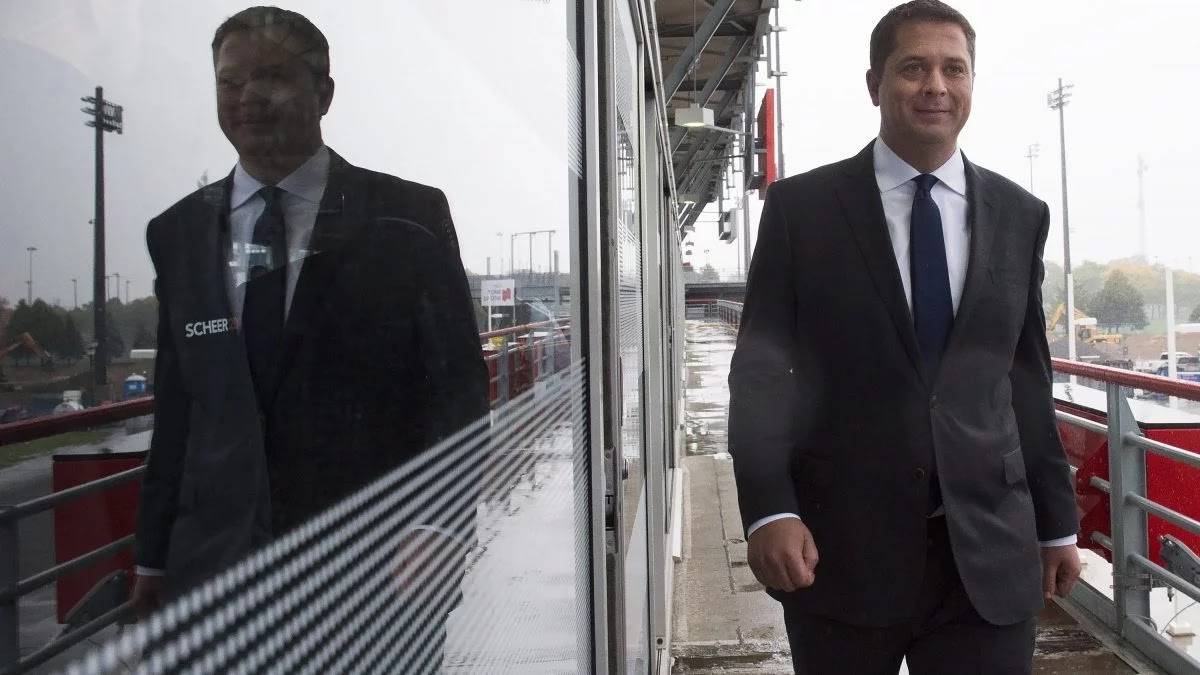
Defeating Scheer By Taking Out Ford


In this election, Justin Trudeau is fighting Andrew Scheer by taking aim at Doug Ford. Martin Regg Cohn writes:

The point is to draw a direct line between an unpopular Ford’s provincial Progressive Conservatives and his federal Conservative counterparts led by Andrew Scheer.
Point. Counterpoint. Counterpart. It’s not hard to connect the dots — and superimpose them over the battle lines that form Ontario’s electoral boundaries.

When the Liberals unveiled their program, it was Ford who was behind it:

Upon winning power, Ford suspended a scheduled $1 increase in the minimum wage to $15 an hour, and imposed a 2-1/2 year freeze until the next inflation adjustment for Ontario’s lowest-paid workers.
By contrast, if he regains power, Trudeau promises to hike the minimum wage to $15 for federally-regulated workers.
Ford’s provincial government has announced widespread cuts to OSAP student loans. Trudeau’s retort?
If re-elected, a federal Liberal government will increase Canada student grants by 40 per cent.
In a miserly attack on postsecondary graduates, Ford rescinded the six-month “grace period” on interest payments for students fresh out of school (and perhaps out of work). His government claimed it wise to “align” Ontario with Ottawa’s existing grace period, ostensibly to “reduce complexity for students.”
Trudeau’s platform goes in the other direction, extending the federal grace period to two years. So will Ford harmonize the interest-free period to once again “reduce complexity for students?”
Ford’s government sidelined Ontario’s anti-racism directorate; Trudeau’s government would double funding for its anti-racism strategy.
Ford cut spending on tree planting in his first budget; Trudeau would budget $3 billion to plant 2 billion trees over the next decade.
Ford reduced child-care funding; Trudeau would boost it.
Ford revoked free prescription drugs for all Ontarians up to age 24 and over 65; Trudeau wants a universal pharmacare program.

So you see what's going on. I honestly don't know how this election will play out. But I'm betting that, should the Conservatives win, they'll praise Andrew Scheer. If they lose, they'll blame Doug Ford.

Image: rabble.ca

Wednesday, October 02, 2019

Scheer's All About Canada First


Yesterday, Andrew Scheer declared that he would cut Canada's foreign aid budget to fund his tax cuts. Canada has not been very generous to foreign countries for quite awhile. The Toronto Star editorializes:

When it comes to doing good around the world, Canada talks big and acts... less big.
We pride ourselves at having invented the idea of peacekeeping, but our contribution to keeping the peace has dwindled to almost nothing.
We talk a good game about helping the neediest and promoting progressive values abroad, but among our peers we’re near the back of the pack in spending on foreign aid.
Now along comes Conservative Leader Andrew Scheer with a bold proposal to take a bad situation and make it even worse.
On Tuesday Scheer unveiled his priorities on foreign policy; and they include slashing Canada’s budget for foreign assistance by 25 per cent, or some $1.5 billion.
What Scheer didn’t mention, and what most Canadians don’t realize, is that this country has already let its spending on humanitarian aid fall to record low levels.

Scheer is spouting the Canadian version of Donald Trump's America First gambit. But there are good reasons to offer aid to foreign countries:

The truth is that countries don’t spend on foreign aid only out of the goodness of their hearts; aside from helping needy countries, it also buys influence. Slashing aid, for example, certainly wouldn’t be a plus as Canada argues for a seat on the UN Security Council.

Justin Trudeau didn't increase foreign aid -- as promised. But Andrew Scheer would slash Trudeau's foreign aid budget. And he has declared that he would return to Stephen Harper's policy of using aid to leverage the interests of Canadian business.

Scheer's smile can't hide the fact that he desperately clings to the prime directive of modern conservatism: Selfishness is a virtue.

Image: SlidePlayer


Tuesday, October 01, 2019

A Matter Of Time


Bill Blum writes that Donald Trump is finished:

Donald John Trump, the 45th president of the United States, is going to be impeached. Not only that, but whether or not the GOP-controlled Senate convicts Trump of “high crimes and misdemeanors,” his presidency is drawing to a close. Unless a political deus ex machina comes to his rescue, he will not serve a second term.

There is all kinds of evidence to point to Trump's removal. But, as with Richard Nixon, the articles of impeachment should be short and simple:

1. Abuse of power for Ukraine.
2. Using the presidency for personal gain.
3. Obstruction of justice for the Mueller investigation and the wholesale defiance of congressional subpoenas.

As with Nixon, the tide demanding Trump's removal is rising:

The current situation is much more akin to 1974, which saw Nixon’s popularity steadily erode until his resignation, than 1999, which saw Bill Clinton’s popularity climb. A CBS News Poll released Sunday showed a whopping 55% of respondents favor the impeachment inquiry. A Quinnipiac University Poll survey released on Monday went beyond the inquiry, finding respondents evenly split, 47 percent to 47 percent, on whether they support impeaching President Trump and removing him from office, a 10-point swing in favor of impeachment over a five-day period.

He has given the Congress the evidence it needs. Now it's just a matter of time.

Image: Amazon.com

Monday, September 30, 2019

More Fordian Folly


Today is the day that support staff in Ontario's schools begin work to rule. Doug Ford's mouth always gets him in trouble.  Martin Regg Cohn writes that, if Doug Ford were smart, he would have learned a lesson from past school strikes:

School strikes are the perennial conflict that bedevils premiers, as Ford’s predecessors can attest. We have seen this movie before, no matter the party in power.
Bob Rae’s NDP launched the prequel in the early 90s; Mike Harris and his Tories headlined the main event later that decade; Dalton McGuinty’s Liberals produced their own unhappy sequel in 2012.
Ahead of this year’s contract negotiations, the Tories have set the stage for confrontation:
The government announced a one per cent cap on all public sector pay raises; raised the student-teacher classroom ratio from 22 to 28 (an increase of 27 per cent in average class sizes over the next four years); and mandated four online courses for each high school student ⸺ an adventure in e-learning unmatched (and untested) across the continent.
The PCs argue that higher teacher-student ratios will be painless for union members, thanks to the magic of attrition. But that is small consolation for students left behind after those retired teachers are long gone.

For Ford, all of this has always been about numbers, not students. And Ford's numbers were wrong:

The stated reason for the higher class sizes, when announced earlier this year, was Ford’s claim that the budget deficit was out of control — after supposedly soaring to $15 billion for the 2018-19 fiscal year. Last month, the Tories acknowledged that the true deficit number was closer to $7.4 billion after all ⸺ less than half of the initial projection that served as the pretext for education cuts.
That inflated deficit scenario was also the impetus for a salary freeze of one per cent to be applied to all public servants. It is a recipe for unfairness that will only stoke confrontation.

All of this incompetence has led the Ontario Secondary School Teachers Federation -- of which I was a member -- to make their bargaining position public:

The OSSTF wants a return to last year’s class ratios; a pause on the unprecedented e-learning plan; and a cost-of-living increase tied to inflation, without any other salary hike.

Given the fact that there is no research to support Ford's e-learning plan, that seems like a pretty reasonable offer. But one wonders if Ford is smart enough to take it.

Image: The Toronto Star

Sunday, September 29, 2019

Democracy Is Alive and Kicking


The last few years have given Democracy a rough ride. But last week, Robin Sears writes, we learned that Democracy is not down for the count:

Early on Tuesday, by an unanimous 11-0 decision the United Kingdom Supreme Court smacked down Prime Minister Boris Johnson, declaring in the most searing language that he had broken the law, and by implication had lied to the Queen, about his motives for seeking an unheard of one month and one-week long suspension of Parliament — on the very brink of the most momentous decision it will make in this century.
In the chilling understated tones that only a certain kind of Brit can muster, Chief Justice Lord Hale, dubbed Boris Johnson a fraud. With painfully slow and brittle enunciation, she devastated the reputation of the prime minister as a foolish grifter. It was an unprecedented finding, not seen, as Justice Hale said, since the 17th century.
Her decision meant the prorogation had never happened and MPs went back to work the next day pummelling the embattled prime minister. It was their collective declaration of the supremacy of Parliament, abetted by their ferocious and funny speaker, John Bercow, that had provoked Boris into trying the shutdown ploy.

And, twelve hours later, Nancy Pelosi informed Donald Trump that he faced impeachment. She declared that:

Trump had abused his office, broken the law, and announced the launch of formal impeachment proceedings against him.
It is only the third time in U.S. history this has taken place, as Nixon resigned before he could be impeached. But like Nixon, this president seems destined to fall on his attempted coverup of a hilariously inept attempt to find dirt on his opponent. Like someone who had watched “The Godfather” once too often, Trump had growled to the Ukrainian president he had better “make up dirt on Biden” — or else.
These two explosions were not bad for a day’s work by institutions — the courts and the legislature — that were said to be crumbling. They demonstrated their resilience and that they remain the bulwark of democracy on each side of the Atlantic.

These are still dark days. Both Johnson and Trump have a truly stunning list of enablers. Nonetheless, there are several lessons that everyone -- particularly Canadians -- should take to heart:

First, is that the executive branch of government is not all-powerful, if government and opposition MPs are willing to assert their authority. If we have a minority government after Oct. 21, the members, new and old, might want to consider how they can quickly establish their sovereignty, similar to the astonishing revolt by the U.K. backbench.
A second lesson, especially for our politicians, is: Think twice before trying to rope judges into your partisan agenda — you might get badly bitten. The scrofulous trickster who is using taxpayer millions and the official public inquiry system in his province to blacken his opponents, has also gathered a group of credulous premiers to support his attempt to bring our Supreme Court into his climate denial cabal.
His lawyers should have pointed out the fate of these kinds of legal charades. Our Supremes will once again assert the right of the Government of Canada to govern on issues of national importance, especially ones of national security, like the climate crisis.

What does all this mean for Johnson and Trump? Both men may be headed for the exits -- much sooner than they or their enablers ever imagined.

Image: theatlantic.com


Saturday, September 28, 2019

When They're Being Conned


The Conservatives are pitching Andrew Scheer as a Canadian Everyman. Alan Freeman writes:

The Globe and Mail’s fawning profile of Andrew Scheer starts with a bit of a fib. It contrasts the laid-back security approach at Stornoway, the official home of the opposition leader, to the “sprawling and regal” residence of the Prime Minister at 24 Sussex Drive.
The anecdote is to convey the idea, much beloved of Conservative Party spin-masters, that Andrew Scheer is “everyman” compared to the Trudeau princeling who’s the current prime minister.

But these days, Trudeau doesn't live at 24 Sussex Drive. And the idea that Scheer is an everyman is a carefully manufactured myth:

Like all myths, Andrew Scheer as the “Canadian everyman of 2019” is essentially a lie. Ordinary Andrew is a one per center. His salary of $264,400 a year as leader of the opposition puts him into the top one per cent of Canadian tax filers, according to Statistics Canada.
His first real job—aside from brief stints as a waiter, insurance broker and political aide—was a $141,000-a-year job as a 25-year-old MP. He’s lived off the public teat in grand style ever since.
At the age of 32, he became the youngest ever Speaker of the House of Commons and moved into the Farm, the lovely rural residence of the House Speaker in the Gatineau Hills north of the city.
Who else but a one per center with essentially free housing could afford to have a stay-at-home spouse and five children? Not the real “Canadian everyman of 2019,” who’s likely living in a one-bedroom condo in downtown Toronto or Vancouver wondering if and when he and his working spouse can ever afford one child, let alone five. (The average Canadian family now has 1.56 children and there at last report there were only 493,000 families in Canada with a single earner and stay-at-home parent, a third the number in 1976.)
Yet the Conservative Party has the nerve to state that “Andrew knows the joys and challenges of raising a growing family in Canada today.” Really?
To gild the “everyman” lily, Scheer harkens back to his Abe Lincoln log-cabin story, only this time it’s a townhouse in suburban Ottawa, where his family made do without a car. “We had to take the bus everywhere we went.” The horrors. In fact, his parents were solidly middle-class, his father a librarian at The Ottawa Citizen and his mother a nurse.

It's the same kind of balderdash which was behind the notion that Donald Trump was The Master of The Deal.

Canadians should know when they're being conned.

Image: THE CANADIAN PRESS/Nathan Denette

Friday, September 27, 2019

Ignorance Incarnate


Ontario's Financial Accountability Office has crunched the numbers. And Victoria Gibson reports that:

Ontario is set to lose more than 10,000 teaching positions over the next five years, due to the Ford government’s changes in class sizes and new requirement that students take a number of their courses online, the legislature’s financial watchdog has found.
In a new report published Thursday, the Financial Accountability Office of Ontario estimated that 994 elementary positions and 9,060 secondary positions will be eliminated from Ontario’s publicly-funded education system by the 2023-24 school year.
The report also estimated that there will be 2,826 fewer teachers in Ontario’s education system this year — 967 fewer elementary teachers and 1,859 fewer secondary teachers.

The FAO also concluded that:

the province’s assertion that the reduction in teaching positions could be achieved without layoffs, saying that Ontario’s new $1.6 billion Teacher Job Protection Fund “should provide sufficient funding” to allow the new class sizes to be achieved without dismissals. News of teacher layoffs have sent tremors through the education system as recently as early September, when in Toronto alone, a local union told several media outlets that more than 150 high-school teachers were without full-time contracts due to what they billed as provincial cuts to education funding.

It's easy to lose sight of what was behind these cutbacks. When he came to office, Doug Ford claimed that the province's deficit was $15 billion. He has recently revised those numbers down to $7.4 billion -- not far from the deficit of $6.7 billion Kathleen Wynne was projecting in her last budget. Ford used the inflated figures to radically restructure the education system. There has been a deluge of criticism:

The FAO report Thursday was followed by swift criticism from Ford’s opposition. Marit Stiles, education critic for the provincial NDP, said the loss of more than 10,000 teachers would “hurt students in every region of our province.” “Parents and educators are sounding alarm bells about the negative impact these cuts will have on our education system – damage that will only get worse as our population grows over time,” Stiles wrote in a statement, urging Ford to reverse the changes that she billed as “deep cuts.”
Michael Coteau, the Don Valley East MPP who has announced his bid for leadership of the provincial Liberal Party, also framed the changes as ‘deep cuts’ in a statement released Thursday. “This will lead to class sizes increasing by up to 27%, on average. In some schools, the damage will be much worse,” Coteau wrote. “This is not what parents want. This is not what students want. This is an irresponsible decision by a government that has shown time and time again that it puts ideology above evidence.”
Another Liberal leadership hopeful, education critic Mitzie Hunter, later called the cuts “short-sighted” and “callous,” citing an Ontario Student Trustees Association report that showed 95 per cent of student respondents disapproving of the new e-learning requirements. “Other reports have indicated that students are struggling to get into classes they need to graduate or for post-secondary programs because they’re full,” Hunter said.

And Mr. Ford wonders why he is booed at public events. The reason is simple: He's Ignorance Incarnate.

Image: twitter

Thursday, September 26, 2019

Be Careful


A year ago, the Conservatives were predicting a juggernaut. Chantal Hebert writes:

Maclean’s December 2018 issue captured the belligerent spirit of the time with a cover picture featuring Ontario, Saskatchewan and Manitoba premiers Doug Ford, Scott Moe and Brian Pallister along with then-would-be Alberta premier Jason Kenney and federal leader Andrew Scheer.
The intention was to put Canada on notice that a Conservative juggernaut was set to crush Trudeau and his climate agenda. The various Conservative leaders were, according to the caption, “spoiling for fight.”

But the times -- and things -- have changed:

At this juncture in the campaign, the Conservative premiers have mostly turned into as many ghosts haunting Scheer’s bid for federal power.
The more they rattle their chains, the more they risk spooking voters into the Liberal fold.
Since the election was called, Scheer spent a lot of time in Ontario but never on a stage with Ford.
A few weeks ago, Saskatchewan’s Moe declared he would not endorse any of the federal parties. The Conservative Party of Canada’s (CPC) war room had reportedly not seen that coming especially since Scheer’s seat is in the province but in the current context it could not have caused it a lot of anguish.

And, in Quebec, it's not the Conservatives who are on the rise. It's the Bloc Quebecois:

The Léger poll found the sovereigntist party in first place among francophone voters — three points ahead of the Liberals and five points ahead of the CPC.
Bloc Leader Yves-François Blanchet has so far run the most efficient Quebec campaign. Premier François Legault — by making demands on immigration and bill 21 that no national party can wholly embrace — has smoothed the Bloc’s path to gains next month.
The prospect that the Bloc could hold the balance of power in a minority Parliament is no longer an abstraction.

Some of us have hoped that the Greens will hold the balance of power. But that balance could turn out much differently than we hoped.

The old adage, "Be careful what you wish for," still holds true.

Image: www.blocquebecois.org

Wednesday, September 25, 2019

Now Is the Time


The Democrats have decided to hold hearings on the impeachment of Donald Trump. Those hearings were inevitable simply because Trump has always been unfit for office. But the timing of those hearings has been critical. David Leonhardt writes in The New York Times:

The Mueller report was too much of a letdown. True, that was in part because of the artful deception by Trump’s attorney general, William Barr, in releasing the report — but only in part. Over all, the report was anticlimactic. It persuaded virtually no one who wasn’t already persuaded of Trump’s unfitness.
If the Democrats had impeached him after the report’s release — after specifically saying that they would make their decision based on the report — they would not have persuaded many swing voters (or virtually any Republicans). I understand that many progressives wanted House Democrats to impeach Trump anyway, as a matter of principle. But I think that view overlooks the history and purpose of impeachment: It is, again, a political process.
If you impeach a president and fail to damage his political standing — if you’re just as likely to shore up his standing, as I think a post-Mueller impeachment would have — you’re doing it wrong. You are going to political war with the Constitution you want rather than the one the country has.

But the whistle blower's report has changed things:

Starting an impeachment inquiry is the proper move because of both what’s changed and what hasn’t. What has changed? In his dealings with Ukraine, the president committed a new and clearly understandable constitutional high crime: He put his own interests above the national interest by pressuring a foreign country to damage a political rival. He evidently misused taxpayer money in the process. He has shown he’s willing to do almost anything to win re-election.
What hasn’t changed? Trump is unfit for office. He has repeatedly violated his oath of office, to preserve, protect and defend the Constitution. He has weakened America’s national security. He has used the presidency for personal enrichment. He has broken the law more than once. He has tried to undermine American democracy.
Trump has handed Democrats a new opportunity to persuade the country that his presidency needs to end, on Jan. 20, 2021, if not sooner. Democrats should seize that opportunity. Even if they can’t persuade Republican senators to remove him from office, they can focus voters’ attention on his egregious misbehaviour.

The irony is that Trump could have escaped impeachment after the Mueller Report. But he is not smart enough to understand that he shouldn't repeat the behaviour that got the Mueller Inquiry going.

Do his supporters understand this? Probably not. They elected Trump to shake up the system. What they didn't understand -- and still don't understand -- is that his aim is not to shake up the system. He is dedicated to its destruction.

If the Democrats  fail to impeach Trump -- even if the Republicans refuse to follow through -- he will succeed. And the Republicans will go down in history as his enablers -- those who happily were unwilling -- in Benjamin Franklin's word -- to "keep" their republic.

Image: Pinterest

Tuesday, September 24, 2019

So, Boris, How's It Going?


The Supreme Court in the UK has ruled that Boris Johnson illegally prorogued Parliament. Martin Kettle writes in The Guardian:

The supreme court has delivered a comprehensive demolition of Boris Johnson’s government and its handling of Brexit. The unanimous judgment of the 11 justices, announced by Lady Hale this morning, amounts to a root and branch rejection of the prime minister’s attempts to rule without parliament, to take Britain out of the European Union by 31 October without a deal, and to contrive a premature general election. The judgment was incisive and without any waffle. It was very consciously written in the best tradition of British constitutional law, of which parliamentary sovereignty is the foundational rock.
The immediate effect of the judgment is devastating for Johnson. It is expressed so cogently and unambiguously that it will be difficult for him to wriggle out of it – even though he is certainly foolish enough to try. Parliament will surely be recalled on Tuesday – since, as the judgment said, it has not been prorogued in the first place. Johnson’s efforts, to the extent that they exist at all, to negotiate a new or tweaked deal with the EU will be held up to the light. And, since Johnson spectacularly lacks a majority in the House of Commons, it is likely that the cross-party efforts to shape Brexit will be redoubled.

The ruling also puts the spotlight on Johnson's opponents:

His opponents, therefore, absolutely need to agree on the form, composition and, above all, the leader of any government that could replace him. If the court’s ruling means anything for politicians, it is that trying to govern as if you have a majority when in fact you do not is impossible. The belief of the hard-right Tory Brexiters that a party coup against Theresa May in a hung parliament would enable them to get their way by electing Johnson lies shattered. They need to learn the lesson very fast. Militant remainers will have to face the equivalent lesson, too. One notable consequence of the judgment, not to be overlooked in the other excitements, is for the Union. By not overruling the Scottish court of session decision on Johnson’s actions, the supreme court has upheld Scottish judges against English ones, and has removed a potential source of grievance for the SNP against “London judges” if the ruling had gone the other way.

Britons are still in a pickle. But their Supreme Court has upheld the primacy of democracy.

Image: IBTimes UK

Monday, September 23, 2019

Hell To Pay


Yesterday, Robin Sears warned that, out in the hinterland, there is palpable rage:

My neighbours in northeastern Ontario are quick to vent their rage about all manner of foolish government regulations and about guns, opioids, and their children’s futures. Trudeau pounding on about women, climate and Indigenous Canadians are the angry backyard chat among our friends. They are not racists, but they are deeply angry about two things: no good jobs for their children unless they leave for the city, and being talked down to by smart aleck politicians.
At the gas pump or the mall, they are the picture of polite deferential Canadians. But scratch the surface on “cruelty to farm animals” or cutbacks to their health clinic and they erupt. They are neither conventional conservatives nor narrowly populist. Their irritations are sparked by too much spending on sex education and too little on the “basics;” too much CRA harassment over GST payments while ignoring “the real rich tax cheats:”; and too little spent on roads in rural Canada versus “billions for big city subways.”
There are two troubling connectors in this welter of grievances: first, governments and politicians are all frauds and corrupt — even “Tyrants!” Second, everything is “rigged” against them by “George Soros and Trump’s gang of billionaire friends” and the politicians they control. The range of enemies runs from “the rich guys” to “the politicians they own,” to mainstream media appearing to sneer at their concerns.
The combinations of villains and issues may seem bizarre, but perfectly defensible to people who feel they are now permanently cast as outsiders, and “losers.”
“Why should my son work for less than minimum wage and yours makes three times that in town?! He worked just as hard at school? I am terrified he is going to fall into the opioid hole,” says an angry father to a richer neighbour, as I quietly eavesdrop at our local diner.

The digital revolution has left many in small town and rural Canada behind:

The so-called “big muscle jobs” at the small industrial plants are gone, the township jobs are being held onto to by elderly men who should have retired but can’t afford to, and there’s no money in farming. For an 18-year-old high school grad in these towns, someone with no family farm or business to fall back on, there are very few local choices. She can be a small-town cashier or domestic helper. He can serve summer tourists or be a handyman — the original insecure gig economy jobs.

It's true that only 15% of Canadians live in the hinterland. But politicians like Doug Ford and Jason Kenny have stoked their anger successfully. If voters in rural Canada are ignored by the major parties, there will be hell to pay.

Image: pressfrom.info

Sunday, September 22, 2019

Tuned Out


Canadians are turning out this election. Bob Hepburn writes in The Toronto Star:

I’ve overheard a woman talking to her 20-something daughter about the election and the daughter responding: “There’s an election?”; I’ve listened as my dentist told me he just wants “it over;” I’ve heard a colleague speak about how no one at an eight-person dinner party on the weekend talked at all about the election.
It’s just not me who is seeing this trend. Viewership for TV political programs and news stories is reportedly down from levels in the 2015 election. At the same time, election stories are garnering less attention from readers at some online news sites than was expected.
In addition, campaign organizers are noticing the same voter sentiment as their leaders criss-cross the country and their volunteers knock on doors in their neighbourhoods seeking support for local candidates.

There are several reasons for this ennui:

First, the election campaign is too long. It actually started back in January, not last week when Justin Trudeau formally asked Gov. Gen. Julie Payette to give her blessing for the launch of the official six-week campaign. For months now, all parties have been in full-election mode, complete with policy pronouncements, local rallies and detailed media strategies.
Second, while campaigns are seen as a time for voters “to get to know” the leaders, the reality is that we already know them. We know what Justin Trudeau is like and what he would bring to a second term — the good, bad and the ugly. We know who Andrew Scheer is because he’s been the Conservative leader since May, 2017. We’ve seen him on television for years. The same is true of Jagmeet Singh, who has led the NDP since October, 2017, and Elizabeth May who has headed the Greens since 2006.
Third, to the casual voter it must seem there’s hardly any difference between the Liberals and the Tories on many key issues, or between the NDP and the Greens. In truth, it’s difficult to discern how the parties differ on how helping the middle class, or how they would deal with health-care funding. And if a voter believes — rightly or wrongly — that there’s no real difference, then would we expect them to follow the campaign?
Fourth, no one big issue that will galvanize voters dominates this election — not SNC-Lavalin, not the regulations on religious symbols in Quebec, not pipelines. Climate change, tax cuts, the economy and jobs are key issue, but not drivers of widespread voter engagement. The last truly issue-driven elections may have been in the 1980s when free trade with the U.S. highlighted the campaigns.

Elections are important. They're the cornerstone of our democracy. These days, democracy is in trouble all over the world. That is one trend we can't afford to follow.

Image: The Atlantic

Saturday, September 21, 2019

Why Republicans Play Dirty


Donald Trump is not the only person dedicated to sabotaging democracy in the United States. Professors Steven Levitsky and Daniel Ziblatt write in The New York Times:

The greatest threat to our democracy today is a Republican Party that plays dirty to win.
Republicans across the country seem to have embraced an “any means necessary” strategy to preserve their power. After losing the governorship in North Carolina in 2016 and Wisconsin in 2018, Republicans used lame-duck legislative sessions to push through a flurry of bills stripping power from incoming Democratic governors. Last year, when the Pennsylvania Supreme Court struck down a Republican gerrymandering initiative, conservative legislators attempted to impeach the justices. And back in North Carolina, Republican legislators used a surprise vote last week, on Sept. 11, to ram through an override of Gov. Roy Cooper’s budget veto — while most Democrats had been told no vote would be held. This is classic “constitutional hardball,” behavior that, while technically legal, uses the letter of the law to subvert its spirit.

This has happened once before -- but the party doing the damage was the Democrats -- in the wake of the Civil War:

In the United States, Southern Democrats reacted in a similar manner to the Reconstruction-era enfranchisement of African-Americans. Mandated by the 15th Amendment, which was ratified in 1870, black suffrage not only imperiled Southern Democrats’ political dominance but also challenged longstanding patterns of white supremacy. Since African-Americans represented a majority or near majority in many of the post-Confederate states, Southern Democrats viewed their enfranchisement as an existential threat. So they, too, played dirty.
Between 1885 and 1908, all 11 post-Confederate states passed laws establishing poll taxes, literacy tests, property and residency requirements and other measures aimed at stripping African-Americans of their voting rights — and locking in Democratic Party dominance. In Tennessee, where the 1889 Dortch Law would disenfranchise illiterate black voters, one newspaper editorialized, “Give us the Dortch bill or we perish.” These measures, building on a monstrous campaign of anti-black violence, did precisely what they were intended to do: Black turnout in the South fell to 2 percent in 1912 from 61 percent in 1880. Unwilling to lose, Southern Democrats stripped the right to vote from millions of people, ushering in nearly a century of authoritarian rule in the South.

Democracy is not just about winning. It's also about knowing how to lose. Levitsky and Ziblatt believe that Republicans are afraid of losing. They know they're going to lose. But they refuse to accept the reasons for their loss. So they do whatever they can to rig the system in their favour.

I confess I have a soft spot for the sixth movie in the Star Trek franchise, The Undiscovered Country. I enjoyed watching two old Stratford alumni -- William Shatner and Christopher Plummer  -- as the two protaganists. The script also gave Plummer ample opportunity to quote Shakespeare. But, more importantly, there is a scene in the film when Spock turns to Kirk and asks, "Are we two -- you and I -- so old and so inflexible that we both have outlived our usefulness?"

I suggest that Republicans know that they are old and inflexible; and they're scared as hell. But they refuse to change. The Democrats understood the problem. It took time, but they changed. After all, they elected the first black American president.

Image: You Tube


Friday, September 20, 2019

When You Live In A Glass House


I'm disgusted. When you live in a glass house, it's not wise to throw stones. But throwing stones is what our politics is all about.

I have no idea how this will effect the outcome of the election.

Image: Business Insider

Thursday, September 19, 2019

Political Honesty


It's better to be honest than to say -- as Doug Ford has -- that you "believe in honest conversations." Martin Regg Cohn writes:

A year ago, Ford told Ontarians he wanted to “follow the money” —code for criminality. An accounting dispute between the previous Liberal government and the auditor general amounted to “the biggest government scandal in a generation,” he claimed.
Ford pointed an accusing finger at his predecessor, Kathleen Wynne: “If you lie on your taxes … there are consequences.”
Her crime? In her last budget, for the 2018-19 fiscal year, Wynne projected a budget deficit of $6.7 billion.
Impossible, cried Ford. After taking power, he assembled an outside panel that alleged the deficit had somehow soared to an outsized $15 billion — more than double Wynne’s figure.

But, after a year, Ford's numbers have changed -- radically:

This month, Ford’s Tories announced the final numbers for that disputed fiscal year. Let us try to uncover the coverup — in all honesty.
Turns out the 2018-19 deficit was $7.4 billion after all. Not the $15 billion that Ford alleged (by mischievously counting a number of Liberal campaign promises that never came to pass).
Compare that final figure to the original $6.7 billion estimate from Wynne’s government in their original budget. That’s a difference of roughly 10 per cent, versus Ford’s post-election allegation that overstated the deficit by 100 per cent.

Ford has been cutting programs ever since he came to office -- because, he said, that $15 billion deficit was unsustainable. However,

no one will be surprised when Ford’s government quietly restates the deficit numbers downwards yet again. Expect the final — truly final — deficit figure to align even more closely with the original projections from that disputed Liberal budget, the one that Ford claimed in so many words was criminally corrupt.

Political Honesty? Where should we look for it?

Image: St. Catherines Standard

Wednesday, September 18, 2019

Racing Toward An Uninhabitable Planet


William Rees believes that the climate crisis could cause mass human extinction. He writes:

On Aug. 15, in a memorable session of the BBC’s HardTalk, [Roger] Hallam irritated multiple cultural nerves by claiming, on the basis of “hard science,” that six billion people will die as a result of climate change in coming decades.
More specifically, our ruling elites’ inaction and lies on climate change will lead to climate turmoil, mass starvation and general societal collapse in this century. Normally unflappable HardTalk host, Stephen Sackur, just couldn’t wrap his mind around Hallam’s unyielding assertions.

There are lots of scientists who are as sceptical as Sachur:

One key to understanding these scientists’ rejections is their language. They assert that there is “no mainstream prediction” nor analysis in the “peer reviewed literature” that climate change will precipitate such catastrophic human mortality.
But keep in mind that scientists are reluctant, for professional reasons, to go far beyond the immediate data in formal publication. Moreover, organizations like the United Nations, including even its Intergovernmental Panel on Climate Change, are so dominated by economists’ concerns and bent by political considerations that extraneous noise obscures the scientific signal.

But, if you look at data on the human population explosion, Hallam's claim becomes quite believable:

When something is growing exponentially, it has a constant doubling time. For example, a population growing at two per cent a year will double every 35 years. Interestingly, the increase that occurs during any doubling period will be greater than the sum of the increases experienced in all previous doublings.
As the figure below shows, it took 200,000 years for the human population to reach its first billion in the early 1800s. In other words, population growth was essentially negligible for 99.95 of human history. But when sustained exponential growth kicked in, it took just 200 years — 1/1000th as much time — for the population to top 7.5 billion early in this century!

The same exponential math applies to the climate crisis:

As much as a decade ago a climate symposium organized to discuss the implications of a 4 C warmer world concluded, “Less than a billion people will survive.” Here [Hans Joachim] Schellnhuber is quoted as saying: “At 4 C Earth’s... carrying capacity estimates are below 1 billion people.” His words were echoed by professor Kevin Anderson of the U.K.’s Tyndall Centre for Climate Change: “Only about 10 per cent of the planet’s population would survive at 4 C.”
Similarly, in May of this year, Johan Rockström, current director of the Potsdam Institute opined that in a 4 C warmer world: “It’s difficult to see how we could accommodate a billion people or even half of that.... There will be a rich minority of people who survive with modern lifestyles, no doubt, but it will be a turbulent, conflict-ridden world.” Meanwhile, greenhouse gas concentrations are still increasing.
Keep in mind that a global temperature increase averaging 4 C means land temperatures would be 5.5 to 6 C warmer away from the coasts. Much of the tropics would be too hot for humans and many densely populated parts of the temperate zone would be desertified. A 4 C warmer world map suggests that as much as half the planet would become uninhabitable. (A ‘4 C world’ assumes business-as-usual or no new climate policies in coming decades. Note, however, that known and unknown ‘feedback’ mechanisms could make 4 C possible, even with new politically acceptable policies in place.)

We are racing -- blindly -- toward an uninhabitable planet.

Image: Countercurrents


Tuesday, September 17, 2019

Locked And Loaded


Donald Trump says his country is "locked and loaded" for a confrontation with Iran. Before he wanders into the desert again, Andrew Bacevich writes that Trump would do well to remember how the United States got entangled in Iran:

In 1987, an Iraqi warplane attacked an American Navy frigate, the Stark, on patrol in the Persian Gulf. Accepting Saddam Hussein’s explanation that the attack, which killed 37 sailors, had been an accident, American officials promptly used the episode, which came at the height of the Iran-Iraq war, to ratchet up pressure on Tehran. The incident provided the impetus for what became a brief, and all but forgotten, maritime war between the United States and Iran.
After the Stark episode, American and Iranian naval forces in the gulf began jousting, an uneven contest that culminated in April 1988 with the virtual destruction of the Iranian Navy.
Yet the United States gained little from this tidy victory. The principal beneficiary was Hussein, who wasted no time in repaying Washington by invading and annexing Kuwait soon after his war with Iran ground to a halt. Thus did America’s “friend” become America’s “enemy.”
The encounter with Iran became a precedent-setting event and a font of illusions. Since then, a series of administrations have indulged the fantasy that the direct or indirect application of military power can somehow restore stability to the gulf.
In fact, just the reverse has occurred. Instability has become chronic, with the relationship between military policy and actual American interests in the region becoming ever more difficult to discern.

Much of American foreign policy provides a study in the law of unintended consequences:

The conviction, apparently widespread in American policy circles, that in the Persian Gulf (and elsewhere) the United States is compelled to take sides, has been a source of recurring mischief. No doubt the escalating rivalry between Saudi Arabia and Iran poses a danger of further destabilizing the gulf. But the United States is under no obligation to underwrite the folly of one side or the other.
Supporting Iraq in its foolhardy war with Iran in the 1980s proved to be strategically shortsighted in the extreme. It yielded vastly more problems than it solved. It set in train a series of costly wars that have produced negligible benefits. Supporting Saudi Arabia today in its misbegotten war in Yemen is no less shortsighted.
Power confers choice, and the United States should exercise it. We can begin to do so by recognizing that Saudi Arabia’s folly need not be our problem.

Mr. Bacevich is no idle theoretician. Americans -- and others -- would be wise to head his warning.

Image: Modern Diplomacy

Monday, September 16, 2019

Pas Comme Les Autres


Martin Patriquin writes that there are  stark parallels between the Adscam scandal of the 1990's and the SNC-Lavalin scandal of today:

A quick refresher: In 1995, utterly spooked by Quebec's near-exit from the federation, the Liberal government of the day devised a plan to essentially sell Quebecers on Canada's many merits and delights. In theory, this branding exercise would make the Maple Leaf ubiquitous at sporting events, hunting shows and on Quebec's formidable festival circuit. In practice, this exercise was entrusted to Liberal-connected ad firms in the province, which billed inflationary amounts for work often not done. 
The ensuing scandal, also birthed by the Globe and Mail, had a feedback loop effect. English Canada resented the Liberal Party's rank Quebec favouritism, which Quebecers themselves resented for the graft and corruption done in their name. The Liberals were relegated to near-rump status in Quebec in the following years, and it took nearly a decade for the party to recover from the cacophony of outrage and arrests. Lavscam has many similar ingredients: ample finger wagging from English Canada and a Liberal government willing to break the rules for an allegedly corrupt Quebec-based business.

But, in Quebec, the outrage felt in the rest of the country hasn't taken hold. Why?

Simple: as a large, home-grown entity, SNC-Lavalin is less a company than corporate god. Like Couche-Tard, GardaWorld, Bombardier and CGI Group, to name a few, SNC is a symbol of Quebec success and might on the world stage.
When one of these corporate gods is sold off — like, say, when an U.S.-based Lowes bought Quebec-based Rona in 2016 for an absurd amount of money — the reaction is less joyous than wake-like. "What will be the next Quebec crown jewel to be sold off?" wondered one columnist in a familiar fit of pique. 
Being a Quebec corporate god holds a lot of water and hides a lot of sin. Even before the Globe and Mail revelations, the Quebec government included the company on a list of 10 "strategic" firms that would be protected from foreign takeovers. 
In the wake of the Globe's revelations, when SNC-Lavalin's decampment to foreign shores became a very real possibility, the company's myriad alleged overindulgences at the behest of Muammar Gaddafi's homicidal regime became an afterthought. Far more important, as Quebec Premier François Legault put it last February, was to "settle" SNC's inconvenient legal situation and "protect the headquarters and the thousands of good, well-paying jobs we have at SNC-Lavalin."
In attempting to do exactly this, Trudeau endeared himself to Quebec's political and media classes — and, apparently, to most Quebecers themselves. 

Quebecers will tell you that la belle province is "pas comme les autres." And they will have a large say in who becomes the next prime minister.

Image: amazon.ca

Sunday, September 15, 2019

It Follows You Forever


Social media are taking down lots of candidates these days. There is one ugly fact that we all now live with: What you write or do on the Internet lives on forever. Robin Sears writes:

It is too much to hope that young people will not say and do dumb things. We all did. But is it too much to expect that they will not lie about them when they are seeking public office?
It shouldn’t be. But once again, a spate of bozo candidate moments has bedevilled the launch of each party’s campaigns.
Everything from domestic abuse to antisemitism, to white supremacy, to Islamophobic attacks have taken down candidates from every party.

We all do stupid things in our youth. But, these days, if you try and lie about the stupid things you've done, the lies will catch up with you:

Do these idiots think that in these days of eternal digital life for every dumb thing you have said or done that they won’t be exposed? How many cases of lives and reputations ruined do they need to hear about to understand that that has not been true for more than a decade now.
Seeking the privilege of holding public office is not filling in a job application. The standards of character and integrity are much higher. For it is entirely appropriate when a hidden embarrassment is revealed, for voters to ask: “Well, if she will lie about that, what else will she lie to me about?”
Yes, the parties will need to continue to tighten their vetting processes, but few screening processes can pick out every determined liar, not even polygraphs.
So the obligation is on the aspiring candidate.
They are the ones who must ask themselves before seeking the trust of thousands of voters, is there something I have done that I am ashamed of? Are there things I have said I wish, years later, I could take back?
Most of us have examples of each in our lives. The next question is quite simple: If I disclose it and offer a genuine apology for it, could I still be accepted as a candidate?
If you honestly cannot see that happening, stand down.

Good advice for political candidates -- indeed, for all of us.

Image: Twitter