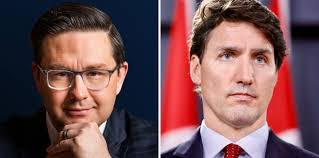
Chantal Hebert writes that Justin Trudeau will not be calling a snap election:
Provided the Liberal/NDP pact holds, Canada will not be going to the polls this fall and perhaps not until 2025. Even if Trudeau wanted to call a snap election to try to get an edge on a rookie leader, his own party is anything but on a solid electoral footing.
By rushing the country to the polls for the second time in as many years, the prime minister would only risk putting the Liberals on the fast lane to an exit from government.
But Trudeau says he'll be there for the next election:
When that happens, expect a no-holds-barred fight to the finish. Trudeau kicked off his tenure in power as a sunny ways politician, but the next election is promising to be anything but that.
The scorched-earth approach that led to Poilievre’s decisive leadership victory this weekend suggests as much.
His team kept its sharp elbows up long after it must have become evident that the prize was in the bag. A strategy designed to convince one’s supporters that their preferred outcome could still be up in the air almost always leads to rewards on the turnout front.
Poilievre did not just beat Jean Charest, he crushed him, including on the former premier’s Quebec turf.
It is not a coincidence that this upset was scored at a time when the dormant provincial Conservative party is undergoing an awakening under Poilievre’s libertarian pal Éric Duhaime. The federal Conservative brain trust may come to think that working with Duhaime could deliver more Quebec votes to the party than securing premier François Legault’s blessing.
Winning the next campaign will not be easy for Trudeau:
The next campaign will almost certainly be Trudeau’s last. History suggests it will be an uphill battle. Sir Wilfrid Laurier was the last incumbent prime minister to secure a fourth consecutive term.
But those long odds did not prevent Pierre Trudeau or Stephen Harper from trying to match Laurier’s record. And if Jean Chrétien had not been beset by internal challenges, he might have been tempted to stick around to take on the newly reunited Conservative party in 2004.
However, with Poilievre in the Conservative leader's chair, there is more than hubris behind Justin's decision:
In Trudeau’s case, it is likely not just that he thinks he can prevail in a battle against Poilievre but almost certainly that he believes he must.
It is not certain the prime minister would have felt as strongly about potentially leaving Canada in Charest’s hands as he clearly does in Poilievre’s case.
It's clear that the Conservatives want Poilievre as their leader. It's not at all clear that most Canadians want him as theirs.
Image: cultmtl.com